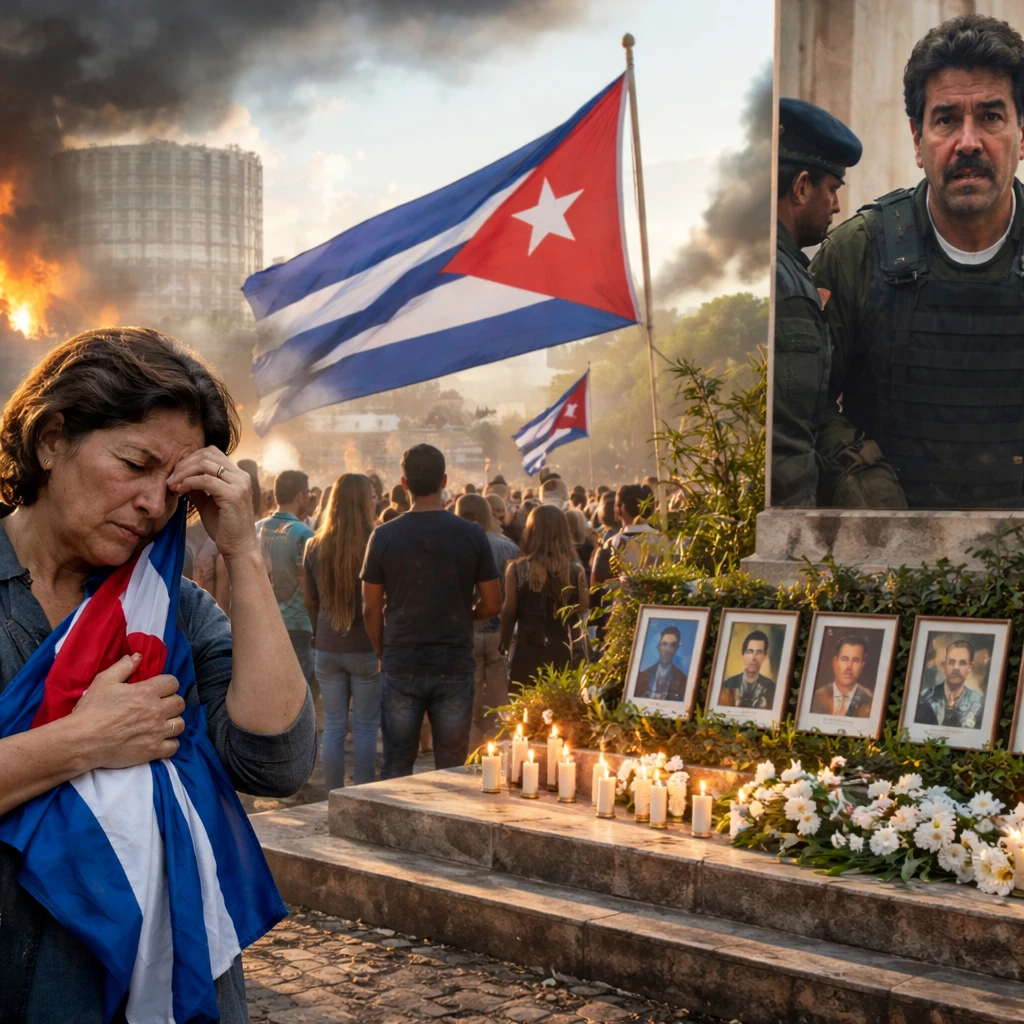

In the early hours of Monday, Cuban authorities solemnly lowered flags across the nation to honor 32 security officials reportedly killed during a U.S. military operation in Venezuela, one of Cuba's closest allies. This somber act coincided with growing anxiety among Cuban citizens about the repercussions of President Nicolás Maduro's capture on their country's stability and economic future.
The relationship between Cuba and Venezuela has long been characterized by close political and military ties. Cuban personnel, including soldiers and security agents, have frequently served as protective detail for Venezuela’s president. In return, Venezuela's oil exports have been critical in sustaining Cuba’s struggling economy for many years. Yet, details from Cuban officials about the fatalities in the recent attack remain limited; they have confirmed the deaths but have not provided further information about the circumstances.
The U.S. administration, under former President Donald Trump, explicitly linked the removal of Maduro to a strategic objective of undermining the Cuban government. The administration indicated that severing Venezuela’s support would exacerbate Cuba’s economic difficulties. Following Maduro's capture, Cuban leaders condemned the U.S. operation as “state terrorism” and called on the global community to oppose such actions.
Speaking on Saturday, former President Trump expressed confidence that Cuba’s fragile economy would deteriorate further in the aftermath of Maduro’s downfall. He bluntly remarked, “It’s going down. It’s going down for the count,” reflecting a belief that Cuba’s prospects were bleak without Venezuelan support.
Observers frequently highlight the paradox of Cuba's influence over Venezuela, an oil-rich country with a population roughly three times larger than Cuba’s 10 million inhabitants. While Cuba has exerted significant control, the Cuban population grapples with persistent challenges, including widespread blackouts and shortages of essential food items. The recent attack has intensified fears of worsening conditions in the near future.
Emotions are raw among Cuban citizens. Seventy-five-year-old Berta Luz Sierra Molina found herself overwhelmed and unable to articulate her feelings, weeping while shielding her face. Similarly, 63-year-old Regina Mendez, though outside military age, expressed readiness to defend her country, stating, “We have to stand strong. Give me a rifle, and I’ll go fight.”
Expert insight into the critical importance of Venezuelan oil comes from Jorge Piñón, a Cuban energy scholar affiliated with the University of Texas at Austin Energy Institute. He disclosed that over the previous three months, Maduro’s government had been supplying Cuba with approximately 35,000 barrels of oil per day—accounting for about one-quarter of Cuba’s total energy demand.
Piñón emphasized a crucial, unresolved question: whether the United States will permit Venezuela to continue fulfilling Cuba’s oil needs. He referred to Mexico's prior role as an oil supplier, noting that it once delivered 22,000 barrels per day to Cuba, but this figure was reduced to 7,000 barrels following U.S. Secretary of State Marco Rubio’s visit to Mexico City in August. Piñón expressed skepticism about the prospect of Mexico increasing supplies now, suggesting that doing so would provoke a strong reaction from the U.S. government.
Further commentary from Ricardo Torres, an economist specializing in Cuba at American University in Washington, highlighted the severity of recent blackouts experienced on the island despite ongoing Venezuelan oil shipments. “Blackouts have been significant, and that is with Venezuela still sending some oil,” he said. Torres portrayed the potential sudden loss of this oil supply as a catastrophic development for Cuba in the short term.
As Cuba confronts the dual impacts of losing key security personnel and the uncertainty surrounding future Venezuelan oil deliveries, the island faces an increasingly precarious economic and political situation. The current state of affairs leaves both citizens and analysts uncertain about Cuba's trajectory moving forward.