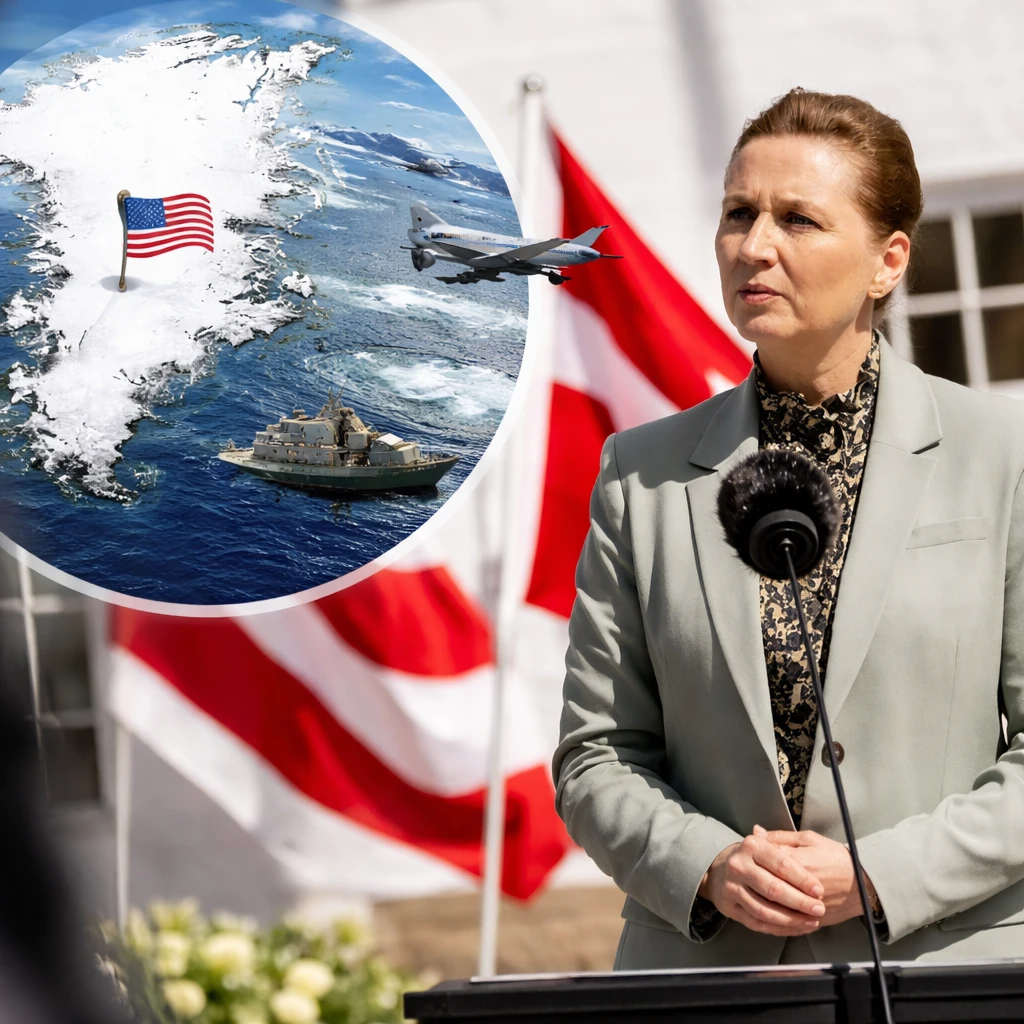

In a development raising significant geopolitical tensions, Denmark's Prime Minister, Mette Frederiksen, issued a stark warning on Monday that the prospect of the United States assuming control of Greenland would signal the end of the NATO military alliance. Frederiksen’s statement was prompted by renewed calls from US President Donald Trump advocating for Greenland, a mineral-abundant and strategically vital Arctic island, to fall under American jurisdiction. This renewed American interest comes in the wake of a covert US military operation aimed at apprehending Venezuelan President Nicolás Maduro and his wife early on Saturday.
The surprise operation conducted by US forces in Caracas stunned international observers and intensified apprehensions in Denmark and Greenland. The latter is an autonomous territory under the Danish crown and thus integrated into the NATO alliance. Both Frederiksen and Jens Frederik Nielsen, Greenland's governing premier, condemned the calls for US acquisition, cautioning that such moves could lead to disastrous ramifications. Their concerns have found resonance with numerous European leaders expressing solidarity.
Addressing Denmark’s television channel TV2 on Monday, Prime Minister Frederiksen emphatically stated, "If the United States chooses to launch a military attack on another NATO member state, all cooperative activities cease. This includes our NATO alliance and the security framework that has been preserved since World War II ended."
Over the past 20 days, President Trump has repeatedly expressed interest in Greenland during his transition into the presidency and in early months of his current term. He has not dismissed the possibility of employing military measures to secure control of the island. His remarks on Sunday reinforced this possibility when he remarked to reporters, "Let’s talk about Greenland in 20 days," stoking apprehensions about an impending US intervention.
Frederiksen underscored the seriousness of Trump's declarations, stating, "His statements must be regarded with gravity. We categorically reject any situation in which Greenland, along with Denmark, faces threats of this nature." During a press conference, Nielsen contrasted Greenland's circumstances with Venezuela's, urging the local population to maintain composure and unity. He assured, "We do not believe there is an immediate threat of the country being overtaken overnight and therefore stress the importance of constructive cooperation." He further asserted, "The idea that the United States can simply take over Greenland is not grounded in reality."
Commentator Ask Rostrup from TV2 noted that Prime Minister Frederiksen's previous stance was an outright refusal of the idea of an American Greenland takeover, but recent escalations in rhetoric have compelled her to now consider its plausibility.
President Trump also publicly derided Denmark’s attempts to enhance Greenland’s defense capabilities, dismissing these as minimal by sarcastically referring to the addition of "one more dog sled" to Greenland's military resources. On his return flight to Washington from Florida on Sunday, Trump stated: "Greenland is strategically crucial at the moment and is swarmed by Russian and Chinese ships." He further claimed, "From a national security viewpoint, we need Greenland, and Denmark is not equipped to manage it effectively."
However, Danish security expert Ulrik Pram Gad from the Danish Institute for International Studies offered a contrary perspective in a recent report, saying, "Although Russian and Chinese naval vessels do operate in the Arctic, their presence is so distant that they cannot be observed from Greenland even with the aid of binoculars." This assessment highlights a disparity in threat perception between Denmark and the United States.
Compounding diplomatic tensions, a social media post by Katie Miller, a former Trump administration official turned podcaster, depicted a map of Greenland colored like the US flag with the word "SOON," shortly after the Venezuelan raid. This provoked a firm response from Denmark’s chief ambassador to Washington, Jesper Møller Sørensen, who emphasized, "We expect full respect for the territorial integrity of the Kingdom of Denmark." Miller is married to Stephen Miller, Trump's influential deputy chief of staff, adding a political dimension to the social media interaction.
The United States currently operates Pituffik Space Base in northwestern Greenland, established under a 1951 defense agreement between the US and Denmark. This facility plays a key role in missile warning, missile defense, and space surveillance efforts beneficial to both the US and NATO. Beyond Greenland, US-Danish military cooperation remains substantial. Denmark has procured American F-35 fighter jets and, just last year, passed legislation permitting US military bases on Danish soil. Critics argue that this legislation compromises Danish sovereignty by enhancing American military access, broadening previously agreed arrangements made in 2023 under the Biden administration.
As geopolitical risks intensify surrounding Greenland's future, NATO's integrity and the security of the broader transatlantic alliance face heightened scrutiny amid divergent US and Danish positions.