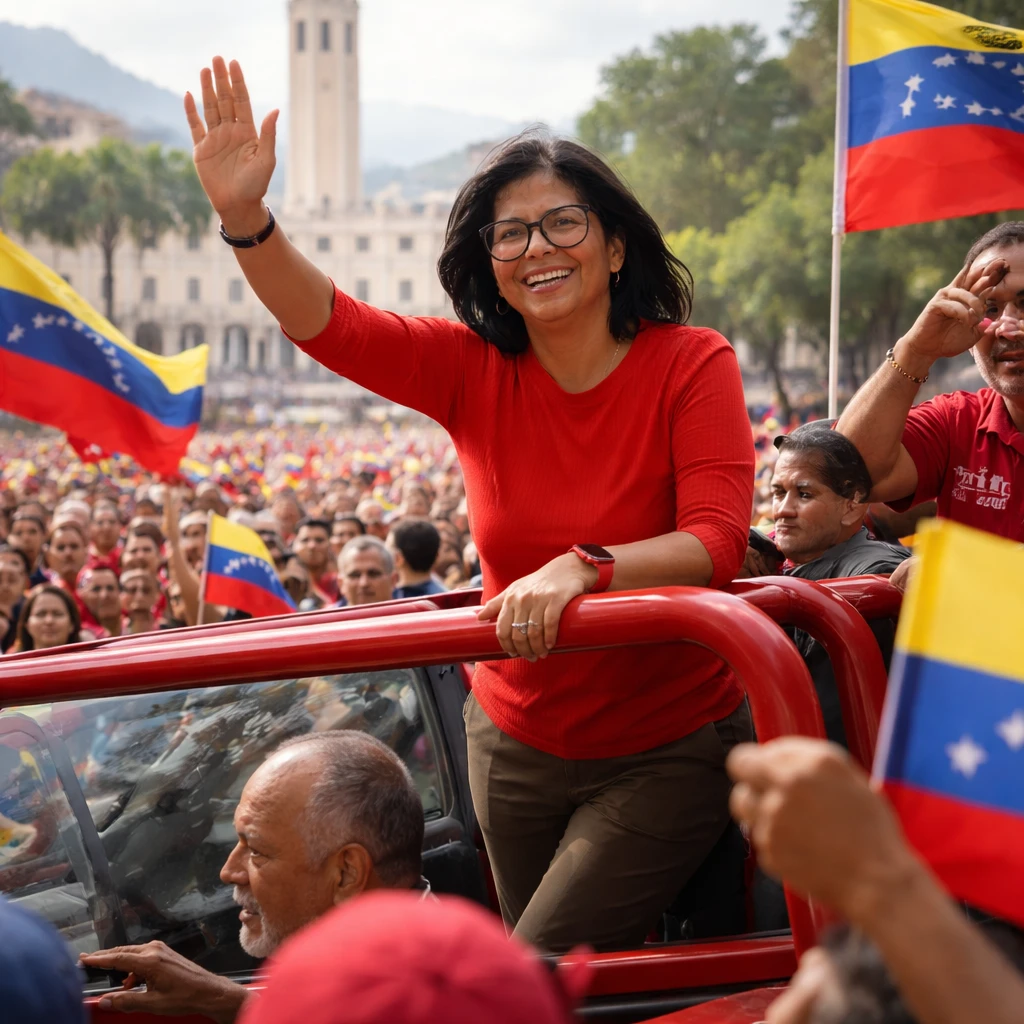

In a significant development within Venezuela’s political landscape, Delcy Rodríguez has stepped into the role of interim president following the United States' nighttime military capture of President Nicolás Maduro. The Venezuelan Supreme Court endorsed Rodríguez's assumption of presidential duties on Saturday, reinforcing her position with backing from the country’s military establishment.
Having served as Maduro’s vice president since 2018, Rodríguez has overseen key facets of Venezuela's oil-rich economy and managed the nation’s intelligence services, positioning her as the next in line for the presidency. Her leadership emerges amid US President Donald Trump's administration's commitment to applying pressure on the Venezuelan regime to align with its vision for the future of the South American oil power.
At 56, González - educated in Britain and France - bears a professional history closely tied to the late Hugo Chávez's revolutionary movement, with a career marked by several high-profile cabinet roles including economic minister, foreign affairs minister, and petroleum minister. Her ascent to interim president has unfolded amid speculation regarding whether she would break with Maduro's antagonistic stance toward the US or continue it.
US Secretary of State Marco Rubio has publicly acknowledged communication with Rodríguez, describing her as "gracious" and someone the Trump administration could collaborate with, distinguishing her from Maduro. However, Rodríguez's initial televised remarks remained defiant, labeling the US government "extremists" and upholding Maduro as the lawful president. She denounced external actions towards Venezuela as violations of international law, surrounded by senior officials and military leaders.
President Trump responded with a stern warning that Rodríguez faced serious consequences if she resisted cooperating, citing a potential punishment exceeding that anticipated for Maduro. He expressed explicit demands for comprehensive access to Venezuela's infrastructure and oil resources to facilitate reconstruction efforts.
Despite this, Rodríguez posted a message on Instagram signaling a pivot towards diplomacy, extending an invitation to the US for cooperative engagement aimed at mutual development under principles of international law.
Rodríguez's political lineage is notable; her brother Jorge Rodríguez heads the Maduro-controlled National Assembly. Their family history includes their father, a socialist leader detained for a 1976 kidnapping incident involving an American businessperson, who died in custody. Unlike other Maduro allies, Rodríguez and her brother have avoided US criminal charges, although she was sanctioned during earlier Trump administration years for her role in undermining democratic processes in Venezuela.
Rodríguez has cultivated relationships with certain Republicans within the oil sector and financial circles, who have opposed US-led regime change. She also played a central role in an assembly formed to counteract opposition-led protests in 2017, effectively bypassing the opposition-controlled legislature. Her rapport with the Venezuelan military is particularly strong, with analysts characterizing her ties as transactional yet influential, a crucial factor given the military’s role as political arbiter in Venezuela.
The duration and nature of Rodríguez’s tenure remain uncertain. Experts suggest her initial hardline rhetoric towards the US may have been aimed at preserving credibility among loyalists. The complexity of Maduro’s capture implied some level of internal governmental collaboration. Analysts observe the delicate balance Rodríguez must maintain, as too evident cooperation with US interests could alienate revolutionary allies.
Venezuela's constitution mandates an election within 30 days if the president is permanently incapacitated, including death or resignation. This procedure was followed upon Chávez's death in 2013. However, the Supreme Court ruling framed Maduro’s absence as temporary, allowing Rodríguez to serve as interim president for up to 90 days, extendable to six months by the National Assembly, with no explicit mention of the maximum period in the court’s wording. Observers speculate this could enable Rodríguez to extend her leadership while consolidating socialist party factions and shielding against the challenging electoral environment.