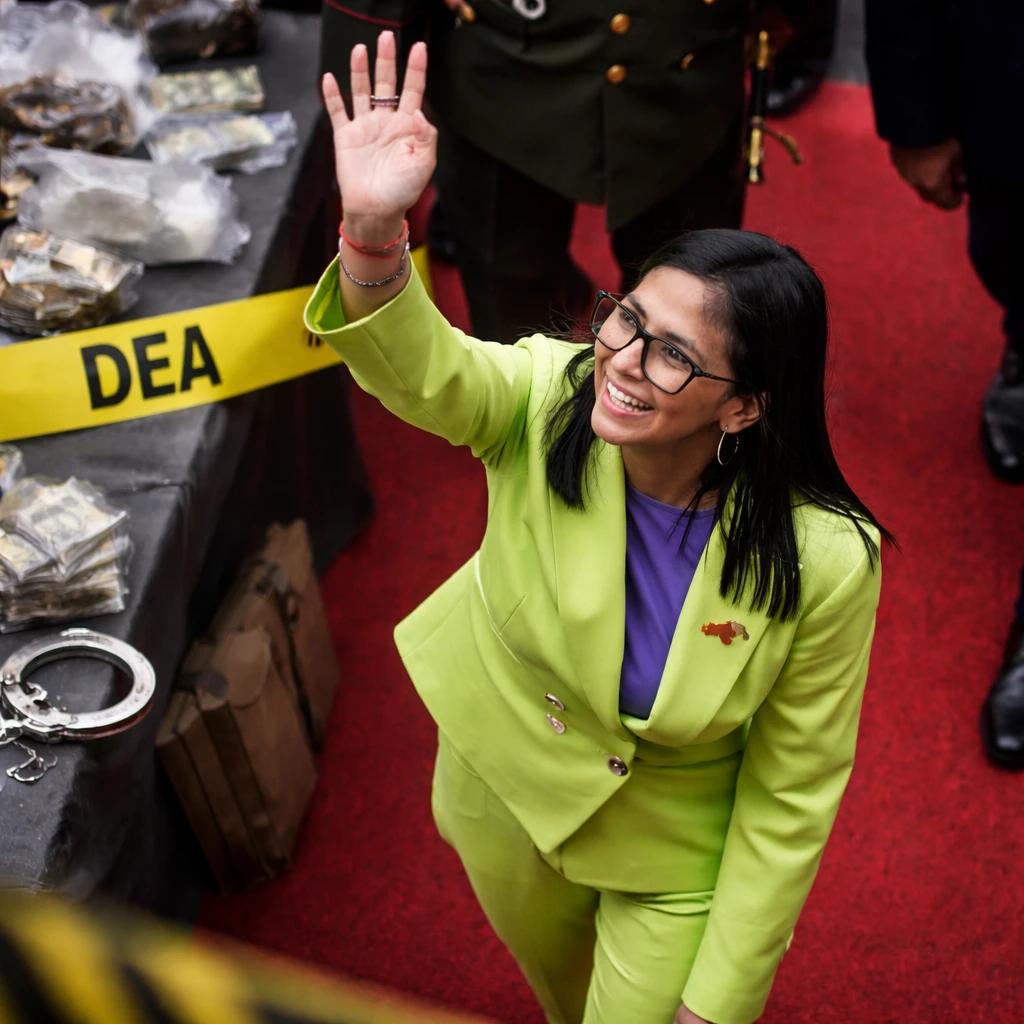
When former U.S. President Donald Trump announced the high-profile apprehension of Nicolás Maduro on charges related to drug trafficking, he simultaneously positioned Maduro's vice president and longtime confidante, Delcy Rodríguez, as an ideal collaborator to stabilize Venezuela in the midst of persistent corruption, drug-related issues, and economic collapse. However, such a depiction overlooks a significant aspect of Rodríguez’s profile: her years-long surveillance by the U.S. Drug Enforcement Administration (DEA) due to allegations involving illicit activities.
Records obtained from DEA sources and corroborated by multiple current and former officials indicate that Rodríguez has been under DEA observation since at least 2018. In 2022, she was elevated to the status of a "priority target," a classification reserved for individuals believed to wield substantial influence on the drug trade. This designation entails rigorous documentation and prioritization within DEA investigative frameworks. The available intelligence files compiled by the DEA include details about Rodríguez’s associates and accusations ranging from narcotics trafficking to gold smuggling.
One particular informant disclosed in early 2021 that Rodríguez was purportedly using hotels in Isla Margarita, a renowned Caribbean resort island, as fronts for laundering money. Connections have also been drawn to Alex Saab, an alleged financier for Maduro, arrested in 2020 on money laundering charges. Despite this web of suspicions, the U.S. government has not formally accused Rodríguez of any criminal conduct, and she remains distinct from more than a dozen Venezuelan officials who face drug trafficking charges alongside Maduro.
Further insights reveal that Rodríguez's name has appeared across nearly a dozen DEA investigations spanning multiple jurisdictions from Paraguay and Ecuador to U.S. cities including Phoenix and New York. Specific focuses of these probes remain confidential. Three DEA personnel consulted for context acknowledged an intense and consistent investigative interest in Rodríguez throughout her tenure as vice president but emphasized that the "priority target" label does not equate to an indictment and that extensive evidence is required for formal charges.
The DEA’s Special Operations Division has played a central role in gathering intelligence on Rodríguez, the same unit involved in the high-profile case against Maduro. Documentation highlights potential links to government contracts awarded to Alex Saab, connections to alleged corrupt dealings involving Omar Nassif-Sruji, brother to Rodríguez's long-time partner Yussef Nassif, and suspicions about financial maneuvers benefiting from government-linked enterprises.
Venezuela’s reputation for corruption is stark; Transparency International ranks it as the third most corrupt nation globally, underscoring how power and criminality are often intertwined. Observers highlight that positions of authority within Maduro’s government, including Rodríguez’s, are likely predicated on at minimum complicity in illicit activities, framing the current regime as a "criminal-hybrid." Such characterization complicates U.S. diplomatic efforts, as the same individual under investigation is simultaneously being courted for cooperation over Venezuela's vast natural resources.
The contradictions in U.S. policy have drawn skepticism. Opposition figure María Corina Machado, who recently met with Trump in Washington to advocate for increased American backing of Venezuelan democracy, accused Rodríguez of having a clearly documented profile known to the American justice system. Meanwhile, the U.S. administration, including the Trump White House, expressed trust in Rodríguez following discussions and high-level meetings such as one with CIA Director John Ratcliffe.
Rodríguez's political ascent traces back to a personal history marked by tragedy and ideology, including the death of her socialist father in police custody during her childhood, fueling her leftist political trajectory. She undertook efforts to attract U.S. investment during the early Trump years, even facilitating a $500,000 donation from Venezuela’s state oil company to Trump's inaugural committee, showing a nuanced engagement with U.S. interests.
However, sanctions imposed by the White House and the European Union highlighted her role in undermining Venezuela’s democratic institutions rather than accusing her directly of corruption. Still, various intelligence and investigative analyses point to her involvement in activities that perpetuate the country’s decline and criminal governance.
The strategic importance of Isla Margarita has been underscored by its use as a hub for drug trafficking networks with historical links to notorious cartels. DEA documents suggest the island's hotels, potentially controlled or connected to Rodríguez, serve financial schemes masking illicit proceeds. The DEA continues investigations into transactions involving Venezuelan government contracts inclusive of food and dialysis medicine imports managed through companies affiliated with Nassif family members.
This intricate nexus of politics, crime, and international relations presents a significant dilemma. On one hand, Rodríguez embodies continuity and control within Venezuela’s administration, uplifting her as a key figure in the country’s future. On the other hand, her alleged engagement with criminal enterprises fuels doubts and provides leverage to U.S. authorities as they navigate the turbulent geopolitical landscape.
Experts articulate that Rodríguez’s prominent role in the corrupt regime logically places her under sustained investigative scrutiny and grants Washington leverage that may influence her political decisions. This dynamic was vividly illustrated by Trump’s remarks warning Rodríguez of severe consequences should she fail to align with U.S. interests, notably regarding access to Venezuela’s energy resources.
The DEA records and expert testimonies collectively illuminate how Venezuela’s governance remains entangled with illicit networks, with Rodríguez representing a central figure in these enduring complexities.