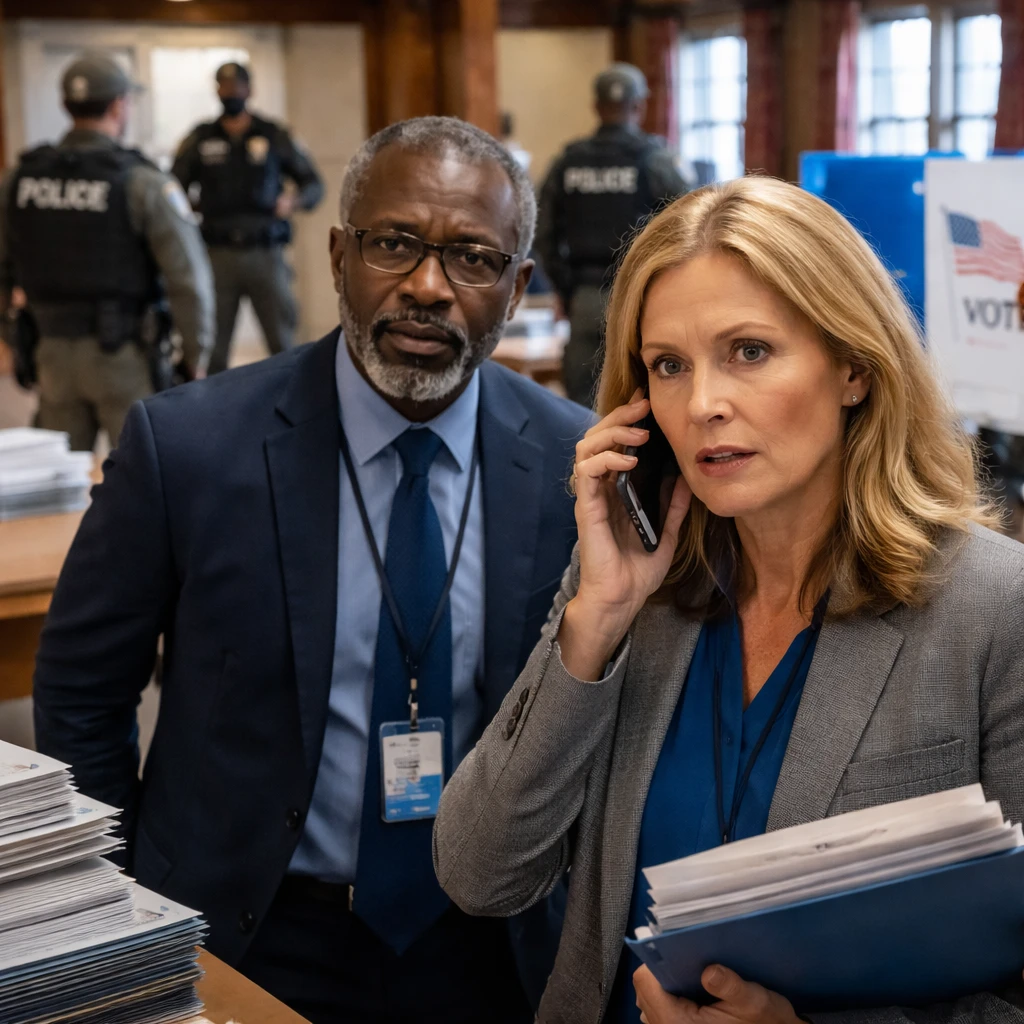

As the 2024 midterm elections approach, Democratic state election officials are proactively formulating crisis management strategies in response to recent federal enforcement activities and election office interventions. Actions such as heightened immigration enforcement in Minnesota, which tragically resulted in the deaths of two U.S. citizens due to federal agent involvement, alongside the FBI's recent search of the election office in Georgia's most populous county, have intensified fears regarding potential federal interference in state election processes.
During a routine annual convocation of state election authorities held this Thursday, Democratic secretaries of state articulated growing vigilance against possible interference tactics linked to the Trump administration. Concerns revolve around scenarios including the presence of immigration enforcement personnel near polling stations and attempts by federal agents to confiscate voting infrastructure or ballots.
"Election security now extends beyond ensuring proper ballot distribution and secure counting; it encompasses extensive scenario planning in anticipation of potential obstructions initiated by the Trump administration," explained Jocelyn Benson, Michigan's Secretary of State and gubernatorial candidate. She highlighted that her office is actively coordinating with local election officials statewide to prepare for various crisis scenarios, incorporating training on handling bomb threats and the unprecedented possibility of Immigration and Customs Enforcement (ICE) agents appearing at voting locations.
Benson elaborated on the operational responses, stating, "We are delineating protocols for deterrence, mitigation, legal actions, and coordination with law enforcement—defining moments when intervention is required and others when restraint is necessary."
Similarly, Colorado's Secretary of State Jena Griswold reported intensifying preparations by updating existing emergency frameworks and conducting disaster response exercises with top state officials, including the governor, attorney general, and county clerks. Griswold expressed particular apprehension about the Trump administration's dismantling of initiatives designed to monitor election interference and foreign electoral meddling, alongside concerns regarding modifications within the U.S. Postal Service affecting mail-in voting processes.
These developments come in the wake of the FBI's search operation at the Atlanta-area election center, which resulted in the confiscation of ballots and related 2020 election documentation. This scrutiny has reignited President Donald Trump's longstanding and unsubstantiated claims contesting the legitimacy of the 2020 presidential election.
The Trump administration's approach has notably extended beyond election procedures into broader immigration enforcement realms. For instance, Attorney General Pam Bondi recently requested Minnesota's governor, Tim Walz, to release state voter rolls to support efforts purportedly aimed at restoring law and order amid widespread protests linked to intensified immigration enforcement and the aforementioned federal agent-involved shootings.
The Justice Department has also initiated lawsuits against at least 23 states and the District of Columbia, seeking comprehensive voter information, including personally identifiable data such as names, birth dates, addresses, driver’s license details, and partial Social Security numbers. Many Democratic-led states have rebuffed these requests, citing violations of state and federal privacy statutes.
Griswold characterized the federal approach as "un-American," pointing to the inappropriate use of law enforcement to advance policy objectives. Meanwhile, Maine Secretary of State Shenna Bellows emphasized confidence in federal laws that safeguard states against extreme actions, particularly concerning the potential presence of armed federal agents at polling locations. "This will likely be straightforward to address legally," she indicated.
Nonetheless, Bellows voiced worries that the visible enforcement measures, including arrests and deportations by ICE across multiple urban centers, could intimidate voters and suppress turnout. "If fear of federal agents prevents individuals from basic activities like grocery shopping, it will inevitably deter them from participating in elections," she remarked.
These tensions have also drawn attention from legislators. Senator Mark Warner of Virginia articulated concerns about the intimidation potential of unfettered ICE operations at election sites, warning against "roving gangs" that might dissuade electoral participation.
Collectively, Democratic election officials are adopting a multifaceted approach to safeguarding electoral integrity amid a politically charged environment marked by federal interventions and heightened enforcement. Their preparations encompass legal strategies, coordination with law enforcement, contingency training, and community communication to mitigate risks associated with current federal policies and practices.