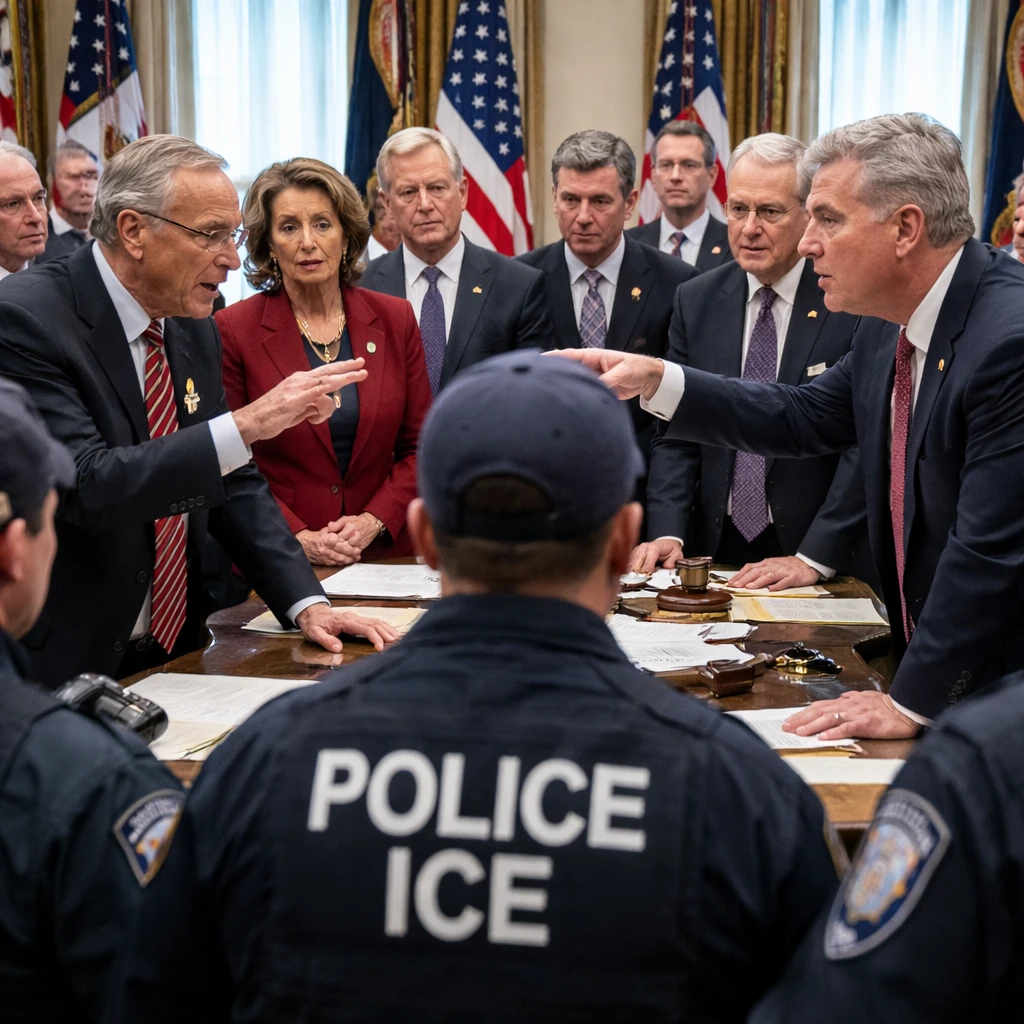

Negotiations in Washington are underway between Democrats and President Donald Trump's administration concerning potential new federal immigration enforcement regulations, a process complicated by entrenched partisan divisions, particularly within the Senate. Republican Senate Majority Leader John Thune has described the prospect of reaching a compromise within the next two weeks on a bipartisan measure as very unlikely or even "an impossibility." The discussions focus on addressing the conduct and oversight of Immigration and Customs Enforcement (ICE) and U.S. Customs and Border Protection (CBP) agents, prompted by the deaths of two Minneapolis protesters earlier this year during enforcement operations in January.
Amid rising tensions around federal immigration enforcement impacting Minnesota and other states, some members of both parties have expressed a shared interest in congressional action to mitigate conflicts. Responding to Democratic demands, President Trump agreed last week to temporarily separate funding for the Department of Homeland Security (DHS) from the broader federal spending bill, continuing appropriations at current levels for a two-week period while lawmakers continue negotiations on potential federal agent regulations.
House Speaker Mike Johnson, a Republican from Louisiana, reported witnessing a phone call between President Trump and Senate Democratic Leader Chuck Schumer of New York, describing the conversation as progress toward reaching a deal. Yet, it remains uncertain whether the president or a majority of Republicans in Congress will concede to key Democratic proposals, which include requiring officers to reveal their identities by removing masks, mandating judicial warrants for certain operations, enhancing cooperation with local authorities, and other conditions that Republicans have so far opposed.
In addition to Democratic proposals, House Republicans have linked their support for the Homeland Security spending bill to advancing their own priorities. These include legislation that would impose citizenship verification requirements prior to voter registration and measures championed by Senators such as South Carolina's Lindsey Graham to impose restrictions on so-called sanctuary cities. Although there is no formal federal definition, sanctuary jurisdictions generally refer to state or local governments that limit their collaboration with federal immigration enforcement agencies.
The stance of Democrats toward compromise is further complicated by strong opposition to the Trump administration's escalating immigration enforcement practices, with some party members expressing unwillingness to settle for limited changes. Senate Democratic Leader Schumer emphasized the party's intent to present Republicans with a thorough and detailed legislative proposal rather than mere assurances.
Disagreement on Key Enforcement Reforms
One area of potential agreement lies in deploying body-worn cameras for immigration officers. Republicans have indicated openness to this measure, consistent with provisions already included in the underlying DHS funding bill. Homeland Security Secretary Kristi Noem recently directed that such body cameras be distributed to all officers operating on the ground in Minneapolis, including those from ICE, with plans to extend this requirement nationwide as funding permits. The bill authorizes $20 million to equip immigration personnel with these devices.
Former U.S. Customs and Border Protection Commissioner Gil Kerlikowske, who served from 2014 to 2017, noted broad agent support for body cameras, which agents view as a tool to protect themselves from unwarranted accusations. However, he also highlighted complex issues related to when cameras should be activated, when footage should be released, and accountability for officers who fail to comply. Schumer has stressed the necessity that body cameras remain activated during enforcement activities.
Conversely, the issue of agents wearing masks has become highly contentious. Democrats argue that requiring agents to remove masks would enhance transparency and accountability, pointing out that most state and local law enforcement agencies do not employ masked officers. Representative Bennie Thompson, the top Democrat on the House Homeland Security Committee, questioned why ICE agents should receive such exceptions.
Republicans counter that unmasking could expose federal agents to harassment and threats, citing evidence of doxing and targeting. House Speaker Johnson stated that publicizing agents' identities and displaying them on uniforms would increase safety risks. Meanwhile, federal regulations currently require immigration officers to identify themselves as soon as it is practicable and safe; ICE officials assert the rules are followed, but critics claim this is not consistently observed.
Regarding search authority, Democrats have called for stricter warrant requirements, including limiting the use of roving patrols targeting individuals on public streets and in private homes. They seek the exclusive use of judicially issued arrest warrants instead of the administrative warrants typically issued internally by immigration authorities. Schumer framed this as a demand for arrest warrants and an end to racial profiling.
Traditionally, administrative warrants authorize arrests but do not permit officers to forcibly enter private property without consent, a power reserved for judicial warrants. However, an ICE internal memo recently obtained authorizes forceful entry based on administrative warrants to apprehend individuals with final orders of removal, a point of contention among civil liberties advocates. Democrats have also expressed interest in protecting sensitive locations such as places of worship, schools, and hospitals from enforcement activities.
House Speaker Johnson has stated resistance to adopting judicial warrant requirements in place of administrative ones, describing the Democratic proposal as adding an unworkable new layer of restrictions. He suggested there might be some room for negotiation about ending roving patrols, but details remain unspecified.
Calls for Enhanced Accountability Measures
Democrats further advocate for establishing a standardized code of conduct governing ICE and other federal agents similar to those applied to state and local law enforcement personnel. The controversy surrounding the exclusion of state investigators from evidence related to the fatal shooting of protester Renee Good by an ICE agent on January 7 in Minnesota illustrates the trust deficit. Democratic Governor Tim Walz criticized the federal decision to bar state authorities from the inquiry, asserting that excluding the state complicates public confidence in the fairness of the investigation.
Outlook and Challenges Ahead
Despite some signs of negotiation, any DHS funding agreement accommodating Democrats' demands may not unify the entire Democratic caucus. Representative Ayanna Pressley of Massachusetts has stated categorically that she would reject any deal that does not mandate removal of masks on federal agents, reaffirming her longstanding position favoring abolition of ICE. Senator Thune has repeatedly underscored the difficulty of concluding a comprehensive agreement within a two-week timeframe and suggested that direct talks between Democrats and President Trump are essential but remain uncertain in their prospects.
In this context of partisan discord and complex policy debates, the future of federal immigration enforcement oversight and funding remains uncertain, with significant implications for law enforcement operations, civil liberties, and federal-state relations.