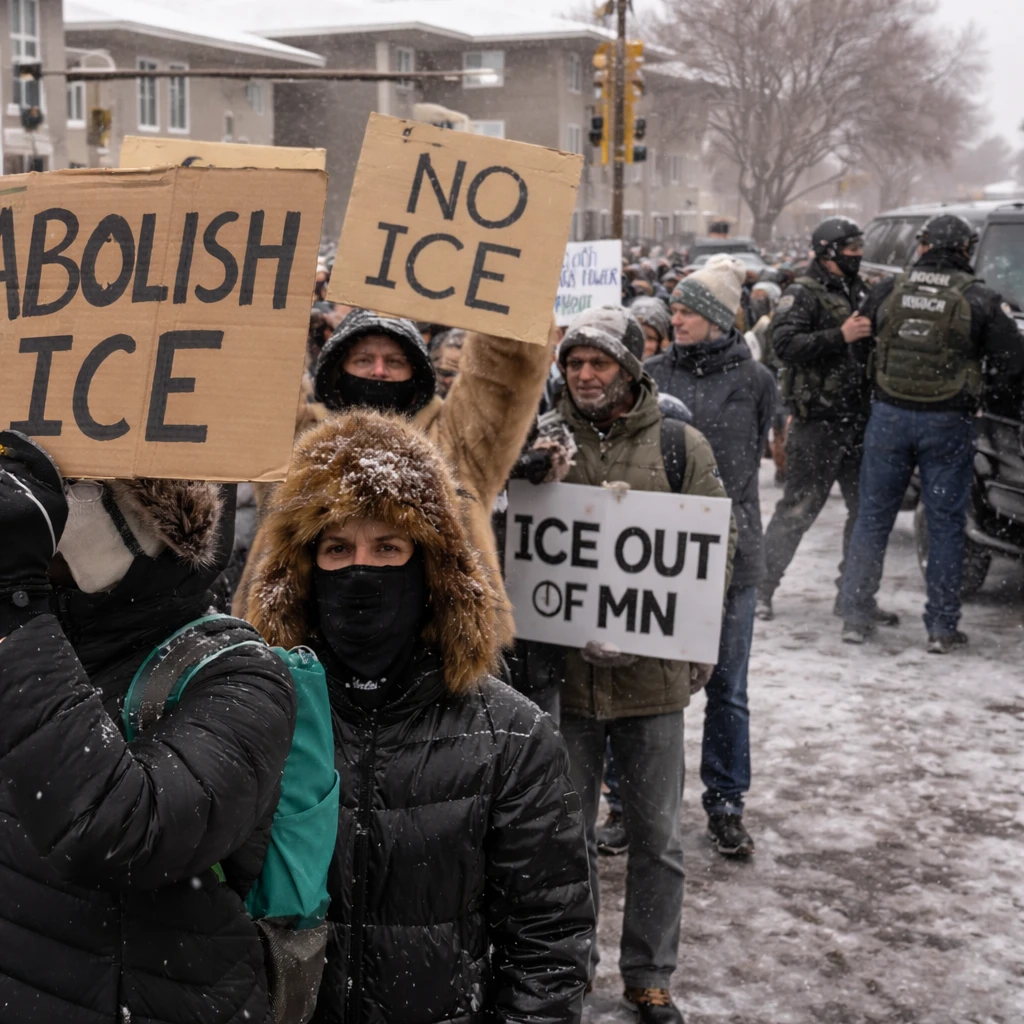

In the lead-up to the midterm elections, the Democratic Party initially emphasized campaigning on issues such as affordability and healthcare, both areas where public dissatisfaction with President Donald Trump was pronounced. However, a forceful federal immigration crackdown in Minnesota, culminating in the fatal shooting of Renee Good during a confrontation with federal officers, has compelled Democrats to reassess their political strategy.
Persistent divisions exist within the party regarding how to leverage public outrage over immigration enforcement. Some Democrats advocate for abolishing the Immigration and Customs Enforcement agency (ICE), echoing rhetoric reminiscent of calls to defund the police during the early Trump administration. These advocates also urge the removal of key officials in the current administration, including the Secretary of Homeland Security, Kristi Noem.
Conversely, other party members have pursued legislative solutions aimed at curtailing alleged abuses by federal agents. Despite these efforts, critiques from activists suggest such measures fall short, and there is mounting pressure to block funding for deportations entirely.
Chuck Rocha, a party strategist advising House and Senate candidates on immigration matters for this election cycle, noted the breadth of perspectives within the Democrats: "We are Democrats. I am certain we will have 50 different ideas and 50 different ways of articulating them."
A failure to navigate this complex policy terrain risks undermining Democrats' prospects of regaining control of Congress and state legislatures and diminishes their opportunity to rebuild voter trust. This is particularly salient given that dissatisfaction with border security policies under Democratic President Joe Biden contributed to Republican Donald Trump's return to the presidency.
Neera Tanden, president of the Center for American Progress and former domestic policy advisor to Biden, expressed optimism about striking the right balance: "It's not too much to ask for a government that can maintain a secure border, deport those without legal status, and simultaneously uphold civil and human rights," she told The Associated Press. "The country has done so before and can do it again."
The federal immigration raids have targeted multiple cities since Trump took office, but the Minnesota operation ignited particularly intense controversy. Renee Good, 37, was fatally shot by a federal agent earlier this month, triggering protests and strong condemnation from local Democratic leaders. While administration officials claimed Good attempted to run over an agent with her vehicle, this explanation has been widely challenged based on circulating video evidence.
Representative Robert Garcia of California, the senior Democrat on the House Oversight and Reform Committee, affirmed strong party unity in condemning actions by the Department of Homeland Security and ICE. "We should campaign for fairness and due process for all, standards that ICE and DHS violate daily," Garcia stated. "We ought to take an assertive stance on this."
Nonetheless, contesting the administration's approach requires Democrats to navigate challenging political waters. A Washington Post/Ipsos survey conducted in September revealed that roughly 40% of U.S. adults trusted Republicans more than Democrats on immigration issues, while fewer than 30% favored Democrats. Republicans also held a substantial advantage on crime-related questions, with 44% expressing confidence compared to 22% for the Democrats.
The Republican Party exhibits confidence that its messaging intertwining immigration enforcement and crime protection will resonate with voters this election cycle. They frequently highlight cases of violent criminals detained or deported, often downplaying incidents involving nonviolent migrants. Delanie Bomar, spokesperson for the Republican National Committee, asserted, "If Democrats want to make 2026 a referendum on which party supports strong immigration policies and protects public safety, we would welcome that fight any day."
Within the Democratic ranks, some prefer to frame immigration primarily through the lens of healthcare and cost-of-living concerns. Representative Alexandria Ocasio-Cortez from New York articulated this approach by linking reduced healthcare funding to resources spent on ICE operations, stating, "Cuts to your healthcare are what enable ICE to carry out these actions." Party strategists have circulated her remarks as a potential model to shift the narrative, especially highlighting Trump’s cuts to social safety programs during his first year.
Public approval for President Trump’s handling of immigration appears to be waning. The AP-NORC Center for Public Affairs Research noted a drop from 49% approval in March to 38% in January of the current year. Juan Proaño, executive director of the League of United Latin American Citizens, the longest-established Hispanic civil rights organization in the U.S., commented that immigration raids have politically damaged Trump. "Republican congressional members are uneasy about these agencies and their tactics, knowing it could harm them in the upcoming elections," he said.
Proaño remarked disappointment in how Democrats had adapted to the Trump administration’s immigration policies over the past year but acknowledged the party’s strategic shift following Good’s death. "I think everyone was breathless over that incident, and I believe there has been a marked change since then," he noted.
Even some past Trump supporters, including podcast host Joe Rogan, have expressed reservations recently, questioning if the administration’s approach resembles an oppressive policing force. Despite this, the Trump administration has intensified federal agent deployment in Minnesota and issued subpoenas to state Democratic leaders, including Governor Tim Walz and Minneapolis Mayor Jacob Frey. These legal actions investigate whether local officials obstructed federal immigration operations.
Ken Martin, chairman of the Democratic National Committee and former Minnesota party leader, reflected on the emotional weight surrounding these developments: "There is profound pain and anguish. It is heartbreaking. It's chilling to think that this is America, which is supposed to be a beacon of democracy and freedom."