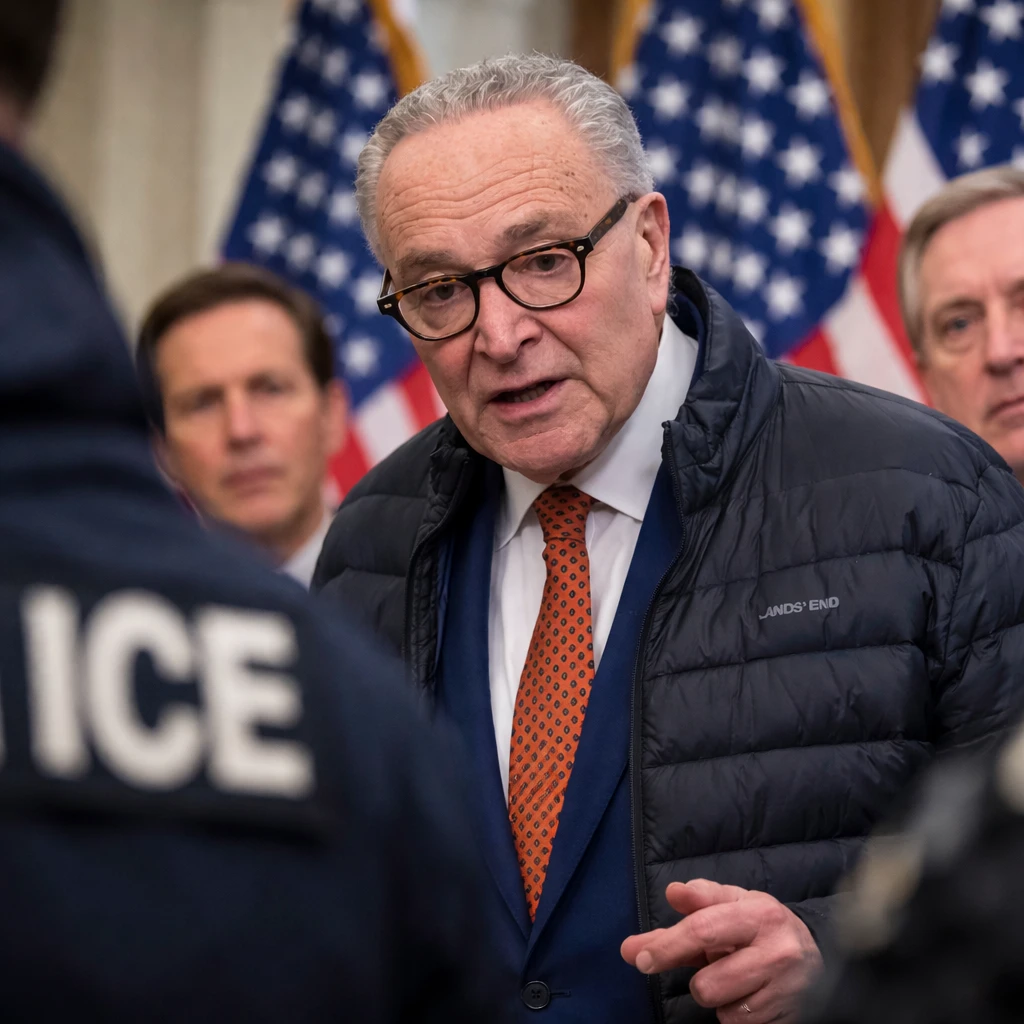

With a partial government shutdown looming by the end of the week, Democratic senators are focusing on a narrowed set of demands aimed at reforming the U.S. Immigration and Customs Enforcement agency (ICE). These efforts are in response to public outrage sparked by the deaths of two individuals during encounters with federal agents in Minneapolis earlier this month. The upcoming crucial vote on Thursday will determine whether to advance legislation that funds the Department of Homeland Security (DHS) and other federal agencies.
So far, Senate Democratic leader Chuck Schumer has not publicly specified the exact demands the caucus will present to influence the spending bill. However, Democrats have scheduled a meeting on Wednesday to consider a range of proposals designed to mandate increased accountability and procedural safeguards for ICE agents. Among these are requirements that agents obtain judicial warrants prior to immigration arrests, mandate self-identification by agents at the point of arrest, abolish arrest quotas, redeploy agents primarily to border security roles, and obligate the DHS to collaborate with state and local authorities in investigating incidents such as the recent fatal shootings in Minnesota.
Senator Schumer has emphasized the urgency of these reforms, condemning current enforcement as "madness" and "terror" and demanding prompt changes to ICE and U.S. Border Patrol operations. The mood within the Democratic caucus reflects a strong determination to leverage fiscal legislation to enforce these policy modifications.
Meanwhile, Senate Majority Leader John Thune, a Republican from South Dakota, has stated that he is awaiting a clear outline of demands from the Democrats and has suggested that these discussions should also involve the White House. There remains ambiguity regarding the extent of engagement by the executive branch as talks appear limited, contributing to increased expectations of a partial government shutdown starting Saturday if no agreement is reached.
Democrats argue that the proposed reforms are targeted and practical, not requiring comprehensive new legislation. Senator Chris Murphy of Connecticut, the senior Democrat on the Homeland Security subcommittee, characterized the objectives as measures that would unify both Congress and the public by ending aggressive “roving patrols” that Democrats say have caused widespread fear. Both Murphy and Schumer have stressed that these changes cannot simply be executive promises but must be enacted through formal congressional passage to restore public trust.
Republicans counter that any alterations to the homeland security funding must gain approval in the House of Representatives to prevent a shutdown. Given that the House is not in session this week, and conservative factions within the chamber oppose modifications, a prompt resolution seems unlikely. Senator John Cornyn of Texas articulated the Republican stance by affirming openness to dialogue on oversight and laws but rejecting government closure as a bargaining tool.
Efforts to reach a compromise face multiple logistical and political hurdles. The House recently approved the remaining appropriations bills as a single package, complicating attempts to isolate and amend the homeland security funding provision independently. Potential procedural maneuvers to address this in the Senate would require unanimous consent or a sequence of votes unlikely to occur before the shutdown deadline. Notably, House Republicans, including the conservative House Freedom Caucus, have signaled strong support for maintaining current funding levels for DHS and ICE, evident in a letter to the president affirming their alignment and warning that the funding package will not be reconsidered without homeland security funding intact.
Democrats, in contrast, remain resolute. Senator Richard Blumenthal of Connecticut called the moment "truly a moral moment" and underscored the necessity of principled opposition to current immigration enforcement practices. The standoff underscores persistent partisan divisions over immigration policy enforcement and federal budget priorities as the deadline draws near.