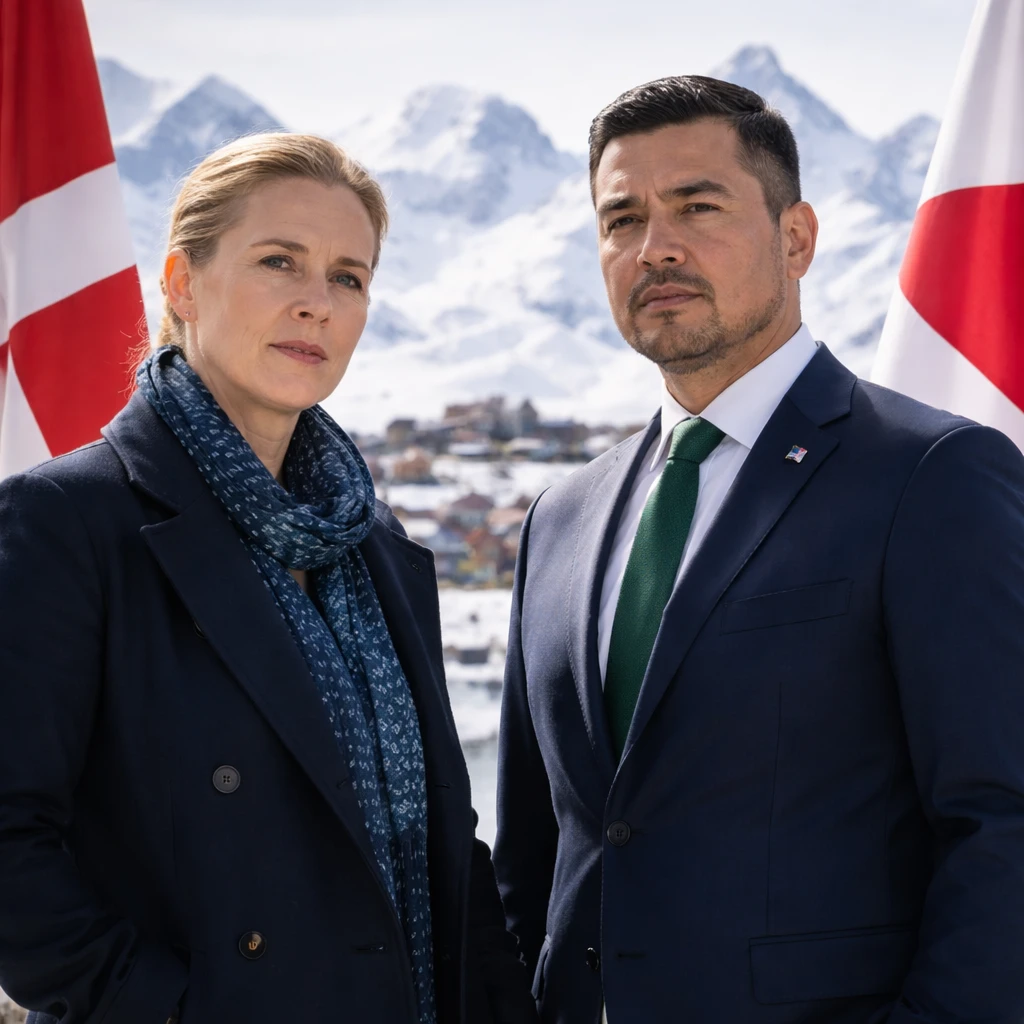

In a coordinated statement reflecting strong alliance ties, the prime ministers of Denmark and Greenland publicly opposed recent United States proposals to acquire Greenland, a vast Arctic territory linked politically to Denmark. Their declaration underscores Greenland's status within the Kingdom of Denmark and its protection under NATO, emphasizing the potential ramifications for the alliance should the U.S. pursue control over the island.
During a joint news conference in Copenhagen, Danish Prime Minister Mette Frederiksen and Greenlandic Prime Minister Jens-Frederik Nielsen highlighted their mutual commitment to remain united amid external pressures. Frederiksen assured Greenlanders of their shared solidarity, stating, "Dear Greenlanders, you should know that we stand together today, we will do so tomorrow, and we will continue to do so." Nielsen added clarity to Greenland's position, affirming allegiance to Denmark and European Union ties with, "If we have to choose between the United States and Denmark here and now, we choose Denmark. We choose NATO. We choose the Kingdom of Denmark. We choose the EU." These remarks precede planned dialogues in Washington between Denmark's and Greenland's foreign ministers, Lars Løkke Rasmussen and Vivian Motzfeldt respectively, with U.S. Vice President JD Vance and Secretary of State Marco Rubio.
The backdrop to these developments is President Donald Trump’s continued insistence on the United States securing Greenland, citing strategic imperatives and concerns about rival powers such as Russia and China. Trump’s administration has reportedly considered various approaches to obtaining the territory, including potential military options. In response to queries about Greenland's preference to remain under Danish governance, Trump dismissed the position, stating, "That’s their problem," and questioned Greenland’s leadership without acknowledging them.
Greenland's Minister for Business and Mineral Resources, Naaja Nathanielsen, characterized the U.S. discussions over the island's potential transfer as "unfathomable," conveying locals' anxiety over the political uncertainty. She noted the widespread unease affecting the community, including children experiencing fear, and stressed the importance of respecting Greenlanders’ voices in the decision-making process. Meanwhile, Danish officials have expressed willingness to enhance military cooperation with the U.S. in Greenland but firmly rule out any sale or transfer of sovereignty.
Historically, U.S. military presence on Greenland has diminished since 1945 from multiple installations with thousands of personnel to a single base at Pituffik hosting approximately 200 troops focusing on missile warning and space surveillance operations. Recent legislative changes in Denmark have granted broader access for U.S. forces to Danish military facilities, reflecting ongoing transatlantic defense ties.
Despite tensions, Denmark remains a committed strategic partner to the United States, demonstrated recently when it offered assistance to U.S. forces involved in intercepting a sanctioned oil tanker in the Atlantic. This support underscores enduring collaboration amid the geopolitical complexities arising from U.S. interest in Greenland.
NATO Secretary-General Mark Rutte, when addressing the issue, chose not to engage directly in the dispute. He emphasized the alliance’s primary mission of ensuring security in the Arctic region, inclusive of Greenland, and stated that his role entails facilitating conflict resolution rather than commenting on intra-alliance discussions.
An upcoming visit by a bipartisan U.S. congressional delegation to Copenhagen aims to reinforce U.S.-Denmark unity. However, Nathanielsen emphasized that Greenlanders must have a decisive role in determining their future, underlining the territory's profound significance as home rather than merely land.