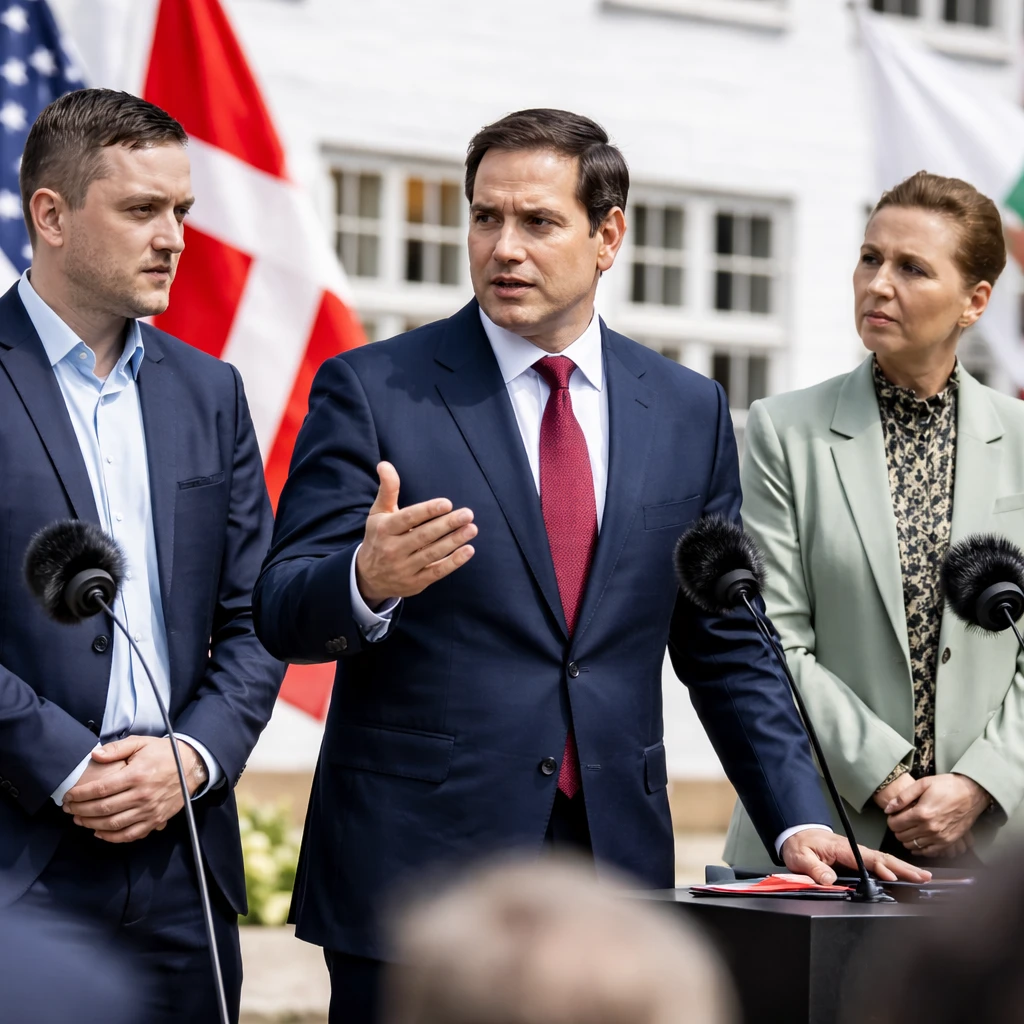

Denmark and the autonomous territory of Greenland have formally sought a meeting with U.S. Secretary of State Marco Rubio in response to the Trump administration's intensified pursuit of acquiring Greenland, an Arctic island held under Danish sovereignty. The U.S. president has emphasized the strategic necessity of controlling the globe's largest island to bolster American security amid escalating geopolitical competition from China and Russia in the Arctic region.
During a classified briefing on Capitol Hill last Monday, Secretary Rubio conveyed to a select group of legislators the administration’s preference to secure Greenland through purchase rather than military intervention. This disclosure, reported by a confidential source due to the private nature of the meeting, underscored the administration's diplomatic but firm approach to the matter.
On Wednesday, Rubio elaborated to the press that President Trump has harbored ambitions to acquire Greenland since his initial term in office. The briefing he attended included both Senate and House members who inquired not only about the U.S. operation targeting former Venezuelan leader Nicolás Maduro but also about the administration’s renewed focus on Greenland.
Heightened diplomatic tensions have emerged within NATO following statements from the White House suggesting the military remains an available option. Danish Prime Minister Mette Frederiksen cautioned that any effort by the U.S. to seize control of Greenland would fundamentally undermine the NATO alliance framework.
Maria Martisiute, a defense analyst from the European Policy Centre, expressed concern over President Trump’s assertive rhetoric, noting that such declarations bordering on intimidation strain the trust among allied nations, particularly within the Nordic bloc.
In a show of solidarity, leaders of several European nations including France, Germany, Italy, Poland, Spain, and the United Kingdom, aligned with Frederiksen in a public statement affirming that Greenland’s rich mineral resources and strategic position belong to its inhabitants.
Danish Foreign Minister Lars Løkke Rasmussen and Greenlandic Foreign Minister Vivian Motzfeldt have issued a formal request seeking to engage Secretary Rubio in discussions at the earliest opportunity. Prior attempts at arranging diplomatic talks on this subject had not been successful, according to a statement posted on Greenland’s government website.
Military strategy experts, such as Thomas Crosbie of the Royal Danish Defense College, argue that an American takeover of Greenland would not enhance U.S. security interests as Washington already benefits from strategic partnerships and military presence in the territory. Crosbie reasoned that manifesting control over Greenland through a physical takeover would offer no tangible advantages beyond the existing arrangements between the U.S., Denmark, and Greenland.
Regarding defense preparedness, Denmark passed legislation last year extending the scope of U.S. military access to Danish soil, broadening agreements established during discussions with the Biden administration. Rasmussen noted that Denmark could rescind such agreements if American attempts to annex Greenland materialize.
The U.S. Department of Defense maintains operations at Pituffik Space Base in northwestern Greenland, providing a military foothold that could be leveraged should there be any aggressive moves. However, experts like Crosbie highlight that physically overwhelming Greenland would be unnecessary; simply asserting American control through existing personnel presence could suffice to establish dominion.
Crosbie further warned that such actions could set a dangerous precedent by eroding international norms and global respect for sovereignty and rule of law, potentially destabilizing the geopolitical landscape.
French Foreign Minister Jean-Noël Barrot relayed to media that he contacted Rubio and found reassurance that the U.S. does not intend to conduct operations akin to Venezuela in Greenland. He emphasized the broad support within the U.S. for respecting NATO allies’ territorial integrity and cautioned against any aggressive measures that would threaten the alliance.
Despite widespread support among Republicans for President Trump’s stance, some bipartisan voices have condemned the rhetoric. Senators Jeanne Shaheen and Thom Tillis, co-chairs of the Senate NATO Observer Group, released a statement urging respect for the sovereignty of the Kingdom of Denmark and warning against coercion of NATO members, which would undermine foundational alliance principles.
This developing diplomatic episode underscores the sensitivities surrounding Arctic geopolitics, alliance dynamics, and national sovereignty.