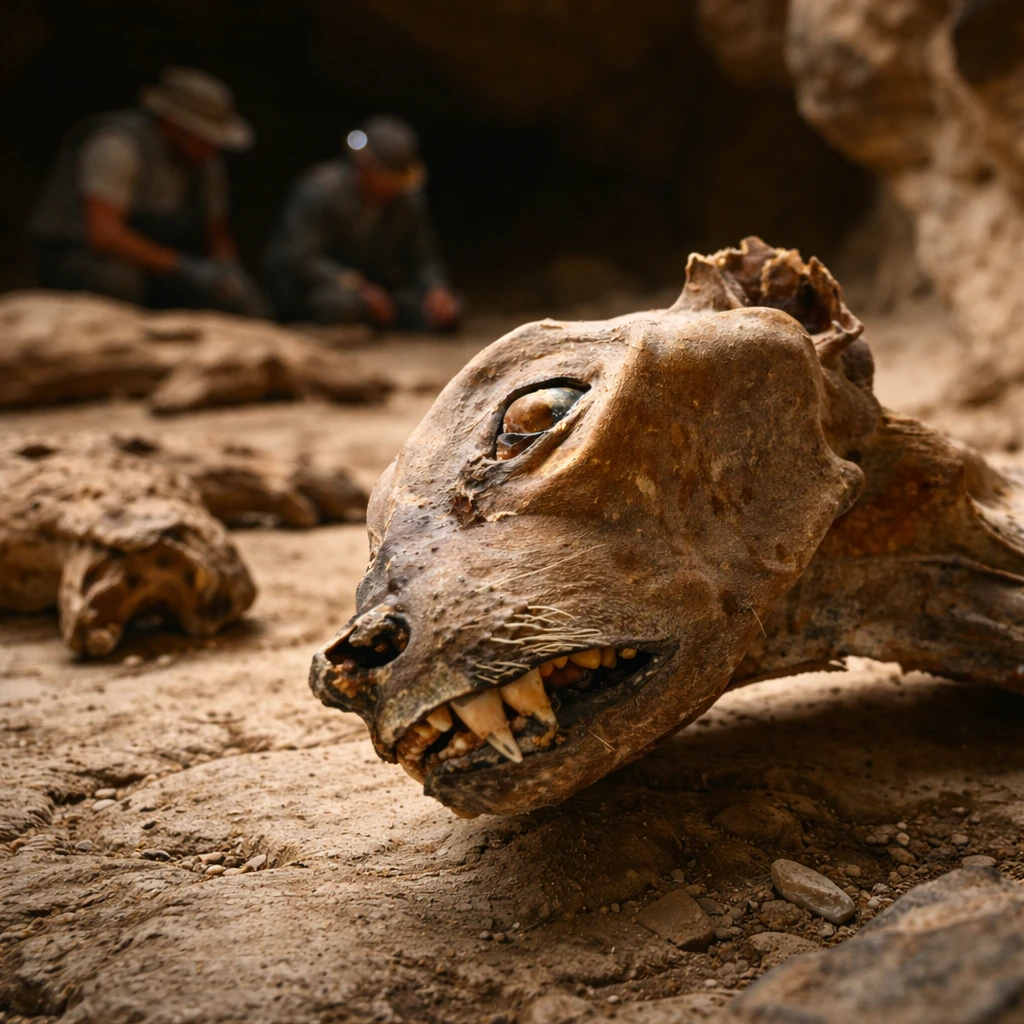

Scientists recently revealed the rare mummified remains of cheetahs discovered within caves located in northern Saudi Arabia. These extraordinary specimens, estimated to be between 130 and over 1,800 years old, include seven mummified bodies alongside the bones of 54 other cheetahs unearthed from a site near Arar city.
Mummification is a process that halts decomposition by preserving dead organisms. While the practice is famously linked to ancient Egyptian civilization, natural mummification can occur in environments such as glacier ice, arid desert sands, or peat bogs. The cheetah mummies discovered show characteristic features like cloudy eyes and shriveled limbs, resembling desiccated husks of the animals.
Joan Madurell-Malapeira from the University of Florence in Italy, although not directly involved in the study, commented on the unprecedented nature of these specimens, stating, "It’s something that I’ve never seen before." The exact mechanisms underpinning the natural mummification in these caves remain uncertain. However, the dry conditions combined with stable temperatures within the caves are considered probable contributing factors, according to a study published in the journal Communications Earth and Environment.
Researchers remain unsure about the reasons behind the large concentration of cheetah remains in these caves. One hypothesis is that the site could have served as a denning area where female cheetahs gave birth and nurtured their young.
These findings contribute to the scant body of evidence concerning naturally mummified large cats. Comparable discoveries include a saber-toothed cat cub found in Russia. Such preservation is rare for large mammals, primarily because their remains must not only be in the proper environmental conditions but also avoid consumption by scavengers like birds or hyenas.
Historically, cheetahs occupied vast ranges across Africa and portions of Asia, yet current data shows that they inhabit only about 9% of their historic territory. The species has not been sighted across the Arabian Peninsula for many decades, a decline likely attributable to factors including habitat destruction, unregulated hunting, and scarcity of prey.
The study marks a milestone by providing the first genetic analysis of naturally mummified large cats. Results indicate that these ancient cheetahs share the closest genetic relationship with modern cheetah populations from Asia and northwest Africa. These genetic insights may support future efforts aimed at reintroducing cheetahs to regions from which they have disappeared.