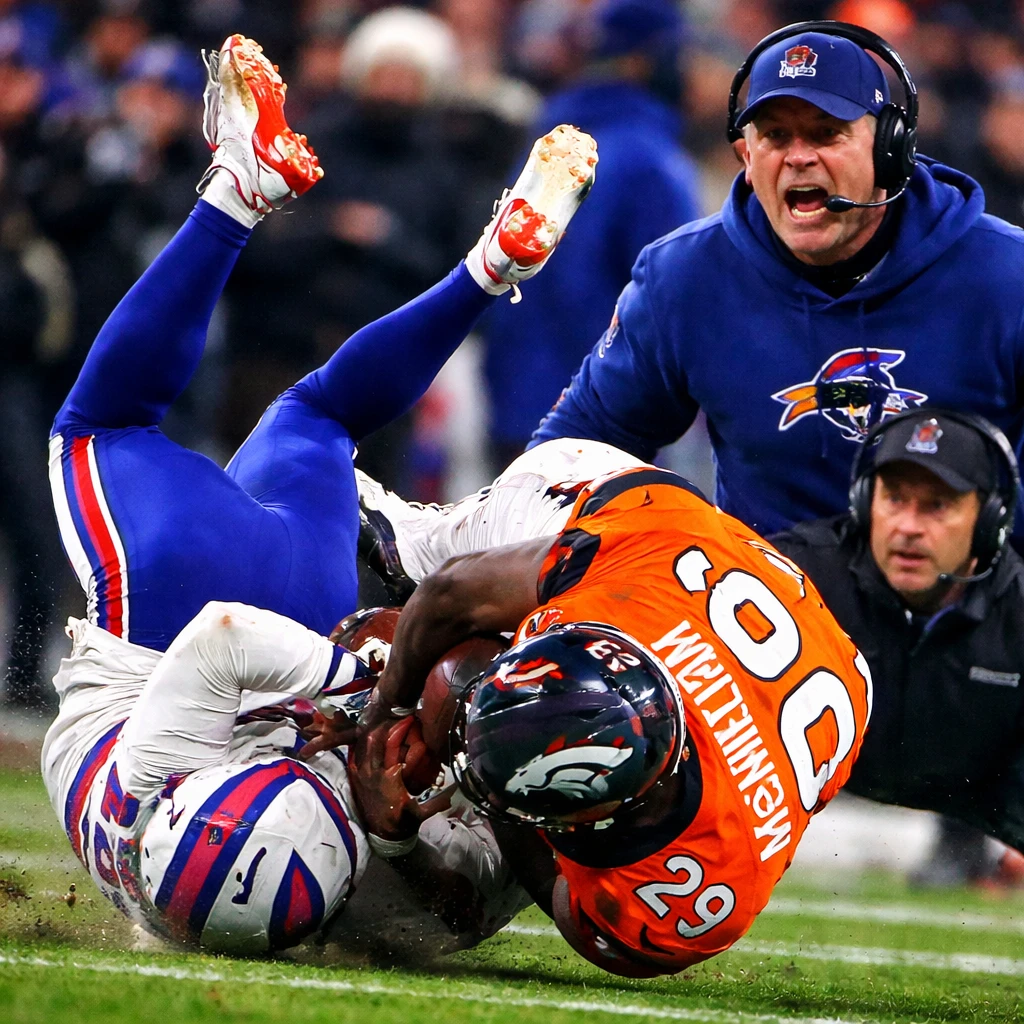
Sean McDermott confronted the aftermath of the Buffalo Bills’ narrow 33-30 overtime defeat to the Denver Broncos with staunch resistance, both during the postgame press conference at Denver’s stadium and throughout the flight back home. He maintained his position that a contested play should have been ruled a catch for Buffalo, which would have allowed the Bills to continue their playoff run.
Conversely, Broncos head coach Sean Payton asserted that the game effectively ended eight plays before Denver’s game-winning drive due to an uncalled safety. Payton argued that had this safety been awarded, it would have prevented quarterback Bo Nix from suffering a broken ankle during the critical concluding moments.
The controversial play involved wide receiver Brandin Cooks, who appeared to have a step advantage on defender Ja’Quan McMillian while catching a 44-yard pass thrown by Josh Allen at the Denver 20-yard line. As the two players tumbled towards the ground, McMillian wrestled the ball away from Cooks. The NFL officially ruled this sequence as an interception in favor of Denver. This turnover initiated Denver’s final drive, which culminated in a field goal to win the game and secured their advancement to the AFC Championship against the New England Patriots.
Within a day of Wil Lutz’s 23-yard field goal sealing Buffalo’s playoff fate, McDermott was relieved of his duties, becoming the tenth NFL head coach to lose his position in the offseason. After vehemently challenging the interception ruling during his postgame remarks, McDermott engaged in a conversation with Jay Skurski of The Buffalo News, reiterating his assertion that the play was indeed a valid catch. "That play is not even close. That’s a catch all the way," he declared, emphasizing fans deserved clarity on the decision.
However, an official pool report from referee Carl Cheffers had already clarified the controversy: "The receiver has to complete the process of a catch. He was going to the ground as part of the process of the catch and lost possession when he hit the ground. The defender gained possession at that moment. The defender completed the process of the catch, so possession was awarded to the defender."
Due to restrictions under overtime rules, McDermott was unable to formally challenge the ruling but called a timeout to allow the officiating team additional opportunity for review. As the play had been previously upheld by the NFL’s expedited replay process in New York, this timeout primarily offered McDermott a chance to seek a detailed explanation for the call. Despite the extended review, McDermott remained dissatisfied.
He expressed confusion over the ruling, stating, "It’s hard for me to understand why it was ruled the way it was ruled. And if it is ruled that way, then why isn’t it slowed down just to make sure that we have this right? That would have made a lot of sense to me because that’s a pivotal point in the game. We have the ball at the 20 maybe kicking a game-winning field goal right there — but I’m saying it because I’m standing up for Buffalo, damn it, I’m standing up for us."
Support for McDermott’s stance emerged from various quarters, including former NFL cornerback Richard Sherman and ESPN analyst and former quarterback Dan Orlovsky, who asserted, "This is a catch every time."
Countering this view, Hall of Fame tight end Sterling Sharpe and former receiver Chad "Ochocinco" Johnson, on their podcast, affirmed the correctness of the interception call. Sharpe referenced the so-called "Calvin Johnson rule" which dictates that receivers must maintain possession of the ball throughout the entirety of the catch process, including while landing on the ground. If possession is lost upon contact with the ground, and the defender secures the ball, the catch is awarded to the defense.
Sharpe elaborated, "If a receiver catches a football and he goes to the ground he must maintain possession of the football throughout the entirety of the catch. He goes to the ground, he needs to get his ass up and hand the ball to the officials."
Brandin Cooks acknowledged the loss of the ball after thinking he had secured the catch initially. He accepted responsibility, stating, "The way I think about it is, make it in a way that it doesn’t have to be in an official’s hands; that’s always gonna be my mindset. I’m never gonna cower away from that. It’s the man I am. That’s the player I am. I own it."
Ja’Quan McMillian, the defender who secured the ball, described the play simply, "We were both fighting for the ball. I just made a play and basically took it out of his hands and came up with it."
When asked about McDermott’s public dispute of the interception, Sean Payton redirected attention to an earlier moment in the game involving a potentially missed safety call. Denver’s defensive lineman D.J. Jones was clearly held by Buffalo center Connor McGovern while quarterback Josh Allen had already stepped into the end zone. However, Payton acknowledged uncertainty in how this would have been officiated, noting that if the hold was judged to begin outside the end zone, the penalty would have been only half the distance to the goal, thereby allowing the game to continue.
Whether or not the safety had been called, and whichever way the holding penalty would have been adjudicated, Payne noted that any such decision could have provoked controversy akin to what followed the interception ruling.
"A phenomenal play by J-Mac," Payton said referring to McMillian’s interception, "But it should’ve ended, really, with a safety."
The Bills-Broncos playoff encounter thus closed amid multiple disputed officiating decisions, underlining ongoing debates about NFL catch rules and game-defining refereeing choices. The immediate repercussions included Buffalo’s season end and the firing of head coach Sean McDermott, while Denver advanced to face the Patriots in the AFC Championship game.
January 20, 2026
News & Politics
Disputed Play Defines Bills-Broncos Playoff Clash and Leaves Sean McDermott Fired
Controversy over catch ruling and missed safety call overshadow Buffalo's playoff exit as coaching changes follow

Jordan Park
Healthcare & Biotech Analyst
Summary
Buffalo Bills head coach Sean McDermott disputed a pivotal interception ruling that helped the Denver Broncos secure a 33-30 overtime victory in their playoff encounter. The questionable call occurred late in the game, involving Brandin Cooks and Ja'Quan McMillian, and prevented the Bills from closing out a potential winning drive. Meanwhile, Denver's Sean Payton highlighted a missed safety call earlier in the game as another major officiating point. The Bills' loss marked an end to their season and led to McDermott's dismissal, underscoring the game’s lasting controversies surrounding officiating decisions.
Key Points
Sean McDermott strongly contested a crucial interception ruling late in Buffalo’s playoff loss to Denver, arguing it was a valid catch that should have allowed the Bills to continue their drive.
Denver’s Sean Payton highlighted a missed safety call earlier in the game which, if awarded, would have ended the game earlier and potentially prevented an injury to Denver’s quarterback.
The interception decision was supported by NFL rules, specifically the 'Calvin Johnson rule', requiring receivers to maintain possession throughout the catch process, including upon hitting the ground.
Risks
- Controversial officiating decisions can significantly impact game outcomes, leading to contention among teams and fans, as seen in Buffalo's playoff loss and subsequent coaching dismissal, affecting team management and fan sentiment.
- Misapplication or inconsistent enforcement of catch and penalty rules in high-stakes games can lead to operational risks for the NFL, including reputational risk and debates over rule clarity and fairness.
- Unresolved disputes on crucial plays may influence team strategies and league policies, affecting competitive balance and potentially altering coaching careers and player health outcomes due to decisions on the field.
Disclosure
This article is an objective account based on reported game events and public statements by involved parties, adhering strictly to the facts as presented without speculation or added inference.