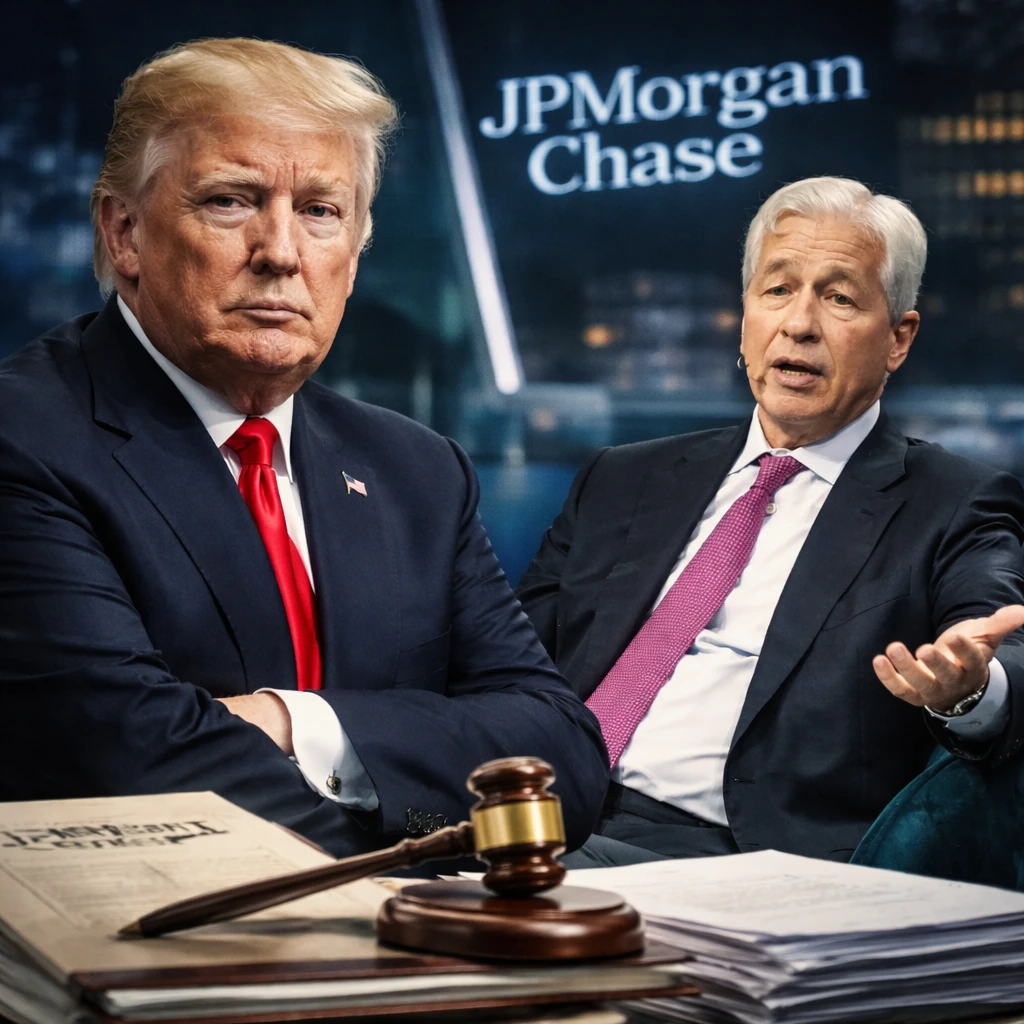

Donald Trump Files $5 Billion Lawsuit Against JPMorgan Chase Over Account Closures Citing Political Bias
January 22, 2026
News & Politics

Donald Trump Files $5 Billion Lawsuit Against JPMorgan Chase Over Account Closures Citing Political Bias

Former President alleges politically motivated debanking by JPMorgan Chase, highlighting broader debates on banking practices post-2021

Summary

Donald Trump initiated legal proceedings against JPMorgan Chase and CEO Jamie Dimon, seeking $5 billion in damages. The lawsuit claims that JPMorgan terminated multiple bank accounts tied to Trump and his businesses shortly after he left the presidency, attributing the closures to political motivations. This legal action underscores ongoing controversies surrounding the banking sector's treatment of politically connected clients and raises questions about the evolving practice of debanking.

Key Points

Donald Trump has filed a $5 billion lawsuit against JPMorgan Chase and CEO Jamie Dimon, alleging politically motivated closures of his and his businesses' bank accounts in early 2021.
The lawsuit contends JPMorgan closed multiple accounts with limited notice and no explanation, impacting Trump's financial operations and prompting urgent account openings elsewhere.
The case illuminates wider controversy over the banking practice of 'debanking,' particularly concerning politically connected clients and the use of 'reputational risk' as rationale for account closures.

Donald Trump has taken legal action against major financial institution JPMorgan Chase and its chief executive, Jamie Dimon, claiming $5 billion in damages for allegedly terminating banking relationships with him and his associated businesses due to political considerations following his departure from office in January 2021.

The suit, filed in Florida's Miami-Dade County court, alleges that in February 2021, JPMorgan summarily closed several accounts associated with Trump on merely 60 days' notice, without offering any rationale. According to the complaint, this action disconnected Trump and his enterprises from access to substantial financial resources, interfering with their operational continuity and compelling them to urgently establish accounts with other banks.

It is asserted in the lawsuit that JPMorgan and Dimon made these decisions based on the belief that prevailing political sentiments favored such measures. The practice described, known as debanking, involves a financial institution closing a customer's accounts or refusing service, which can also encompass withholding lending or other financial services.

Although debanking was once a relatively niche issue within financial services, it has gained prominence amidst political debates, particularly as conservative figures have alleged that banks discriminate against them and related interests. The term gained national attention during the Obama administration through controversies like "Operation Choke Point," which targeted certain industries such as firearm retailers and payday lenders.

Furthermore, following the Capitol breach on January 6, 2021, Trump and other conservatives have contended that banks have preemptively severed financial ties citing "reputational risk" as justification. Measures have since been introduced during Trump's recent tenure to prevent regulatory allowance for banks to deny customers services based solely on such reputational concerns.

Legal representatives for Trump argue that JPMorgan's conduct exemplifies a pervasive, covert banking industry practice aimed at influencing public political alignment by restricting access to financial infrastructure.

Beyond claims of politically motivated closed accounts, the lawsuit brings accusations of trade libel against JPMorgan and charges that CEO Dimon violated Florida's Unfair and Deceptive Trade Practices Act. JPMorgan responded by expressing regret over the litigation but firmly denied any political motivation in its actions. A spokesperson emphasized that account closure decisions are driven by concerns over legal or regulatory risk, not political or religious affiliations.

This case highlights the uncertainties and tensions arising at the intersection of political change and banking sector risk management practices.

Risks
  • Potential reputational and operational risk to clients and financial institutions arising from politically motivated account closures, impacting sector confidence and client access to banking services.
  • Legal and regulatory risks for banks navigating politically sensitive client relationships, potentially affecting their compliance practices and risk management strategies, particularly in commercial banking and financial services.
  • Market uncertainties stemming from politicization of banking practices, possibly leading to increased scrutiny and regulatory interventions impacting credit availability and banking service continuity.
Disclosure
This article is an independent journalistic analysis based solely on the facts presented in the disclosed legal case and public statements by relevant parties. No additional external information or speculation has been introduced.
Search Articles
Category
News & Politics

News & Politics

Related Articles
Partisan Divide Deepens as White House Excludes Democratic Governors from NGA Meeting

The longstanding bipartisan forum of the National Governors Association (NGA) is facing disruption a...

Commerce Secretary Lutnick Clarifies Epstein Island Lunch Amid Scrutiny Over Relationship

Commerce Secretary Howard Lutnick acknowledged having a family lunch with convicted sex offender Jef...

FDA Initiates Review of BHA Food Additive Safety

The U.S. Food and Drug Administration (FDA) has announced plans to conduct a comprehensive reassessm...

Using Fireplace Ashes in Your Garden: Benefits and Considerations

Amidst a notably cold winter leading to increased fireplace use, many homeowners are seeking sustain...