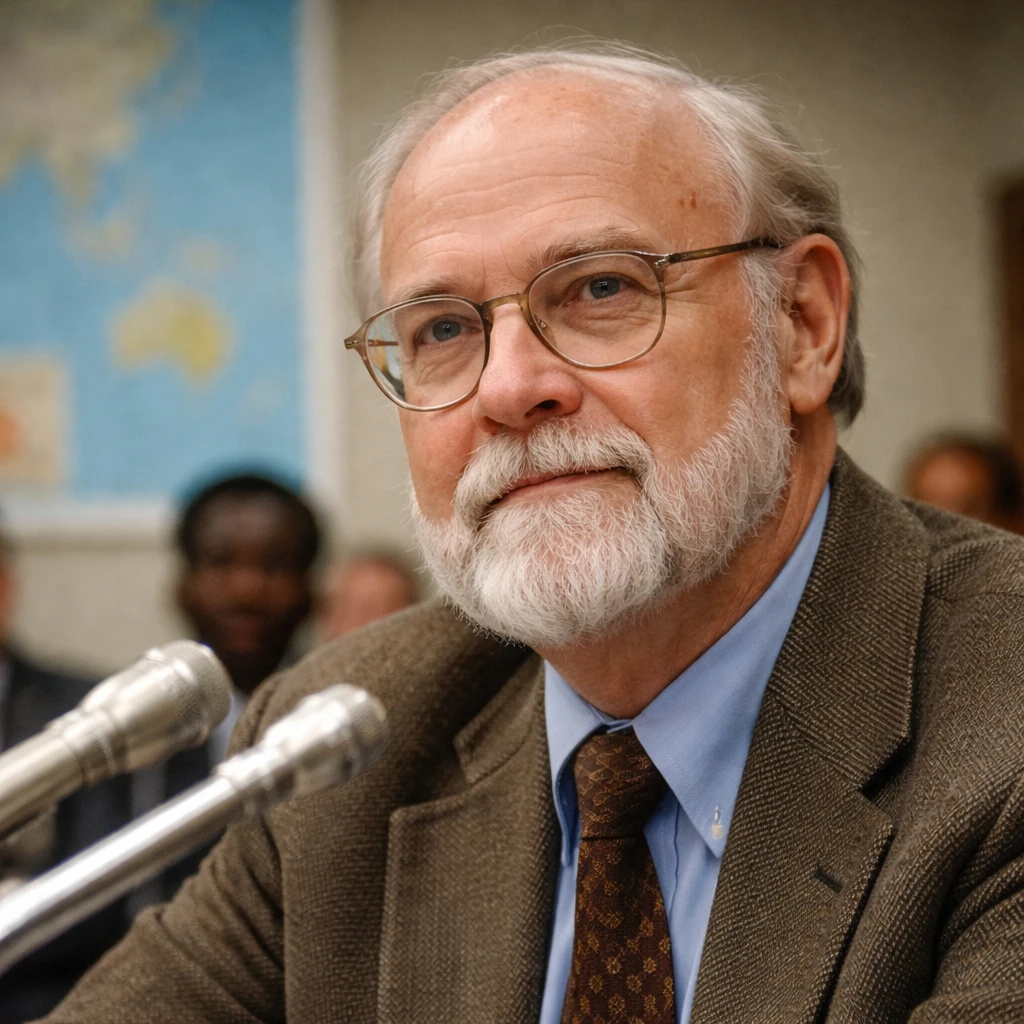

ATLANTA — Dr. William Foege, an influential leader in public health who played an instrumental role in the global eradication of smallpox, passed away in Atlanta at the age of 89, according to a statement from the Task Force for Global Health, an organization he helped establish to promote worldwide health initiatives.
Standing an impressive 2.01 meters (6 feet 7 inches) tall, Foege was distinguished not only by his physical stature but also by his profound intellect and calm demeanor. His remarkable aptitude for confronting infectious diseases marked him as a pivotal figure in public health history.
During the late 1970s and early 1980s, Foege served as Director of the United States Centers for Disease Control and Prevention (CDC), subsequently undertaking numerous leadership roles that shaped international health campaigns and policies.
However, Foege's most significant achievement predates his CDC tenure, rooted in his groundbreaking efforts against smallpox, one of the deadliest diseases ever recorded. Historically, smallpox was responsible for the deaths of roughly one-third of those infected and left many survivors with severe facial scars from pus-filled lesions.
While vaccination programs against smallpox were established and the disease was eradicated from the United States, it persisted elsewhere. Vaccination initiatives globally faced stagnation, leaving many areas vulnerable.
In the 1960s, as a young medical missionary in Nigeria, Foege and his colleagues developed a novel containment strategy known as "ring vaccination." Rather than vaccinate entire populations, this approach involved identifying each case of smallpox and immunizing all individuals who had contact with infected patients, effectively creating a protective barrier around outbreaks.
This strategy critically depended on rapid detection and response, born out of necessity due to vaccine scarcity, as Foege elaborated in his 2011 book "House on Fire," which details the smallpox eradication campaign.
The implementation of ring vaccination proved successful and vital to the ultimate elimination of smallpox. The last known natural case occurred in Somalia in 1977, and by 1980, the World Health Organization officially declared smallpox eradicated worldwide.
Dr. Tom Frieden, former CDC Director, underscored Foege's impact by stating, "If we consider the metric of who has saved the most lives, he belongs in the pantheon. The eradication of smallpox has prevented hundreds of millions of deaths."
Born on March 12, 1936, Foege was the son of a Lutheran minister. His interest in medicine began at age 13 while working in a pharmacy in Colville, Washington. He earned his medical degree from the University of Washington in 1961, followed by a master’s in public health from Harvard University in 1965.
Foege’s leadership extended beyond the CDC, including executive roles with The Carter Center and senior positions at the Bill and Melinda Gates Foundation, influencing global health strategies across various domains.
In 2012, President Barack Obama honored Foege with the Presidential Medal of Freedom, the United States’ highest civilian award. Four years later, Duke University President Richard Brodhead described him as "the father of global health" during the conferral of an honorary degree.
Reflecting on Foege's enduring influence, Dr. Patrick O’Carroll, CEO of the Task Force for Global Health, stated, "Bill Foege was unwavering in his commitment to improving health worldwide through strong coalitions and purposeful science. We strive to honor that dedication in every program we operate daily."