Duke University Initiates Legal Action to Restrict Quarterback Darian Mensah’s Transfer and NIL Contract Negotiations
January 20, 2026
News & Politics

Duke University Initiates Legal Action to Restrict Quarterback Darian Mensah’s Transfer and NIL Contract Negotiations

Legal dispute centers on validity and exclusivity of Duke's NIL contract with star quarterback amidst transfer efforts

Summary

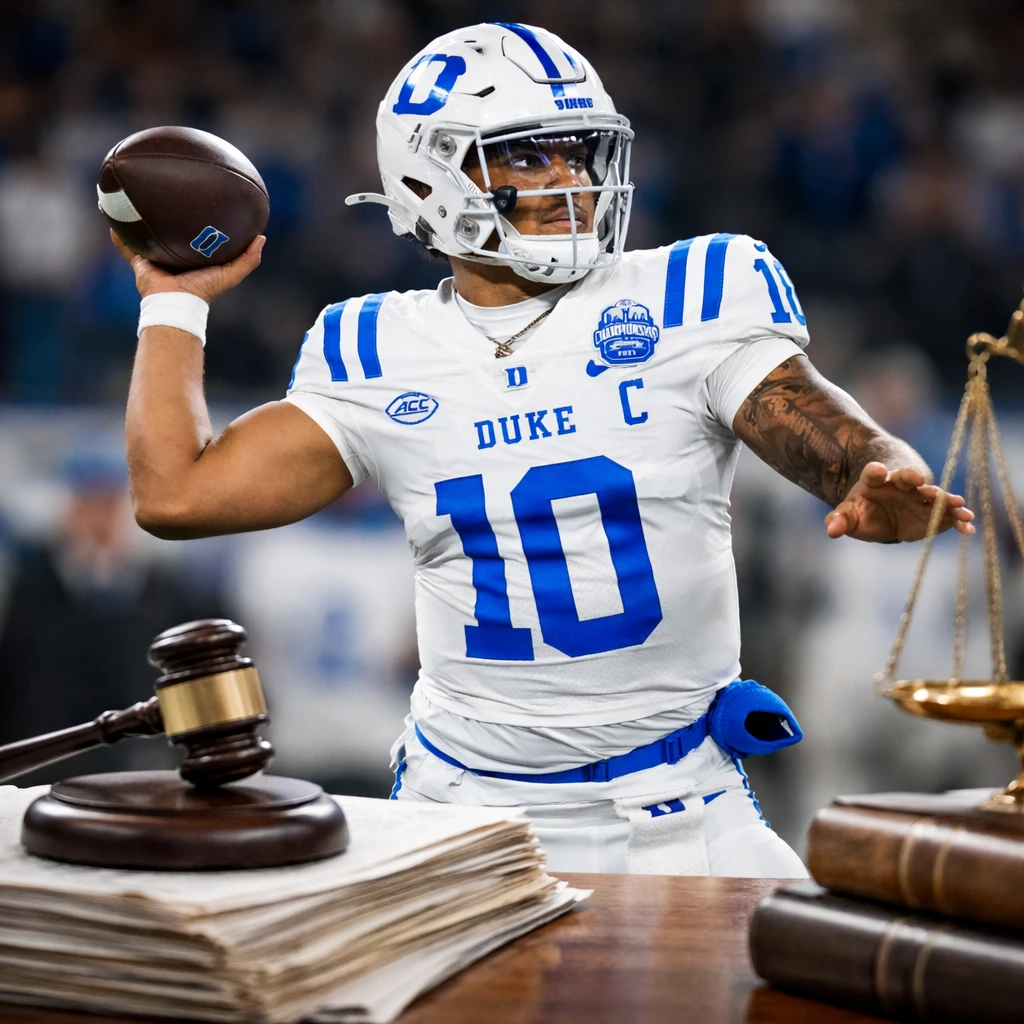
Duke University has initiated a lawsuit against quarterback Darian Mensah to prevent him from transferring to another institution and entering into a new NIL (name, image, and likeness) contract elsewhere. The legal action concerns a two-year exclusive NIL contract Duke claims to hold with Mensah, who recently reversed his decision to remain at Duke after leading the team to an ACC championship. The dispute highlights growing tensions in collegiate athletics surrounding player transfers and NIL agreements.

Key Points

Duke University is pursuing legal action to enforce an exclusive two-year NIL contract with quarterback Darian Mensah, attempting to prevent his transfer and contract negotiations with other schools.
The contract in question was signed in July 2025 and extends through the 2026 season, covering Mensah’s name, image, and likeness rights tied to playing college football at Duke.
The court denied Duke’s initial request to block Mensah’s transfer portal entry but currently bars him from enrolling or playing elsewhere pending a judicial decision expected on February 2.

Duke University has filed a lawsuit against quarterback Darian Mensah aiming to halt his attempts to transfer and sign a contract with another school to continue his college football career next season. The complaint was submitted to the Durham County Superior Court on Monday, following Mensah's unexpected decision to backtrack on his earlier declaration to return to the Blue Devils after spearheading their Atlantic Coast Conference title run.

The lawsuit asserts that Duke’s binding two-year contract with Mensah, inked in July 2025 and extending through the 2026 season, grants the university exclusive rights to market the quarterback’s name, image, and likeness (NIL) associated with playing college football at Duke. Based on this agreement, Duke seeks a temporary restraining order to impede Mensah from entering the NCAA transfer portal and to obstruct any further steps towards engaging with a different program. The university’s legal filing argues that the contract mandates that any disputes undergo arbitration prior to litigation or other resolution methods.

“This case arises out of the decision of a star quarterback in the increasingly complex world of college athletics,” the complaint explains. “But at its core, this is a simple case that involves the integrity of contracts.”

In correspondence with the Associated Press, sports-law attorney Darren Heitner—who has been involved in representation for Mensah—confirmed that the court denied Duke’s initial request for a temporary restraining order blocking Mensah from accessing the transfer portal. However, Heitner later conveyed via social media that Mensah is currently prohibited from enrolling or competing at another institution until the presiding judge issues a ruling following the upcoming hearing scheduled for February 2.

Mensah, who originally transferred to Duke from Tulane University and even competed against his former team, delivered an outstanding performance last season. He ranked second nationally in the Football Bowl Subdivision by amassing 3,973 passing yards and tied for second with 34 touchdown passes.

The current legal confrontation between Mensah and Duke reflects a broader trend emerging in college sports’ evolving NIL and revenue-sharing landscape. Increasingly, student-athletes pursuing transfers face contractual disputes with their current institutions. For instance, earlier this month, Washington quarterback Demond Williams Jr. contemplated a transfer but reversed that decision amid rumors of legal action regarding his NIL contract. Similarly, in December, Missouri pass rusher Damon Wilson II initiated litigation alleging that Georgia’s athletic department was unlawfully penalizing him for entering the transfer portal in January 2025.


Risks
  • Pending judicial ruling on the enforceability of exclusive NIL contracts in the context of player transfers could create legal uncertainty in college sports contract negotiations, affecting athlete mobility and institutional rights.
  • Ongoing disputes over NIL contracts and transfer rights may negatively influence recruiting dynamics and financial planning for college athletic programs, potentially impacting related sectors such as collegiate sports marketing and merchandising.
  • The hesitation or inability of players to transfer freely during legal conflicts may affect team compositions and competitive balance, which in turn could influence revenues tied to college football programs, broadcast rights, and sponsorship deals.
Disclosure
This article is based solely on verified information provided and does not include external speculation or unverifiable assumptions regarding the ongoing legal case or its broader implications beyond reported facts.
Search Articles
Category
News & Politics

News & Politics

Related Articles
FDA Initiates Review of BHA Food Additive Safety

The U.S. Food and Drug Administration (FDA) has announced plans to conduct a comprehensive reassessm...

Partisan Divide Deepens as White House Excludes Democratic Governors from NGA Meeting

The longstanding bipartisan forum of the National Governors Association (NGA) is facing disruption a...

Using Fireplace Ashes in Your Garden: Benefits and Considerations

Amidst a notably cold winter leading to increased fireplace use, many homeowners are seeking sustain...