
TULKAREM, West Bank — For nearly a year, Hanadi Abu Zant has been unable to pay her apartment rent after losing her permit to work inside Israel. When her landlord threatens police intervention, she seeks refuge in a local mosque. "My greatest fear is eviction. Where will we sleep, on the street?" she expressed tearfully.
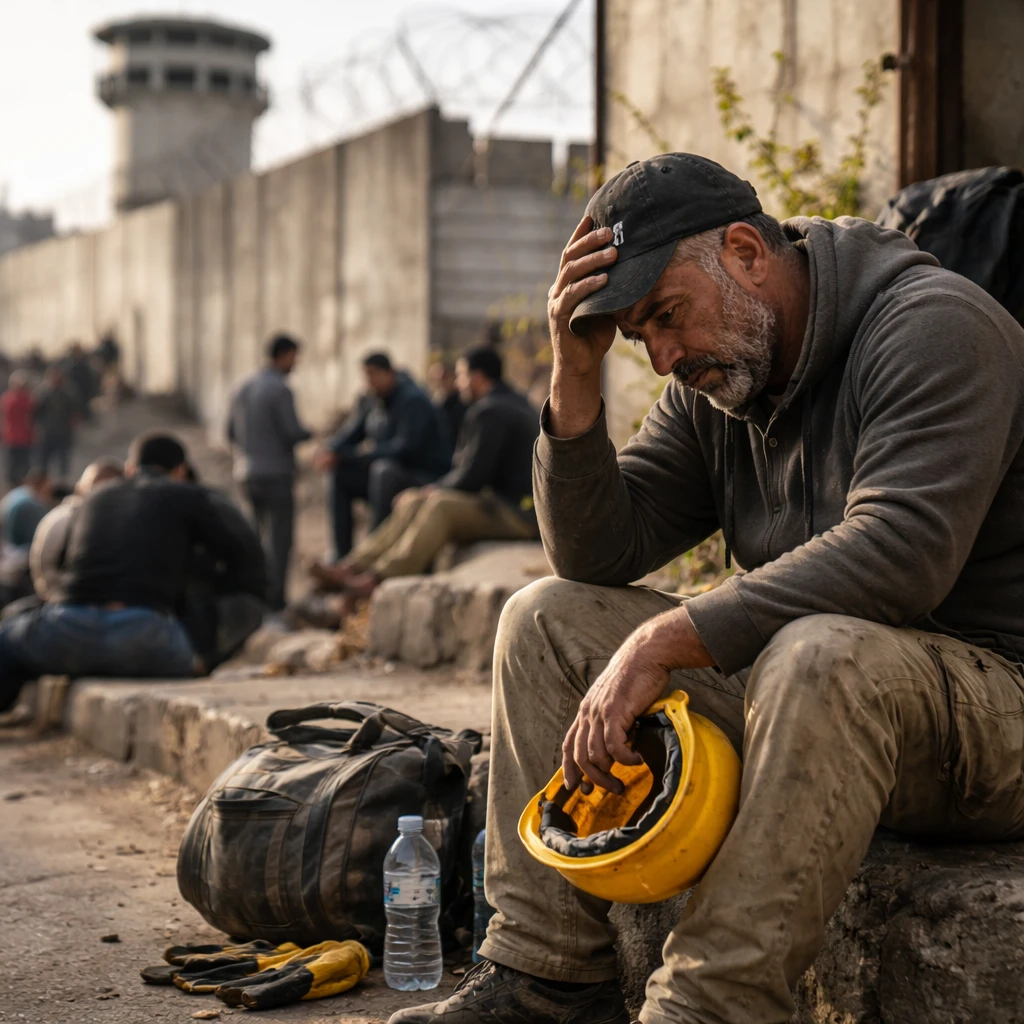
Abu Zant is among roughly 100,000 Palestinians whose work permits were revoked following the Hamas attack on October 7, 2023, which ignited the conflict in Gaza. Confined to the occupied West Bank, where job opportunities are scarce and wages significantly lower, these individuals face increasingly limited and perilous choices amid a worsening economic crisis.
Some have sold personal belongings or incurred debt to finance essentials such as food, electricity, and their children's schooling. Others resort to paying inflated fees for black market permits or clandestinely attempt to enter Israel, risking arrest or worse if mistaken for militants.
Israel, which has administered the West Bank for nearly six decades, maintains that it is under no obligation to grant Palestinians work entry and bases such decisions on security assessments. Nevertheless, thousands of Palestinians still work in numerous Israeli settlements in the West Bank, constructed on land Palestinians claim for a future state.
The World Bank has warned that the West Bank's economic stability is at risk of collapse due to Israeli restrictions. Palestinian Central Bureau of Statistics data shows unemployment rose to almost 30% by late last year, compared to approximately 12% before the conflict.
Before the conflict, tens of thousands of Palestinians found employment inside Israel, mostly in construction and service sectors, receiving wages that often doubled those in the West Bank—a territory constrained by a lack of coastline and decades of Israeli roadblocks, land confiscations, and other limitations affecting economic growth. Palestinians also hold the Palestinian Authority accountable for insufficient job creation efforts.
Since the conflict began, fewer than 10,000 of the revoked permits have been restored, according to Gisha, an Israeli group advocating for Palestinian freedom of movement.
The wages earned in Israel funneled approximately $4 billion into the Palestinian economy in 2022, according to the Institute for National Security Studies (INSS), equating to nearly two-thirds of the Palestinian Authority’s budget that year.
An Israeli official, speaking on condition of anonymity, emphasized that Palestinians do not have an inherent right to enter Israel and that permits depend on security considerations.
Israel captured the West Bank, Gaza Strip, and East Jerusalem during the 1967 Six-Day War, territories Palestinians seek for a future state. About three million Palestinians live in the West Bank alongside over 500,000 Israeli settlers who move freely.
The Gaza war has increased Palestinian attacks on Israelis, as well as violence by settlers. According to Israeli authorities, military operations targeting armed groups have led to substantial damage and displacement of tens of thousands of Palestinians in the West Bank.
Hanadi Abu Zant secured employment in an Israeli food packaging plant earning roughly $1,400 monthly after her husband left her five years ago, supporting her four children. She initially believed the work ban after the conflict outbreak would last only a few months and supplemented income by baking for friends.
Hasan Joma, who ran a business in Tulkarem matching Palestinians with Israeli jobs pre-war, reports that intermediaries are charging triple the usual price for permits.
While no exact figures are available, it is estimated tens of thousands of Palestinians work illegally in Israel, according to Esteban Klor, an economist at the Hebrew University and senior researcher at INSS. Some risk their lives attempting to cross Israel’s separation barrier—a complex structure of nine-meter concrete walls, fences, and military roads.
Shuhrat Barghouthi shared that her husband has been imprisoned for five months after trying to scale the barrier to reach work in Israel. Before the war, the couple earned about $5,700 monthly in Israel. Now, unemployed, they face debts around $14,000.
"Come see my refrigerator, it’s empty; there is nothing to feed my children," she said. She cannot afford heating or rent, which has gone unpaid for two years. Common illnesses afflict her children, who often go to sleep hungry. Occasionally, the landlord has thrown their belongings into the street while trying to evict them.
Regarding Palestinian labor in Israeli settlements, roughly 48,000 worked in these areas before the conflict, with over 65% retaining their permits, according to Gisha. Palestinians and most of the international community regard these settlements, which have rapidly expanded recently, as illegal under international law.
Israeli officials did not respond to inquiries about the rationale behind allowing more Palestinians to work in settlements.
Palestinians employed there, speaking anonymously due to fear of reprisal, report heightened security measures since the conflict and note an increased propensity of employers to terminate employment for minor infractions amid a surplus of desperate workers.
Two workers in the Mishor Adumim settlement noted that security personnel inspect workers’ phones and arbitrarily revoke permits.
In response to reduced Palestinian labor, Israeli employers have turned to foreign workers, who are costlier and often lack language proficiency, contrasting with Palestinians who frequently speak Hebrew fluently.
Israeli developer Raphael Dadush noted the restrictions have caused costly delays. Palestinians made up over half of his workforce before the conflict. Attempts to replace them with Chinese workers have proven less than ideal. He respects the government’s security concerns but advocates for solutions to reintegrate Palestinian workers.
Assaf Adiv, head of an Israeli group promoting Palestinian labor rights, warned of inevitable "chaos" without economic integration. "The alternative to working in Israel is hunger and despair," he said.