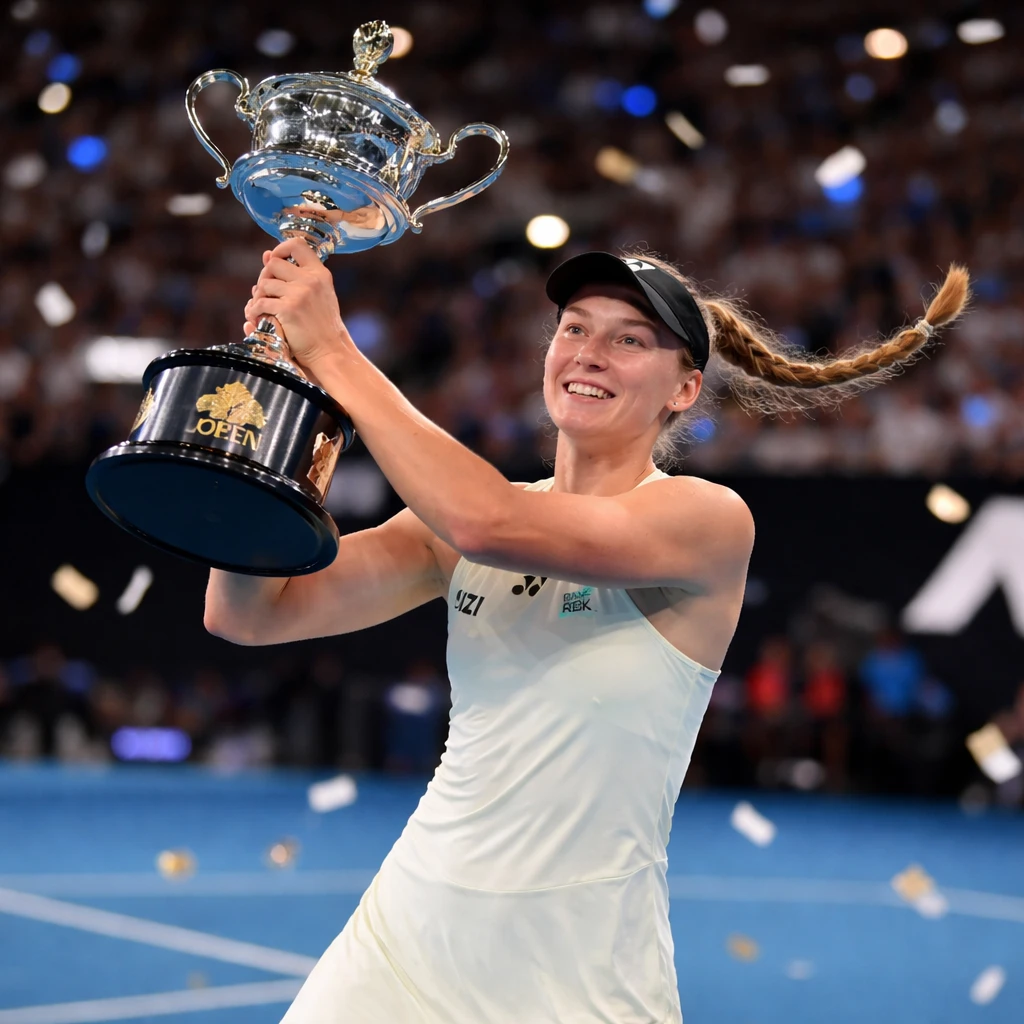
Elena Rybakina, the 26-year-old tennis player representing Kazakhstan, achieved her second Grand Slam triumph at the Australian Open on Saturday by defeating world number one Aryna Sabalenka. The final, held in Melbourne, saw Rybakina overcoming a formidable opponent who had previously bested her in the same final four years prior.
Despite not exhibiting outward signs of tension, Rybakina acknowledged the intense emotions experienced within during the match, particularly as it culminated in a decisive ace serving to close the third set. The final scoreline read 6-4, 4-6, 6-4.
Born in Moscow but competing under Kazakhstan’s banner, Rybakina emphasized the significance of the moment and the necessity of capitalizing on her serving opportunities, stating that serving out the match was the advantage she held at the critical juncture.
This victory came shortly after a challenging semifinal against Jessica Pegula, where Rybakina faced pressure while serving out the match — requiring nearly thirty minutes and overcoming two breaks of serve to secure victory.
Reflecting on her previous experience in the Australian Open final four years prior, where she won the first set but ultimately lost in three sets, Rybakina demonstrated improved resilience. After taking the initial set in the current final, she rebounded from losing the second set and falling behind 3-0 in the decider to win five consecutive games and regain control of the match.
Expressing relief and renewed confidence following the win, Rybakina regarded the achievement as a valuable foundation for the remainder of the tennis season.
Entering the tournament as the fifth seed, Rybakina now holds two major titles, the first being Wimbledon in 2022. Her opponent, Aryna Sabalenka, had previously accrued three additional major championships since that 2020 Australian Open final, including consecutive titles at the Australian Open and U.S. Open in subsequent years. Prior to this match, Rybakina had not reached another major final until the current tournament.
A turning point in Rybakina’s career was her win against Sabalenka at the WTA Finals in November of the previous year. Since Wimbledon, she has amassed 20 wins out of 21 matches, establishing formidable form heading into the final.
Commenting on her season, Rybakina noted a slow start but expressed optimism about maintaining her momentum and working effectively with her team.
Her current streak includes ten consecutive wins against Top 10 ranked players, and this latest title propels her to a ranking position of No. 3 globally.
Following the match, the Kazakhstan flag was prominently displayed on the Rod Laver Arena court during Rybakina’s trophy celebration and photo session with her support team.
Rybakina credited her coach, Stefano Vukov, who faced a suspension last year, acknowledging his role in refining her game. Vukov was honored by the tournament organizers with a silver plate as recognition for his contribution. She reflected on their partnership since 2019, highlighting the value of his ongoing tactical guidance and encouragement during matches.
“He knows me very well,” said Rybakina. “My whole team, I’m very grateful and thankful to them. We had great results before. A little bit it was down last year. (Now) we managed to turn it around.”
For Sabalenka, this loss marked consecutive defeats in the Australian Open final, having been previously upset in the championship match by Madison Keys the year before. She expressed regret over a quick momentum shift in the third set where she lost a 3-0 lead, which altered the match trajectory significantly. Despite this, Sabalenka remains hopeful for future successes in the ongoing season.
Throughout the final, Rybakina’s game was characterized by aggressive play and a commanding serve, delivering six aces. Apart from brief lapses that led to lost service games at the end of the second and beginning of the third sets, she effectively countered six break point opportunities.
>Sabalenka’s intensity was evident through her vocalizations and self-motivation during the match, yet Rybakina maintained a calm and focused demeanor, allowing her serving and return strategies to dictate the contest’s outcome.
The match concluded with a sportsmanlike exchange at the net, where both athletes shared a hug, and Rybakina celebrated her victory by applauding her racket strings before raising her arm to acknowledge the crowd.