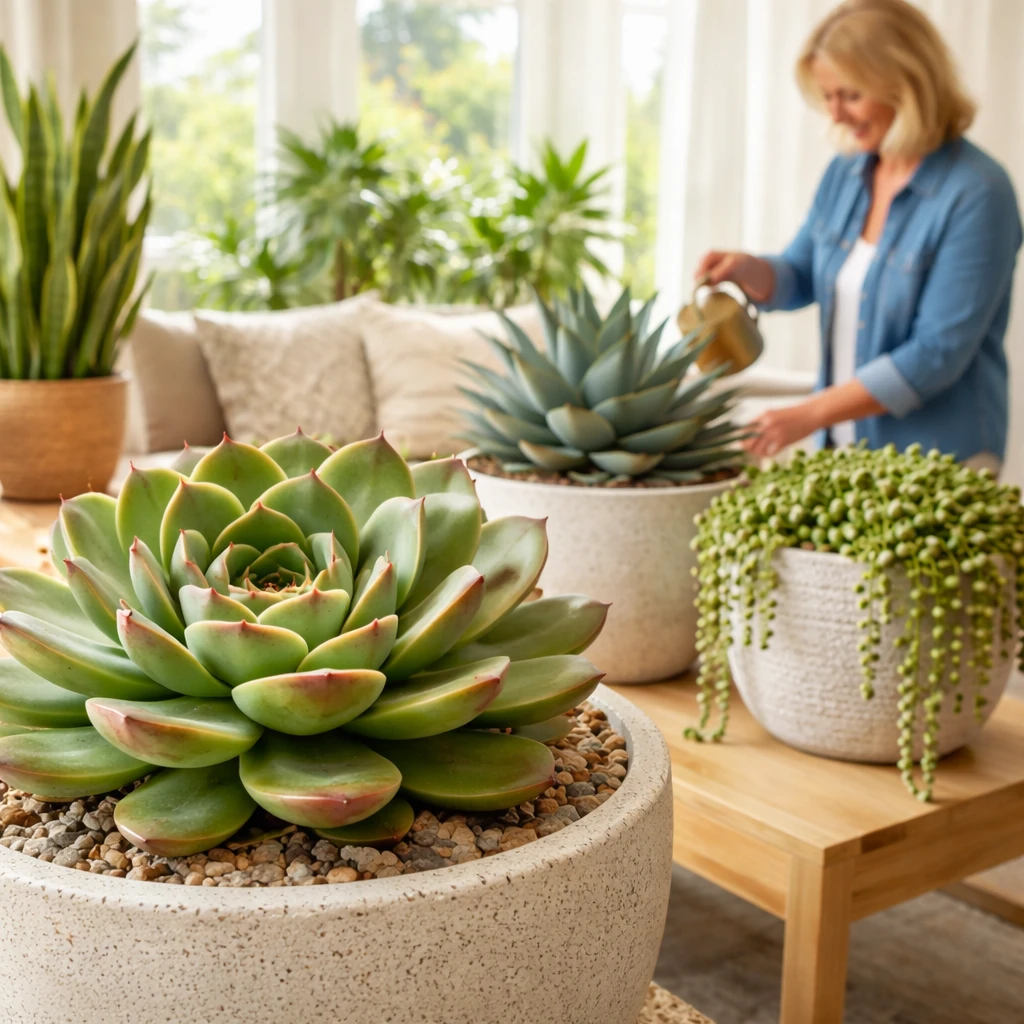

Indoor succulent gardening is often associated with compact arrangements of small drought-resistant plants nestled in shallow dishes, displaying hues of green, red, and purple. Yet for those seeking to replicate the expansive warmth of desert terrain within cooler indoor environments, a grander approach is gaining attention. Marylee Pangman, a Tucson-based garden educator and writer renowned for her expertise in desert container cultivation, advocates embracing large and striking succulents for indoor spaces.
“I recommend selecting a single statement succulent undertaking as a starting point,” advises Pangman, who has designed and maintained hundreds of gardens across southern Arizona. “Mastering one plant builds gardening confidence, paving the way for a broader collection later.”
Options for sizable succulent specimens include the snake plant (Sansevieria trifasciata), notable for its towering, tongue-shaped green and yellow leaves that can reach the ceiling when potted in a tall ceramic floor planter. Another impressive choice is the African milk tree (Euphorbia trigona), which grows upright with multiple branches and can extend up to 6 feet (1.8 meters) indoors.
Succulents, encompassing various cacti subspecies, have fleshy tissues designed to conserve moisture, making them well-suited for indoor environments. Their diversity in form and scale allows larger structural varieties to become focal points within a room’s décor.
Pangman emphasizes succulents as ideal plants for those with demanding schedules or retirees preferring visually enjoyable yet low-effort gardening. Compared to thirstier houseplants, succulents generally tolerate lower light and require infrequent watering—often just once every two to four weeks.
“They are especially accommodating for individuals who travel frequently,” notes Pangman.
Pangman’s journey into succulent cultivation began after relocating to Tucson in 1996 from upstate New York to avoid harsh winters. With no prior gardening experience, she rapidly became a master gardener within two years and launched "The Contained Gardener," a business focused on potted landscape design. After eventually selling the business, she now disseminates her knowledge through writing, including her book "Getting Potted in the Desert," and offers online classes via her platform and the Tucson Botanical Garden.
For those aiming to cultivate large succulents indoors, Pangman offers detailed recommendations:
Plant Selection Based on Light Conditions
- High light/south-facing areas: Vertical and architectural species like medicinal aloe vera, which attains heights of 2 to 3 feet (0.6 to 0.9 meters), thrive here. Agaves such as fox tail (Agave attenuata), with its sculptural rosettes that can expand 3 to 4 feet (0.9 to 1 meter) wide, are also suitable, alongside variants like Queen Victoria agave and Blue Elf aloe hybrid that perform well in compact residences.
- Medium light/east- and west-facing zones: Dramatic plants like African milk tree (Euphorbia trigona), the classic jade plant (Crassula ovata), felt bush (Kalanchoe beharensis) with its velvety foliage, and Aeonium arboreum, which produces rosette clusters on woody branches, flourish under these lighting conditions.
- Lower light/north-facing spots: Hardy snake plants (Sansevieria trifasciata) and shade-tolerant gasteria varieties with dagger-shaped leaves are recommended. The smaller zebra plant (Haworthia fasciata) creates an impact when grouped. Though not a true succulent, the ZZ plant (Zamiifolia), known for its glossy leaves and stems, adapts to low-light settings and infrequent watering.
Potting Advice
Large succulent plants need ample containers, ideally between 18 to 22 inches (46 to 56 centimeters) in diameter and 16 to 18 inches (41 to 46 centimeters) deep. Pangman advises against plastic pots, favoring breathable terracotta, glazed ceramic, or lightweight resin pots equipped with drainage holes. Utilizing wheeled plant stands can protect flooring from the weight of the pots, facilitate rotating plants to ensure even light exposure, and enable easy relocation outdoors during spring.
Soil and Top Dressing
Choosing gritty, well-draining soil is crucial. Pangman recommends sourcing commercial cactus and succulent mixes from local nurseries or home improvement stores. To accentuate aesthetics and assist moisture management, adding a top dressing of colored recycled glass, gravel, or smooth river stones over the soil is beneficial.
Lighting and Placement
Succulents should be placed away from windows, ideally 3 to 5 feet (0.9 to 1.5 meters) inside the room. Rotating pots is valuable for plants near east- and west-facing windows, ensuring all sides receive sunlight. Insufficient light is indicated by pale coloration and stretched growth, while excessive light can cause sunburn manifesting as brown or white patches.
Watering
Overwatering poses the greatest threat to succulents. Typically, watering once every two to four weeks suffices. Larger pots retain moisture longer; thus, testing soil moisture 2 to 3 inches (5 to 8 centimeters) below the surface with a moisture meter before watering helps prevent soggy conditions. When watering is necessary, do so until water drains from the bottom.
Further Resources
In addition to Pangman’s educational materials, local resources such as nurseries, home improvement centers, community colleges, agricultural extension offices affiliated with public universities, and county government programs can provide additional gardening guidance.