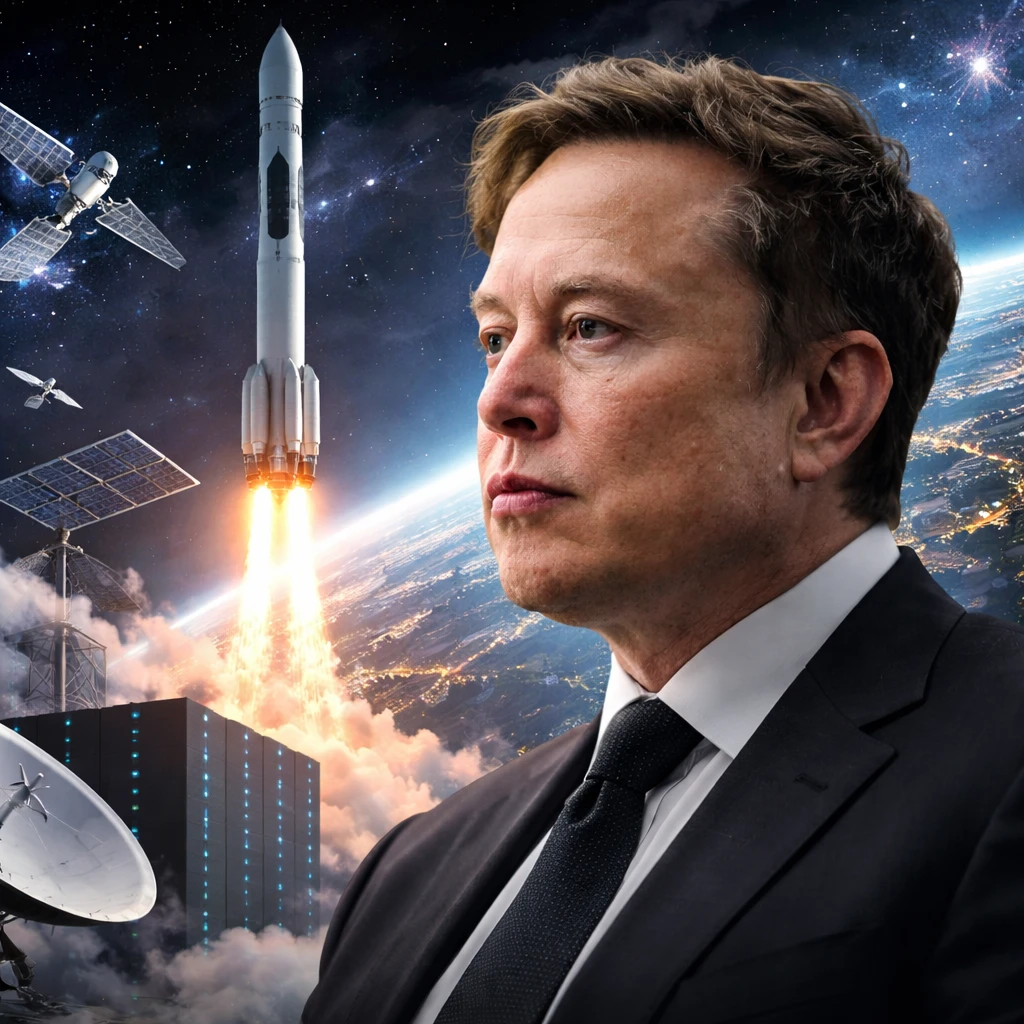
Elon Musk is moving forward with plans to merge his space exploration and artificial intelligence businesses into one company, in anticipation of a major initial public offering later this year. On Monday, SpaceX disclosed its acquisition of xAI, an AI company founded by Musk, to establish a more integrated presence across his range of tech enterprises. This merger will blend various Musk ventures, including the AI chatbot Grok, Starlink satellite communications, and the social media platform now known as X.
Musk has repeatedly underscored the necessity of accelerating development of technologies that would enable data centers to operate in space. According to him, this shift could alleviate the immense expenses related to energy consumption and other resource requirements inherent in running artificial intelligence infrastructures on Earth.
He suggested that such objectives might be more achievable under a unified corporate structure. On SpaceX's website, Musk stated, "In the long term, space-based AI is obviously the only way to scale," highlighting the advantage of constant solar energy in orbit by adding, "It's always sunny in space!"
Further detailing his vision, Musk projects that within two to three years, operating AI compute capabilities from space will be the most cost-effective approach. This ambition situates SpaceX in competition with Google’s Project Suncatcher, which aims to deploy solar-powered satellites equipped with AI chips, with a prototype potentially launched as early as next year.
Despite Musk's forecast, skepticism exists among other major technology companies. Microsoft’s president, Brad Smith, expressed doubt about a move from terrestrial to orbital data centers, anticipating that such a transition is unlikely in the near future.
In the AI sector, Musk faces significant competition, including from OpenAI, which he once co-founded and which is reportedly preparing for its own IPO. Musk's disapproval of OpenAI contributed to his creation of xAI and development of Grok as an alternative platform.
Simultaneously, Tesla, another of Musk’s enterprises, is steering towards an increased focus on autonomous taxis and humanoid robots powered by artificial intelligence, reflecting a strategic pivot away from slowing vehicle sales. Tesla recently announced a $2 billion investment in xAI, reinforcing the interconnectivity of Musk's ventures.
Musk has a history of consolidating his companies, as seen when Tesla acquired SolarCity approximately a decade ago and more recently, xAI acquired the social media company X, formerly Twitter. Speculation on Wall Street has intensified around the potential for further integrations, including a possible merger of Tesla with SpaceX, hinting at a broader conglomerate sometimes referred to informally as Musk Inc.
According to Forbes, Musk’s net worth is estimated at $768 billion. Beyond his flagship companies, he also owns Neuralink, a brain-machine interface startup, and the Boring Company, focused on tunnel infrastructure.
The financial terms of the SpaceX acquisition of xAI have not been publicly disclosed. Notably, the investment firm 1789 Capital, where former President Donald Trump’s son Don Jr. is a partner, has invested over $1 billion across various Musk enterprises within the past year, including SpaceX, xAI, and X, with some of those holdings having been liquidated.
While advancing plans for space-based AI data centers, xAI is simultaneously expanding terrestrial infrastructure. Officials in Mississippi recently announced that xAI intends to invest $20 billion to develop a data center near the Tennessee border. This facility, named MACROHARDRR, marks the company’s third data center in the Memphis regional area.
Musk has also expressed hopes that his combined company might contribute to a broader goal of human colonization of other planets as a safeguard against potential natural or anthropogenic disasters on Earth. At the recent World Economic Forum in Davos, Musk described humanity as "a tiny candle in a vast darkness, a tiny candle of consciousness that could easily go out," underscoring his motivation for these ventures.