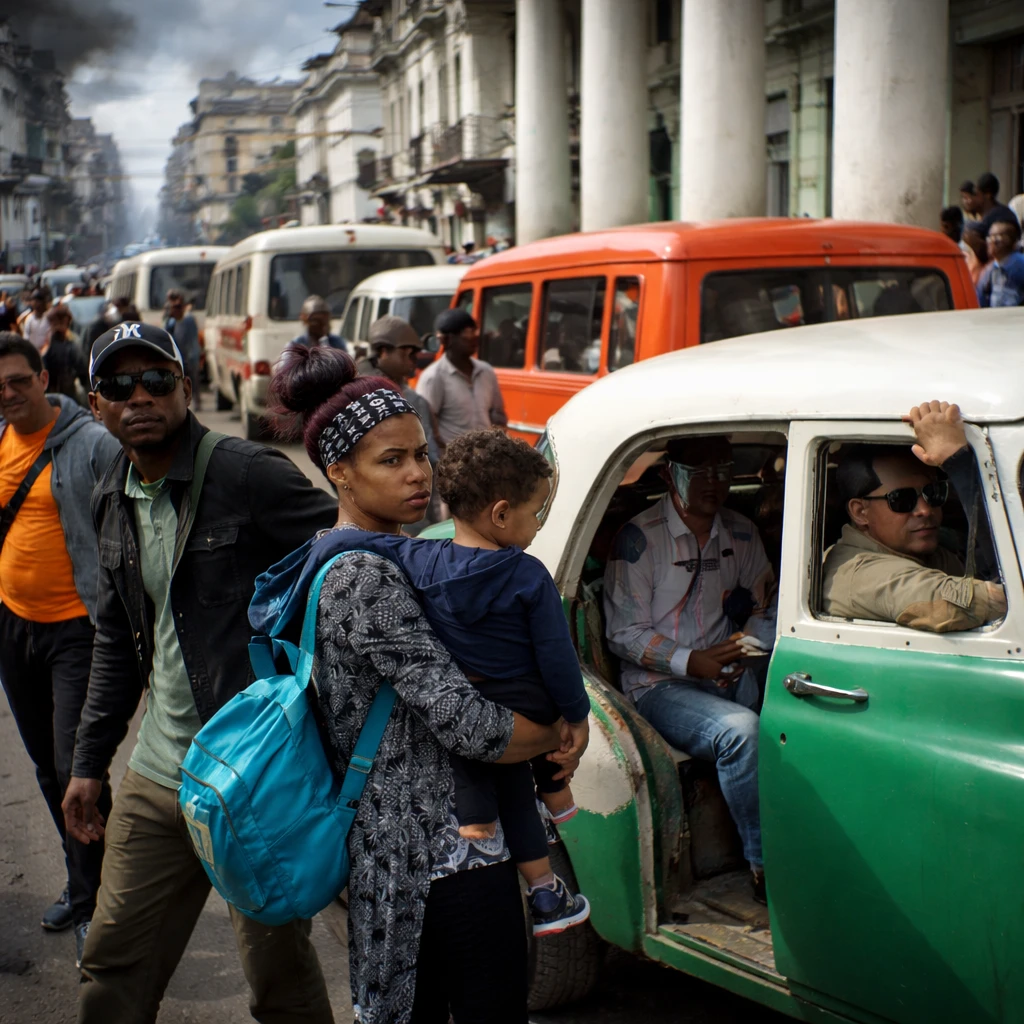
In Havana, the worsening energy shortage became palpable when Solanda Oña, a 64-year-old bookseller, found herself unable to board the usual bus from her affluent coastal district back to her modest neighborhood in the city's working-class center. For the first time, the public transportation she relied on failed to appear, forcing her to spend the night in a nearby restaurant. This experience, she fears, signals a new reality if fuel scarcity continues unchecked.
On the day following Cuban President Miguel Díaz-Canel's announcement about the severe impacts of U.S. actions aimed at obstructing oil supplies, tensions ran high throughout Havana. The president urged the population to brace for sacrifices to mitigate the worsening conditions caused by these restrictions.
Many Cubans, grappling with years of mounting economic difficulties, responded with uncertainty and concern over what further hardships could be borne. Oña herself expressed deep apprehension, lamenting that whereas there had previously been at least one reliable bus to commute home, now none was available.
By the morning of the following day, residents of Havana's working-class neighborhoods such as those frequented by Oña witnessed clear manifestations of the unfolding crisis. Public buses, already unreliable, ceased operation entirely, stranding passengers for prolonged periods. In response, many resorted to walking long distances or hitchhiking to reach their destinations. Meanwhile, shortages of gasoline and frequent power outages—longstanding issues on the island—have intensified as U.S. President Donald Trump increased pressure on Cuba through a series of stringent policies.
The recent executive order signed by President Trump threatens tariffs on nations supplying oil to Cuba, exacerbating the island's critical energy predicament. In direct response, Cuba's national transportation agency announced a reduction in service routes in the eastern provinces. The University of Havana also declared cancellations of select events and an expansion of remote learning options, attributing these changes to persistent energy deficits.
Despite these disruptions, much of Havana's urban life persisted, with schools, financial institutions, bakeries, and retail outlets remaining operational. Some private transport modes, including taxis and employer-organized shared electric motorcycles, continued functioning to alleviate mobility challenges. However, the elevated costs of taxi services remain prohibitive for many Cubans subsisting on government wages averaging below $20 monthly.
Concurrently, the U.S. pledged $6 million in aid to Cuban citizens on the evening following the president's warning, though overall the severance of primary energy inflows has substantially impacted the civilian population. Cuba's domestic oil production covers only around 40% of its consumption requirements.
The Cuban government attributes financial losses exceeding $7.5 billion between March 2024 and February 2025 directly to U.S. sanctions, significantly surpassing the previous year’s impact. The energy crisis intensified further after Venezuela halted its oil shipments in January, coinciding with a U.S. military operation that resulted in the capture of Venezuela’s then-President Nicolás Maduro. Subsequently, historic ally Mexico also ceased its oil exports to Cuba late in the same month.
As a consequence of these developments, Cubans increasingly compare the current economic hardships to the severe downturn experienced during the 1990s Special Period, which followed abrupt reductions in Soviet aid.
"What does it mean to not allow a single drop of fuel to reach a country?" President Díaz-Canel asked rhetorically, highlighting the multifaceted effects on transportation of food, production industries, public transit, healthcare services, educational institutions, and tourism sectors.
For individuals like Cristina Díaz, a 51-year-old mother of two working as a house cleaner, the answer lies in adapting to the scarcity by walking to work. She observed many residents undertaking long walks alongside roadways in Havana, reflecting broad societal adjustments to constrained transportation options.
"We’re living as best we can," Díaz said. "What can I do? I live here, I was born here, and this is my lot. I have to walk to get to work and to be able to feed my children."
Images across the city depict citizens utilizing bicycle taxis and other alternative means to navigate the disrupted urban environment. Nevertheless, the overarching dependence on stable energy supplies remains a critical underpinning for Cuba's economy and social welfare.