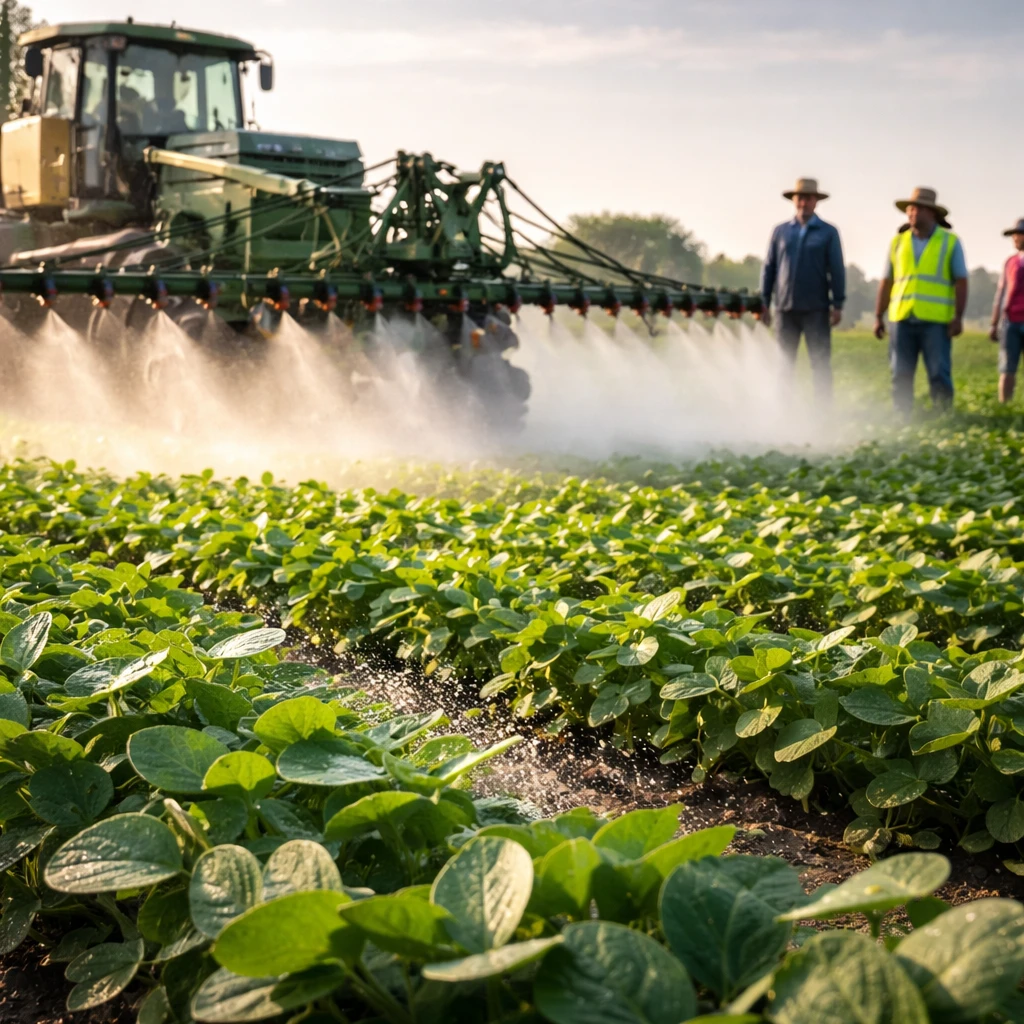

The Environmental Protection Agency (EPA) announced on Friday the reauthorization of dicamba, a widely used herbicide, for application on genetically modified soybean and cotton crops. Dicamba, known for its ability to target weeds without damaging specific engineered crops, has faced intense scrutiny due to its propensity to drift beyond intended fields and damage surrounding vegetation.
In explaining its decision, the EPA highlighted the essential role that dicamba plays for farmers contending with rapidly evolving weed populations that threaten crop viability. Recognizing the associated risks, the agency has implemented rigorous safeguards and application restrictions designed to minimize unintended impacts.
Dicamba's longstanding presence in agricultural use has increased significantly in recent years, becoming more prevalent across American farmland. Despite its established history, this surge in usage has reignited debates over environmental safety and agricultural sustainability.
Environmental advocacy groups have criticized the EPA's renewed approval, pointing to judicial decisions in 2020 and 2024 that rejected comparable authorizations. These groups assert that broadening dicamba application to soybean and cotton crops will lead to extensive use and heightened harm to non-target plants.
Kelly Ryerson, an activist affiliated with the Make American Healthy Again (MAHA) movement — a group noted for its tentative political alignment with the Trump administration — expressed disappointment with the EPA’s latest ruling. Ryerson underscored her primary objective of permanently discontinuing over-the-top (post-emergence) applications of dicamba, arguing that the newly imposed restrictions fall short and perpetuate the cycle where farmers are caught in continuous chemical dependency.
Responding to critiques, the EPA emphasized the necessity of supporting growers reliant on this herbicide, clarifying that the issue transcends political divides like those represented by MAHA. The agency acknowledged the validity of concerns surrounding dicamba drift and stated that measures such as restricting application volumes per acre, limiting use during high temperatures, and enforcing buffer zones have been established to protect neighboring crops.
According to the EPA, adherence to these guidelines allows for the herbicide's effective use without posing significant threats to human health or environmental stability.
The American Soybean Association welcomed the EPA's directive, citing the establishment of clear regulatory parameters as beneficial for agricultural planning and the management of invasive weed species ahead of the forthcoming planting season.
Conversely, environmental organizations highlighted the extensive damage caused by dicamba drift, pointing to significant losses in vegetable crop areas, orchards, and other plant communities vital for ecological balance.
Nathan Donley, the Environmental Health Science Director at the Center for Biological Diversity, criticized the administration for prioritizing the pesticide industry's interests at the potential expense of public health and environmental protection.
Critics insist that the EPA’s application restrictions inadequately limit the frequency and duration of dicamba use. They argue that the buffer zones designed to prevent chemical drift have already demonstrated insufficient efficacy.
Scientific investigations into dicamba’s health effects continue, with a 2020 study published in the International Journal of Epidemiology associating exposure to this herbicide with increased risks of certain cancers, such as liver cancer and leukemia affecting blood and bone marrow.
Bayer, a producer involved in the manufacture of dicamba, indicated that the federal approval permits them to pursue state-level authorizations. The company also plans to roll out training programs for pesticide applicators in the upcoming weeks to ensure proper use.
The decision reflects ongoing tensions between agricultural needs and environmental concerns, underscoring the complex regulatory landscape governing pesticide application amid evolving scientific and public health data.