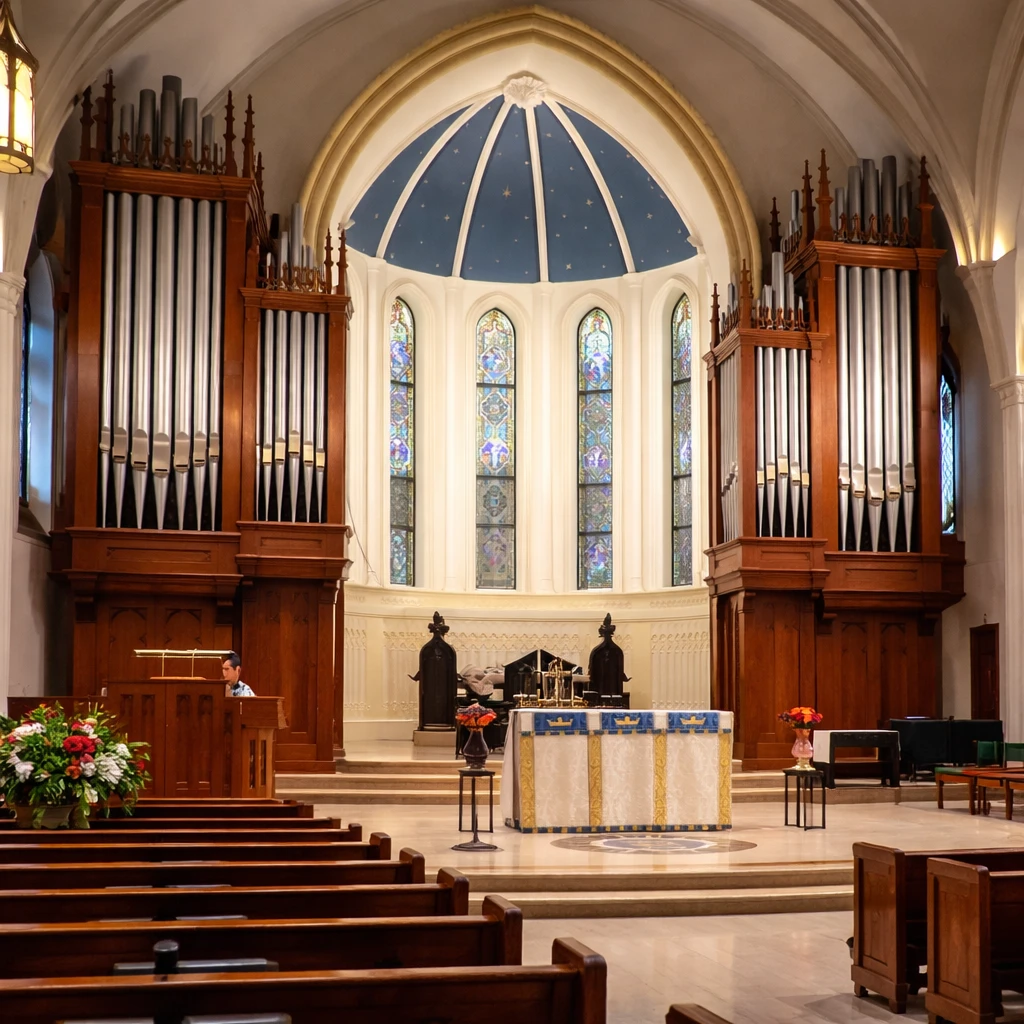
On a warm day in August, a 53-foot truck bearing a freshly handcrafted pipe organ arrived from Utah at the Church of the Epiphany, located on Manhattan’s Upper East Side. The delivery was met with ceremonial reverence, including holy water, incense, and the playful sound of slide whistles. Clergy members climbed aboard the truck’s loading dock, donning stoles to bless the organ as approximately 30 parishioners celebrated with bursts of confetti. This celebration prefaced a prolonged effort involving community members of all ages lifting the organ’s heavy pipes and components up to the church’s second-floor sanctuary. The 600-pound organ console was the most formidable piece, requiring over 30 minutes to maneuver up an external staircase with the help of both builders and parishioners.
Denise Cruz, a vestry member and speech pathologist, remarked on the organ’s role in uniting the church’s diverse membership through this communal endeavor.
Despite a national trend of dwindling church attendance and a decreasing number of professional organists, some congregations remain committed to integrating new pipe organs into their worship spaces to enrich spiritual experiences and attract community members. The Church of the Epiphany’s latest organ joins a number of recent installations in New York City, like those at Trinity Church and St. Thomas Church, emphasizing the persistence of traditional music in contemporary worship.
For the Rev. Matthew Dayton-Welch, the new organ embodies more than improved acoustics; it signifies the culmination of a $70 million project to relocate and expand the church community. With the organ itself costing $2.5 million, the investment speaks to the church’s thriving and optimistic outlook rather than retrenchment.
Dayton-Welch contrasted Epiphany’s approach with many churches that reduce their footprint due to shrinking congregations. Instead, Epiphany opted for growth, making a deliberate and strategic move within the city. Initially located on York Avenue, the parish sought a larger space and identified the former Jan Hus Presbyterian Church a block west as the new site, a shift the rector described as momentous. However, the transition was unexpectedly complicated by leadership changes and structural challenges.
The departure of the church’s former rector, the Rev. Jennifer Anne Reddall, to a bishopric in Arizona set the stage for an unplanned search for new leadership. Furthermore, a 2020 site excavation revealed the presence of an underlying natural creek, necessitating extensive redesign of the building’s foundation to mitigate flooding risks.
Congregants like Christian Vanderbrouk noted the hardships endured, including flooding in the church basement, the devastating impact of the COVID-19 pandemic on the local neighborhood—marked by the grim presence of refrigerated morgue trucks—and a fire incident in 2021 caused by overheated rafters.
Dayton-Welch summarized the church's recent history as having endured “a flood, a fire and a plague.” By the time he arrived in 2023, the congregation had officially relocated to East 74th Street.
Amid these challenges, the church commissioned Bigelow & Co. Organ Builders in American Fork, Utah, in 2020 to construct a custom organ tailored to the new sanctuary’s needs. Michael Bigelow, company founder and a member of The Church of Jesus Christ of Latter-day Saints, operates his workshop in a former LDS church with high ceilings conducive to organ fabrication.
During an April visit to Bigelow’s workshop, the construction of mechanical tracker systems—integral components that open air valves underneath each pipe—was underway. The Epiphany organ employs mechanical tracker action rather than the common electric-action design, emphasizing a traditional approach to organ mechanics.
Initially designed with a robust German tonal character emphasizing volume, the organ was subsequently adapted to better suit Anglican liturgical style based on church leaders’ feedback. This resulted in modifications such as replacing neo-Baroque stops with more expressive options, including the addition of a Flute Celeste stop, known for its ethereal, shimmering sound quality.
Organ voicing—a meticulous process involving adjusting pipe lengths, openings, and edges to fine-tune sound quality—was led by David Chamberlin, Bigelow’s tonal director and an accomplished organist himself. The precise crafting aims to spiritually uplift and enrich listeners.
By late summer, the organ was carefully dismantled and transported to New York. Preparing the church for its installation involved significant modifications, including resetting electrical systems, calibrating temperature and humidity controls, and creating new air pathways through the building’s historic brick walls to ensure adequate airflow for the instrument.
The church and organ were designed concurrently, a strategic choice allowing the room and instrument to function harmoniously, with the architectural space considered an extension of the organ itself. The church leadership views the organ not only as a source of worship music for the regular 60–80 weekly attendees but also as a tool for community engagement beyond typical services.
Church programs, such as ongoing Wednesday night dinners for vulnerable populations and college students, exemplify Epiphany’s dedication to community service. The music program is viewed as a way of fostering belonging and connection among diverse groups.
Alex Nguyen, who took on the role of director of music in September, plans to broaden the organ’s appeal beyond traditional recitals. His vision includes events blending genres like jazz and multimedia presentations and interactive activities to cultivate interest among younger audiences.
Longtime attendee Cruz, originally drawn to Epiphany after a personal health challenge, describes the church as a welcoming home. She likened the arrival of the new organ to a birth, instilling new life and purpose into the parish and enabling a shared musical ministry.
Industry perspective from Andrew Gingery, vice president of the Associated Pipe Organ Builders of America, highlights that certain denominations continue to value pipe organs despite shifting religious demographics. Demand remains strong post-pandemic, especially among churches with sufficient resources to invest in quality music, which plays a crucial role in sustaining active congregations across denominations such as Catholic, Episcopal, Lutheran, and Presbyterian.
Recently, the Epiphany congregation experienced the organ’s sound during worship, even while the voicing process was still underway. Members reported a powerful and moving experience. The final voice adjustments were nearing completion by early January on the Feast of Epiphany, when the organ was to be blessed by the bishop of New York.
For Cruz and her family, recognizing the significance of Three Kings Day, the organ’s completion represents a treasured communal milestone. Vanderbrouk reflected on the organ as a symbol of permanence for a congregation accustomed to change, underscoring the church’s firm commitment to its current location and community presence after extensive rebuilding and relocation efforts.