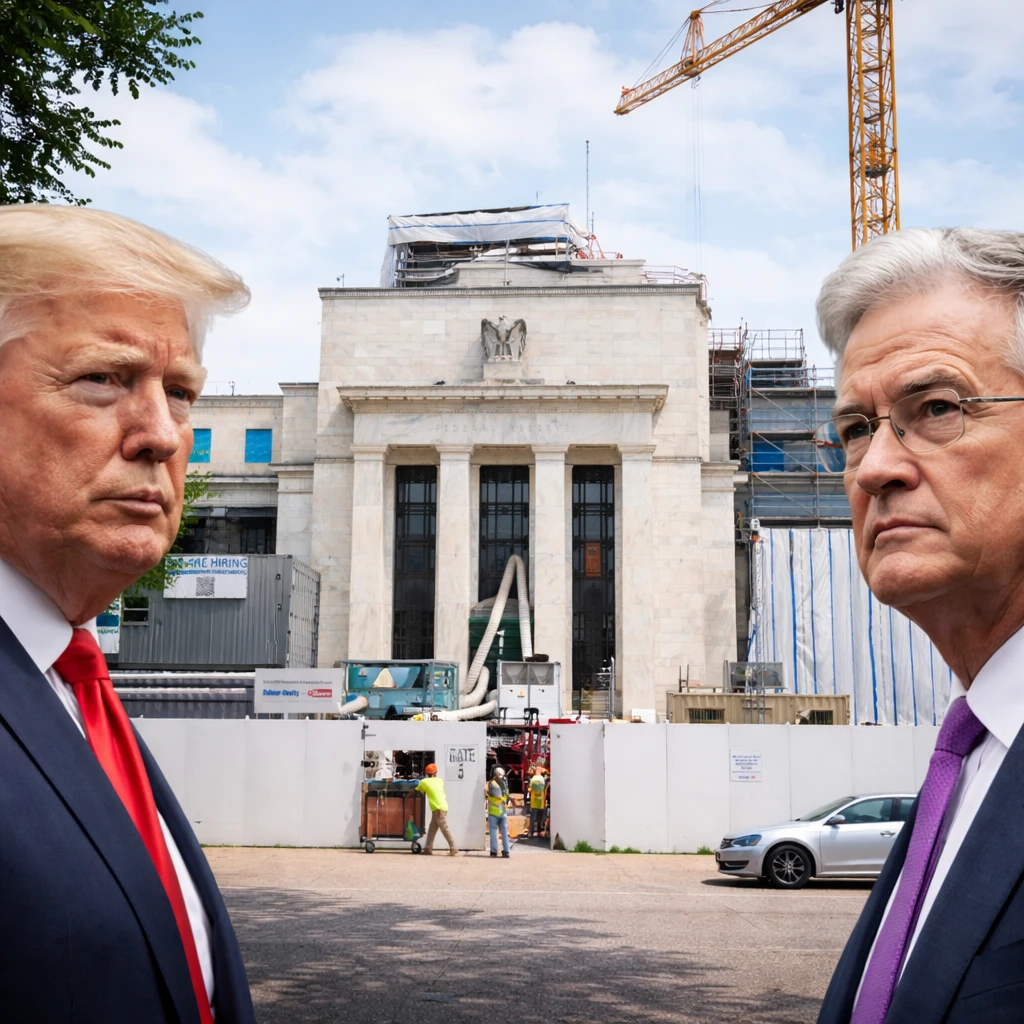

President Donald Trump has significantly heightened his conflict with the Federal Reserve, with the Justice Department investigating the independent institution and threatening potential criminal charges while issuing subpoenas as part of a probe. Though presented as a concern over Fed Chair Jerome Powell’s Congressional testimony in June concerning the expenses tied to extensive renovations of Fed facilities, Powell in a Sunday statement dismissed these legal threats as "pretexts" for the president's efforts to usurp control of U.S. interest rate policy from the Fed's technical leadership.
Trump has consistently criticized Powell and the Federal Reserve for not implementing rapid interest rate reductions. Economists caution that if the Fed succumbs to political pressure and prioritizes the president’s demands, it risks damaging its reputation as an effective inflation controller and potentially prompting investors to seek higher yields before purchasing U.S. Treasury securities.
The controversy centers on a costly renovation initiative:
The $2.5 billion refurbishment of two Federal Reserve buildings situated in Washington has been ongoing since Trump’s initial presidential term, drawing minimal attention until recently. Over the summer, the administration raised concerns about budget overruns amid the president’s increased urging for rate cuts to stimulate economic activity. Importantly, these renovation expenses are not funded directly by taxpayers. Unlike federal agencies reliant on Congressional appropriations, the Fed finances its operations through interest returns on its significant Treasury bond holdings. According to the central bank, its primary headquarters, the Marriner S. Eccles building, required urgent modernization due to outdated electrical, plumbing, and HVAC infrastructure, some systems dating back to the 1930s.
The Fed is undertaking hazardous material removal and system upgrades:
The refurbishing effort includes abatement of asbestos, lead, and other dangerous substances. It also involves installing updated electrical wiring and communications infrastructure. Located near prominent Washington landmarks, the H-shaped Marriner S. Eccles building pays homage to a 1930s and 1940s Fed chair. Adjacent to this, the Fed is also renovating a building acquired in 2018.
According to the Fed, historic preservation is a key consideration in the project, maintaining elements such as marble stonework, original façades, meeting rooms, and vintage conference rooms. Preservation efforts extend to elevators original to the structure.
Costs have notably risen:
Initially budgeted around $1.9 billion, the project’s cost has soared by $600 million. The Fed attributes the increase to several factors, notably the inflationary surge in 2021 and 2022 driving up labor and material expenses, an unexpectedly extensive asbestos removal requirement, and regional height restrictions mandating underground construction, which is more expensive.
As a consequence of these escalating costs, the Fed's board elected to cancel intended refurbishments of a third building scheduled for 2024. The Fed projects that the renovations will reduce expenses over time by consolidating its approximately 3,000 Washington-based employees into fewer facilities, thus reducing rental costs.
The Senate Banking Committee hearing highlighted divergent narratives:
During a June hearing, Senator Tim Scott, a Republican from South Carolina and committee chairman, alleged that the renovation included lavish additions such as rooftop terraces, custom elevators opening to exclusive dining areas, white marble finishes, and a private art collection. Powell refuted these claims, emphasizing the absence of new marble and special elevators. Despite these contentions, in July Trump visited the site alongside Powell and exaggerated the renovation cost, although later downplaying concerns, emphasizing the need to complete the work and expressing his wish to assist rather than criticize. When asked about the possibility of terminating individuals over overruns, Trump refrained from categorizing the situation as a firing offense.
Subsequently, tensions intensified:
At a news conference on December 29, Trump declared that his administration would likely initiate legal proceedings against Powell for "gross incompetence" related to renovation expenditures, which he characterized as “the highest price of construction per square foot in history.” The Supreme Court had ruled last year that Trump could not dismiss Powell solely on policy disagreements such as interest rate decisions but can remove him “for cause,” such as misconduct or neglect of duty.
The dispute appeared subdued before reigniting:
Post-summer, the renovation dispute faded but Trump sustained pressure on the Fed. In August, he attempted the unprecedented action of removing Fed Governor Lisa Cook amid mortgage fraud allegations, which she denied. Cook legally contested the removal, and courts have permitted her to remain during the dispute. The Supreme Court is slated to hear arguments regarding this matter on January 21.
Trump has leveraged investigations as tools against political opponents, including New York's Attorney General Letitia James and former FBI Director James Comey.
In a brief conversation with NBC News, Trump denied knowledge of the Justice Department inquiry into Powell and rejected the notion that it aimed to influence Fed policy. White House Press Secretary Karoline Leavitt affirmed that Trump did not direct the investigation.
In parallel, Trump has hinted at nominating a successor for Powell as Fed chair, whose current chair term expires in May, though his governorship extends to January 2028.
Trump faces criticism for his own costly modifications:
The president underwent scrutiny for deciding to demolish the East Wing facade of the White House to construct a $250 million ballroom. This new facility, spanning 90,000 square feet, will exceed the size of the main Executive Mansion, which is 55,000 square feet. Trump indicated the ballroom would host up to 999 guests and justified the need for a larger venue, citing the current largest room, the East Room, holds only 200 people and expressing dissatisfaction with hosting state events in outdoor tents.
Similar to the Fed renovation, Trump asserts that the ballroom's funding is private, sourced from supporters, corporations, and personal contributions.
Contributing economic analysis was provided by Christopher Rugaber.