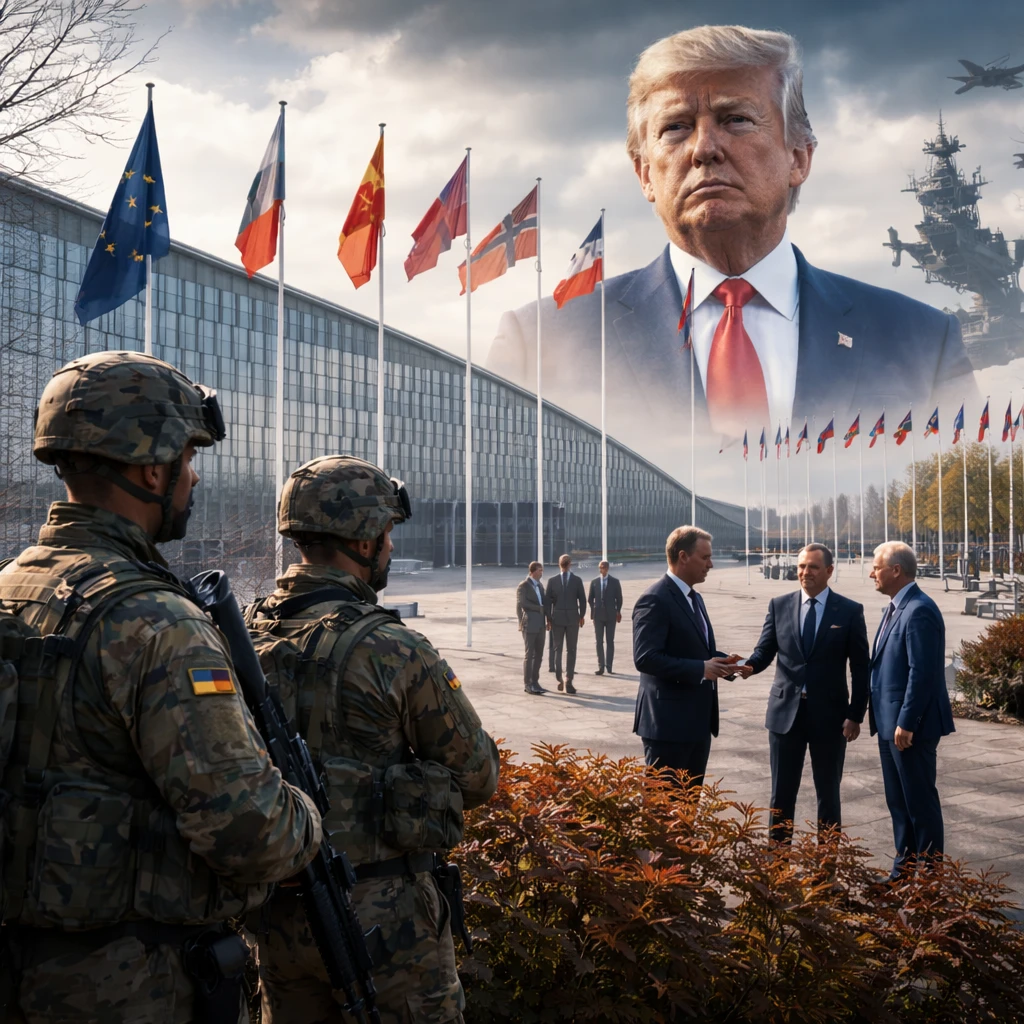

European Union leaders have intensified their criticism of US President Donald Trump's recent threats to impose tariffs on countries that resist US control over Greenland. The rhetoric from Europe's policymakers has hardened, employing terms such as "intimidation," "threats," and "blackmail" to characterize the US stance. This reflects rising alarm over what was previously considered an unthinkable scenario: the most powerful NATO member threatening to appropriate territory belonging to another allied nation.
Trade retaliation from the EU and affected states appears imminent should the US enforce these tariff threats. The sense of mistrust within the trans-Atlantic alliance has significantly increased within a year of President Trump's return to the White House. EU officials acknowledge that efforts to appease or flatter the US administration have failed, prompting a shift in tactics to manage both an unreliable ally and the proximity of a more assertive Russia.
During his first term, Trump was seen as pushing NATO towards dysfunction. Former NATO Secretary-General Jens Stoltenberg warned of a possible breakdown following Trump's 2018 summit threats to withdraw US support. Currently, Danish Prime Minister Mette Frederiksen has cautioned that any attempt by the US to annex Greenland, an autonomous Danish territory, could lead to the suspension of all NATO cooperation.
Maria Martisiute, an analyst at the European Policy Centre, described the situation as being in the preliminary phase of a significant political and military crisis, highlighting a growing acceptance among European leaders that the US has abandoned its traditional NATO commitments.
As Russia's war in Ukraine nears four years, European NATO members awaited clarity from the US on their security strategies in January 2025. European nations view Putin's Russia as an existential threat that could destabilize the continent should Russian forces prevail in Ukraine. Early expectations for continued US support under the Biden administration diminished rapidly, as military aid and funding from Washington decreased. This shortfall in American support has compelled Europe to take on a greater share of security responsibilities and financial burden.
In February, US Defense Secretary Pete Hegseth openly communicated a shift in US policy at NATO's headquarters: the United States would prioritize other global concerns, expecting Europe to address its own regional security. He confirmed that Ukraine would not be admitted into NATO and that territories lost to Russia were unlikely to be returned. European efforts to support Ukraine militarily could not count on US intervention should conflict spread onto European troops involved.
President Trump publicly shifted blame onto Ukrainian President Volodymyr Zelenskyy for the ongoing conflict, complicating relations even after diplomatic engagements with European monarchs intended to ease tensions.
In the context of European politics, US Vice President JD Vance met with a far-right German party leader, suggesting that Europe's predominant threat was internal rather than the Russian military challenge. This contrasts with the stance of Germany's newly elected Chancellor Friedrich Merz, who indicated the urgency for major and swift enhancements to German and European defense capabilities amid rising threats.
Throughout the year, European leaders, including President Zelenskyy, engaged with Washington to maintain US support, presenting a detailed 28-point proposal to end the war that heavily favored Russian demands. Despite ongoing negotiations, notably without participation from Russian President Vladimir Putin, few anticipate a resolution due to these conditions and the US administration's position blaming Ukraine for the conflict's impasse.
Meanwhile, the European Union has pursued strengthening its own defense infrastructure, even as the US engaged in a global tariff conflict affecting its own allies and disrupting European economies. The EU established a multibillion-euro defense fund aimed at procuring arms and ammunition primarily from European manufacturers, reducing dependence on American suppliers. Regulatory adjustments were made to ease debt constraints for security-related expenditures, and funds have been allocated to bolster Ukraine's defense industry. Furthermore, in December, EU leaders committed to financing the majority of Ukraine's military and economic support over the coming two years amid concerns over Kyiv's financial stability.
The release of a new US national security strategy has further strained trans-Atlantic relations. This strategy characterizes European allies as weak, offers implicit support to far-right political forces, and critiques European policies on free speech and immigration. In response, European Council President Antonio Costa warned the US against interfering in European internal affairs, while Chancellor Merz emphasized the increasing necessity for Europe to pursue greater independence from the United States.
Work has commenced on formulating an EU-specific security strategy designed to adapt to shifting geopolitical realities, with European Commission President Ursula von der Leyen highlighting objectives to enhance European strategic autonomy.
Symbolizing European resolve, several countries—including France, Germany, the UK, Norway, Sweden, and the Netherlands—recently deployed small, but highly symbolic, military contingents to Greenland. French President Emmanuel Macron underscored the importance of supporting sovereign nations to safeguard their territories. He acknowledged that Europe is undergoing a fundamental reassessment of its longstanding assumptions about alliances previously deemed steadfast and reliable, which are now sources of doubt or even opposition against former partners expecting unwavering support.
Currently, the eight European nations targeted by President Trump’s tariff threats maintain a united stance in affirming their commitment to the principles of national sovereignty and territorial integrity. They caution that imposing tariffs risks undermining transatlantic relations and triggering a detrimental cycle of retaliation.