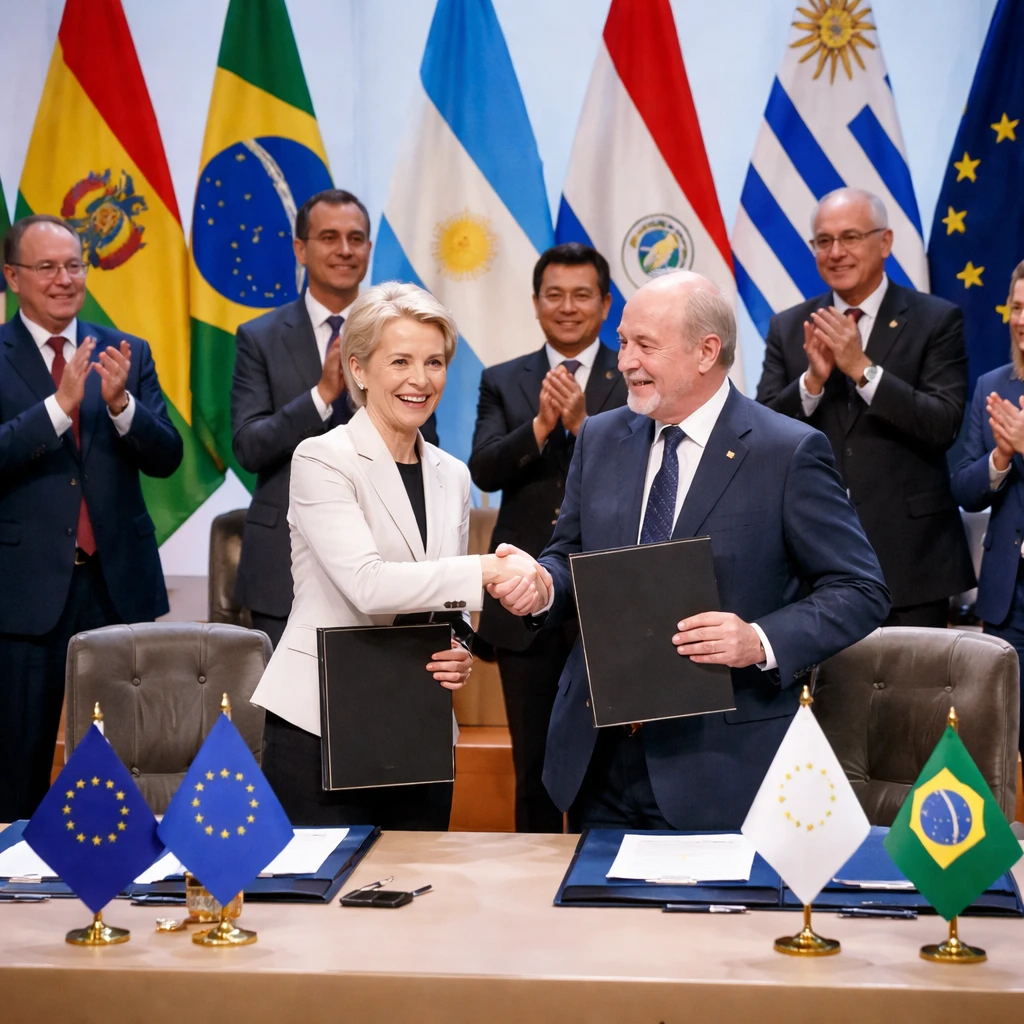
The European Union (EU) and Mercosur, a South American trade group comprising Argentina, Brazil, Paraguay, and Uruguay, have officially signed a sweeping free trade agreement in Asunción, Paraguay. This landmark accord concludes over twenty-five years of arduous negotiations aiming to boost bilateral trade amid increasing global protectionism and intensifying trade disputes.
The ceremony, held in Paraguay's capital, is considered a geopolitical success for the EU. It expands the bloc's access to a region abundant in natural resources that is being increasingly contested by the United States and China. The pact underscores South America's commitment to maintaining broad and diversified diplomatic and trade relationships, despite unilateral assertions from the U.S. to dominate the Western Hemisphere.
European Commission President Ursula von der Leyen highlighted the strategic significance of the pact, stating, "the geopolitical importance of this agreement cannot be overstated," especially as skepticism around free trade's value has grown. Her remarks coincided with U.S. President Donald Trump's declaration of new tariffs targeting eight European countries, reflecting heightened transatlantic tensions.
At the signing event, attended by Mercosur heads of state from Argentina, Uruguay, and Paraguay, as well as Brazil's foreign minister, von der Leyen affirmed the EU's commitment to equitable trade practices and long-term partnerships. She emphasized, "We choose fair trade over tariffs. We choose a productive long-term partnership over isolation," underscoring a mutual belief that joint efforts will benefit the peoples and economies involved.
The agreement is driven by South America's prominent cattle-rearing nations and Europe's industrial sectors, eager to open markets for automobiles and machinery. Once implemented, the pact would create one of the largest free trade zones globally, potentially lowering costs for over 700 million consumers across these regions.
Despite the successful signing, challenges remain before the agreement takes effect, notably needing ratification by the European Parliament. Various protective interest groups, particularly European agricultural communities concerned about the influx of inexpensive South American products, have actively resisted the deal. Recent protests by farmers' groups in Europe highlight the contentious domestic debate which could impede parliamentary approval.
The accord calls for the gradual elimination of more than 90% of tariffs on goods and services exchanged between the two blocks, with some tariffs phased out over a period of 10 to 15 years. However, certain agricultural commodities, including beef, will remain subject to strict quotas designed to protect European farmers. Supplementary measures such as safeguard clauses and enhanced subsidies to financially vulnerable European agricultural sectors have facilitated support for the treaty from some countries like Italy.
Nevertheless, opposition remains. France has expressed reservations driven by concerns that dissatisfaction among farmers could fuel support for far-right political factions ahead of upcoming elections. Observers note that the ultimate fate of the agreement hinges on the European Parliament's political willingness to endorse it.
João Paulo Cavalcanti, a Brazilian international trade attorney, noted that political considerations within the European Parliament may represent a significant obstacle to final approval.