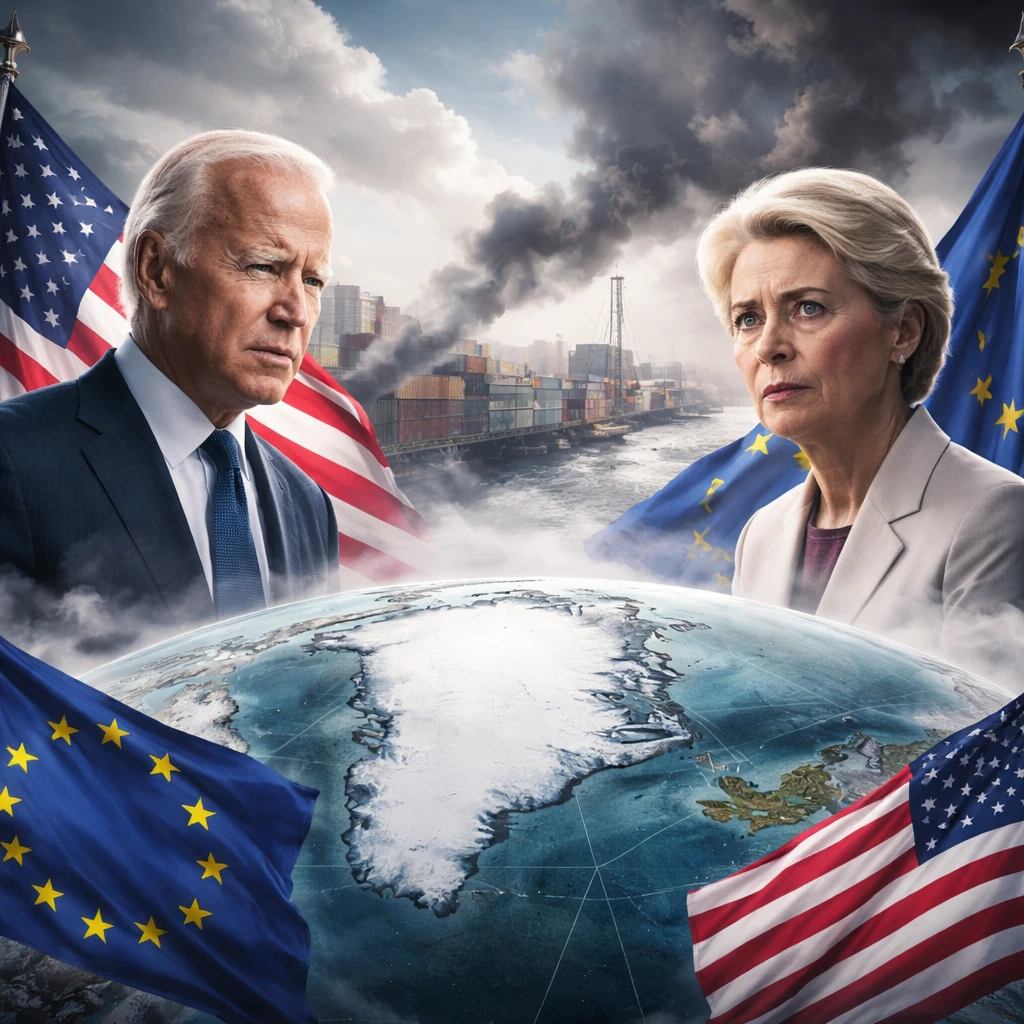
At the World Economic Forum in Davos, Switzerland, European Union President Ursula von der Leyen publicly condemned the United States' plans to impose a 10% tariff on goods imported from eight European countries supportive of Denmark amid rising tensions concerning US ambitions over Greenland. She emphasized that the EU and US had reached a trade agreement the previous July, underscoring that "a deal is a deal" and that trust between allies should be maintained in both politics and business.
Von der Leyen warned against a perilous downward spiral that could advantage mutual adversaries, stressing the importance of the EU and US viewing each other as not just allies but friends. She assured a unified, steadfast, and measured response from the EU against the tariff threat.
French President Emmanuel Macron joined the response by cautioning that the imposition of such tariffs may compel the EU to employ its recently developed anti-coercion instrument, a potent tool designed to sanction entities exerting unjust pressure on the Union. Macron described it as a grave step, highlighting the absurdity of allied nations slipping into conflict instead of uniting for objectives such as peace in Ukraine.
Meanwhile, Greenland's Prime Minister Jens-Frederik Nielsen spoke at a news conference in Nuuk, emphasizing the necessity of respecting international law and territorial sovereignty. He reaffirmed Greenland's longstanding loyalty and cooperation with NATO and the United States and expressed willingness to enhance partnership, but only within a framework of mutual respect. He warned that disregard for these principles could severely jeopardize reliable relations.
US President Donald Trump, preparing to address the forum, has defended the US interest in Greenland on security grounds, citing potential threats posed by China and Russia. US Treasury Secretary Scott Bessent sought to downplay the tension by affirming the strength of transatlantic relations and urging patience as the tariff situation develops. Nonetheless, Danish Prime Minister Mette Frederiksen, addressing her parliament, alluded to the possibility that the conflict may intensify, emphasizing Denmark’s consistent pursuit of cooperative relations rather than confrontation.
At the same forum, California Governor Gavin Newsom criticized Europe's handling of the tariff threats as inadequate, urging European leaders to demonstrate greater resolve and unity in opposing US pressure. Concurrently, European NATO members are evaluating an increased military presence in the Arctic as a security measure, aligning with US requests, according to Sweden's Defense Minister Pål Jonson.
Russia’s Foreign Minister Sergey Lavrov dismissed allegations of threats from Russia or China toward Greenland, labeling the island a former colonial possession of Denmark and not an inherent part of that country. This juxtaposition adds further complexity to the geopolitical narrative surrounding the region.
Separately, tensions also surfaced between the US and the UK over Britain's recent decision to restore sovereignty of the Chagos Islands to Mauritius despite earlier US support for retaining the territory, which hosts an important US military installation. US House Speaker Mike Johnson sought to soothe transatlantic relations by emphasizing the enduring ability of the US and UK to amicably resolve differences.
In the backdrop of these tensions, President Trump shared a text message from President Macron proposing a post-Davos G7 meeting in Paris, revealing ongoing diplomatic efforts amidst unresolved conflict. Macron's office confirmed the authenticity of the message.
This ongoing controversy highlights the fragility of alliances once taken for granted and poses significant challenges to global trade frameworks and geopolitical stability.