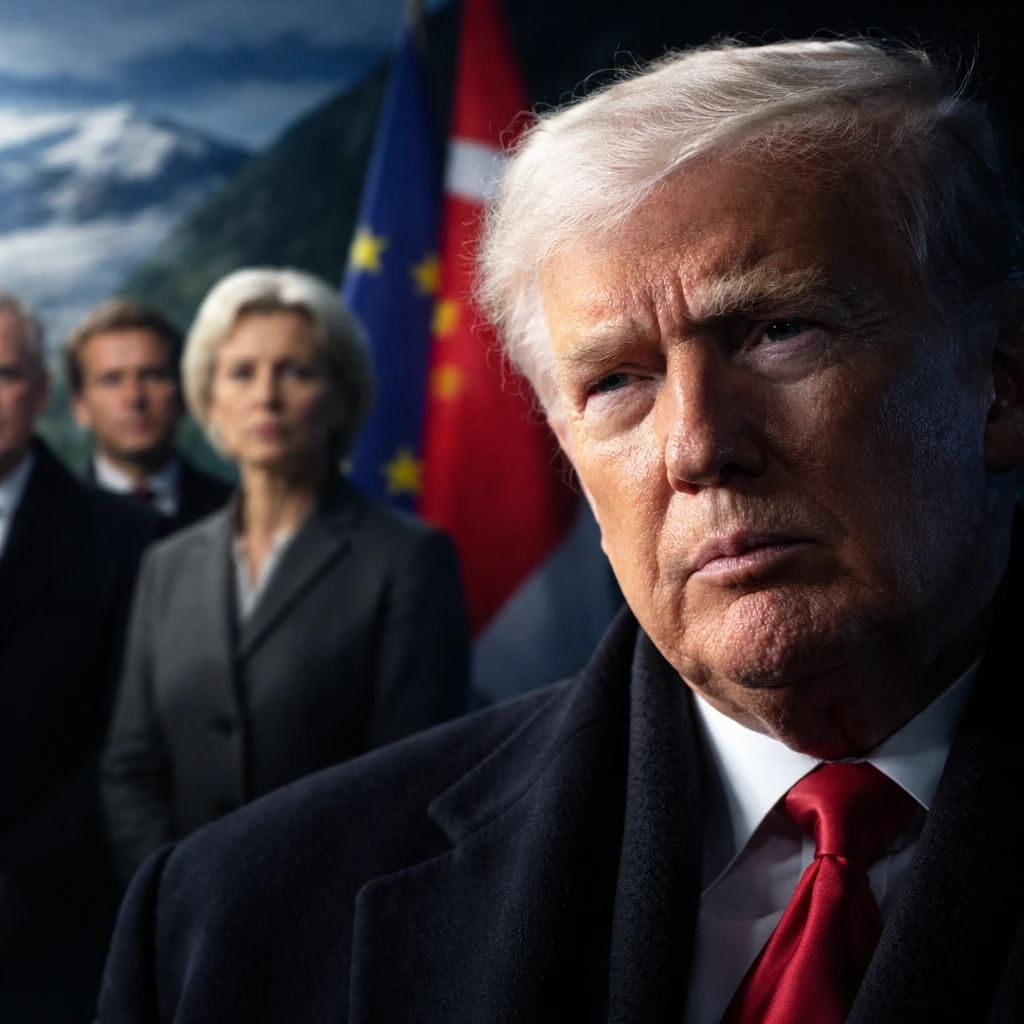

In the wake of renewed pressure from former U.S. President Donald Trump regarding Greenland, European leaders have markedly shifted their diplomatic posture from deference to explicit defiance. Over the course of the past year, these leaders, initially uncertain about managing the idiosyncrasies of Trump's second term, have edged closer to clearly saying "no" to demands perceived as challenging international law and sovereignty.
The pivotal moment arrived when Trump, with little precedent, revived his insistence that the United States must assume control over Greenland, the semiautonomous island considered part of NATO ally Denmark. His statement included threats to impose tariffs on countries opposing this acquisition, sparking a rare moment of unified resistance among European nations.
British Prime Minister Keir Starmer unequivocally affirmed the United Kingdom's support for Greenland’s sovereignty, asserting that "Britain will not yield." Similarly, several European leaders collectively asserted that "Europe will not be blackmailed" in response to such ultimatums. Norwegian Prime Minister Jonas Gahr Støre emphasized that "threats have no place among allies," reinforcing the growing consensus against coercive tactics within diplomatic alliances.
This sharpened tone in European leadership circles coincided with mounting domestic challenges for Trump, including impending U.S. congressional elections, a declining stock market, and waning approval ratings. The political headwinds evident within the United States mirrored earlier instances of domestic institutions, such as the Federal Reserve under Chair Jerome Powell, countering Trump's policies.
Advocating a transactional style of diplomacy, Trump’s neglect of international legal frameworks contrasted starkly with the norms favored by European leaders. This fundamental disconnect surfaced as Trump proposed territorial acquisitions extending beyond Greenland, encompassing Panama and potentially Canada, which many in Europe found untenable.
Previously accustomed to measured diplomatic engagement, European nations have found it necessary to recalibrate their collective response mechanisms to counter Trump's unorthodox approach. Mark Shanahan, an expert in political engagement, noted that while Trump’s first term left Europe unsure of how to respond, the current climate reflects an evolving understanding that traditional diplomacy may not suffice when confronted with such demands.
Within months of Trump's inauguration, European leaders convened a NATO summit that led to commitments from member nations for greater defense spending, acknowledging, to some extent, Trump's influence in prompting modernization. Nevertheless, past internal descriptors of Trump as a "daddy" figure mediating international disputes have since lost favor alongside his escalating territorial assertions.
The Greenland episode particularly highlighted a departure from traditional diplomatic caution. Greenland's Prime Minister Jens-Frederik Nielsen openly declared "enough," rejecting annexation fantasies, signaling a firmer, public stance against U.S. pressure. Denmark’s Prime Minister Mette Frederiksen reiterated this by stating that any breach of Greenland’s sovereignty would fracture NATO, urging fellow alliance members to heed these warnings seriously.
The collective European response manifested in a series of formal statements repudiating the renewed threats. Trump's retaliatory announcement of potential import tariffs on several European countries, conditional on their acquiescence to U.S. acquisition aims, escalated tensions further. He threatened a 10% tariff starting within a month, increasing to 25% by June 1 if no agreement was reached.
The reactions at the World Economic Forum in Davos illustrated a turning point, with European leaders recognizing the need for resilience in the face of coercion. Mark Carney, former Governor of the Bank of Canada, reframed the Greenland issue as part of a broader necessity for European unity against bullying tactics, advocating acceptance of a fundamental rupture in alliance dynamics.
Academic experts noted the newness of this rupture, emphasizing the difficult but important task of potentially restoring transatlantic cooperation on adjusted terms post-Trump. The economic and political incentives for repair remain significant for both European and American interests.
As Trump began to retreat from his most aggressive language in Davos, canceling threats of force and announcing an undefined "framework" for Greenland that might negate tariff impositions, Denmark maintained firmness. Frederiksen declared unequivocally, "We cannot negotiate on our sovereignty," signaling a definitive refusal beneath any diplomatic overture.
This evolution in European diplomacy from accommodation to assertive refusal marks a notable development in international relations, reflecting an awareness of emerging geopolitical challenges and the limits of traditional engagement strategies with unconventional leaders.