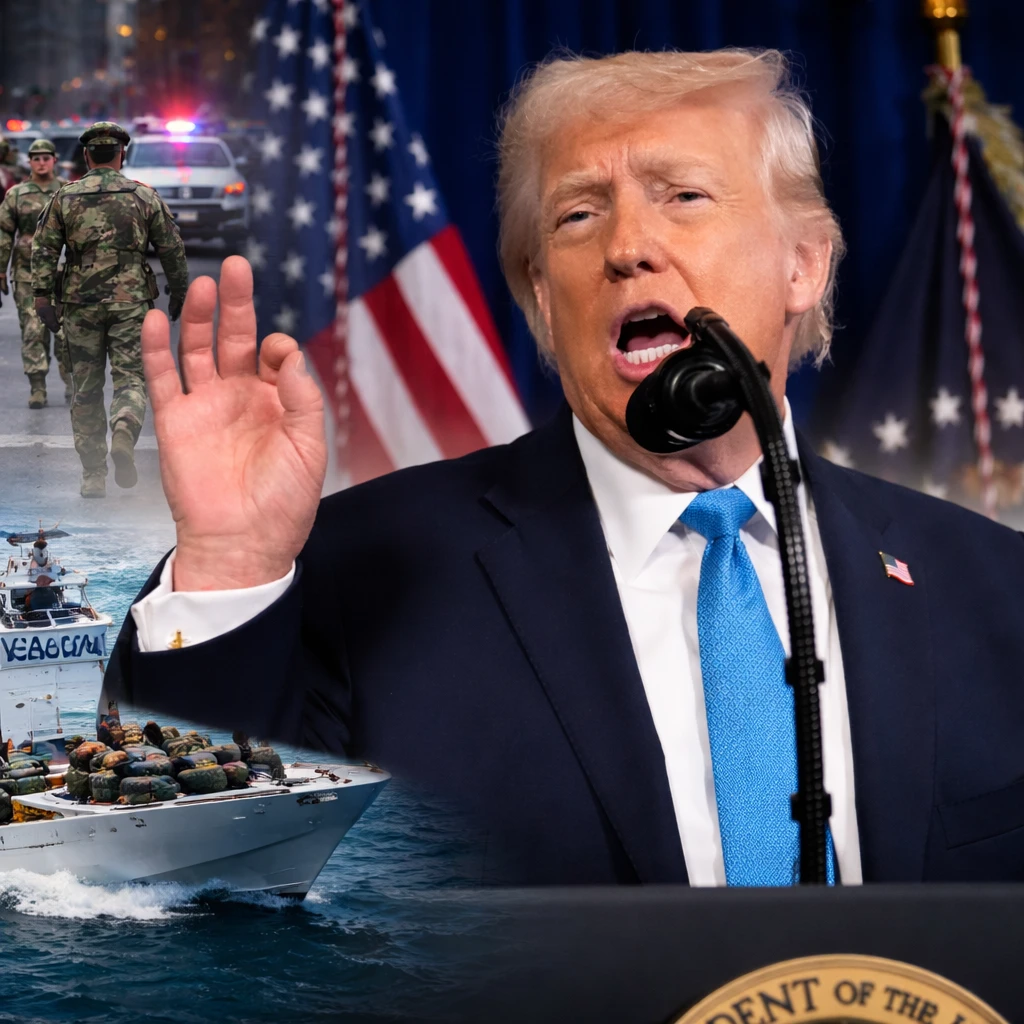

In a lengthy press conference on Saturday, President Donald Trump discussed the U.S. military's recent raid aimed at extracting Venezuelan President Nicolás Maduro and his spouse. Throughout his remarks, the President diverged into various topics, reiterating claims about his initiatives that conflict with verified data.
During his address, Trump commended the military, citing the deployment of National Guard units to American urban centers and presenting claims about crime reductions in Washington, D.C., Chicago, and Los Angeles that do not align with official statistics.
Claims about drug-related deaths prevented by U.S. raids on Venezuelan vessels
President Trump stated that each vessel targeted by U.S strikes kills approximately 25,000 people on average.
Analysis of this figure reveals inconsistencies. Historically, Trump has claimed that every boat intercepted by U.S. forces saves 25,000 American lives by preventing drug trafficking. However, data from the Centers for Disease Control and Prevention (CDC) presents a much lower reality. For example, the CDC's National Vital Statistics System indicates there were as many as 76,516 drug overdose deaths in the U.S. in the 12 months ending April 2025—a figure that had decreased by 24.5% from the prior year’s 101,363 deaths.
Since September 2, the U.S. military has launched attacks on at least 35 boats in the Caribbean Sea and eastern Pacific Ocean, the most recent on December 31. Using the Administration's estimate of 25,000 lives saved per boat, this would suggest approximately 875,000 lives were preserved—far exceeding actual overdose death counts. This discrepancy suggests the administration’s claim overstates the impact considerably.
The majority of drug overdose deaths in 2024 involved opioids, accounting for 73.4%, with illegal fentanyls responsible for 65.1%, according to the CDC’s State Unintentional Drug Overdose Reporting System. Notably, while these U.S. military strikes targeted vessels in maritime areas such as the Caribbean Sea, fentanyl primarily enters the U.S. overland through Mexico, where production occurs utilizing precursor chemicals imported from China and India. This information raises questions about the effectiveness of these strikes in addressing the primary channel for fentanyl trafficking.
National Guard deployment and crime statistics in Washington, D.C.
Trump asserted that Washington, D.C., has not experienced a homicide in a span of six to seven months, aside from a recent terrorist attack. However, official Metropolitan Police Department statistics record 59 homicides in the last seven months, including two occurrences in the previous week. Among these incidents was the fatal shooting of a West Virginia National Guard member by an Afghan national on November 26, an event investigated by the FBI as an act of terrorism. Additionally, in 2025, the city recorded 126 homicides, with 29 happening after National Guard deployment began on August 11.
The President also declared a public safety emergency at the time of the deployment and announced plans to dismantle homeless encampments. Nonetheless, the city’s attorney general reported that violent crime in the district reached its lowest point in 30 years in 2024 and declined further by 26% in 2025.
National Guard involvement in Chicago and Los Angeles
Regarding Chicago, President Trump said that National Guard support contributed to a slight reduction in crime. In reality, National Guard troops were not deployed to the streets due to legal challenges, and their mission, as stated by a Justice Department lawyer in court, focused on protecting federal properties and field agents rather than addressing broader crime reduction.
Between 2020 and 2024, Chicago saw a 25% decrease in homicides; however, other categories experienced increases: rape rose 27%, robbery 17%, and aggravated assault 11%.
In Los Angeles, around 4,000 National Guard members and 700 Marines were deployed in June to guard federal buildings and assist federal agents with immigration arrests. The troop presence gradually declined to a few hundred officers before their removal from the streets by December 15, following a court ruling that restored control of the Guard to California Governor Gavin Newsom. Although an appellate court temporarily suspended parts of this order, the Trump administration chose not to seek further stays. Ultimately, the U.S. Court of Appeals for the Ninth Circuit mandated the return of National Guard control to Gov. Newsom.
This examination reveals substantial discrepancies between President Trump’s statements and recorded facts concerning the impact of military actions against drug trafficking vessels and the effects of National Guard deployments in major U.S. cities.