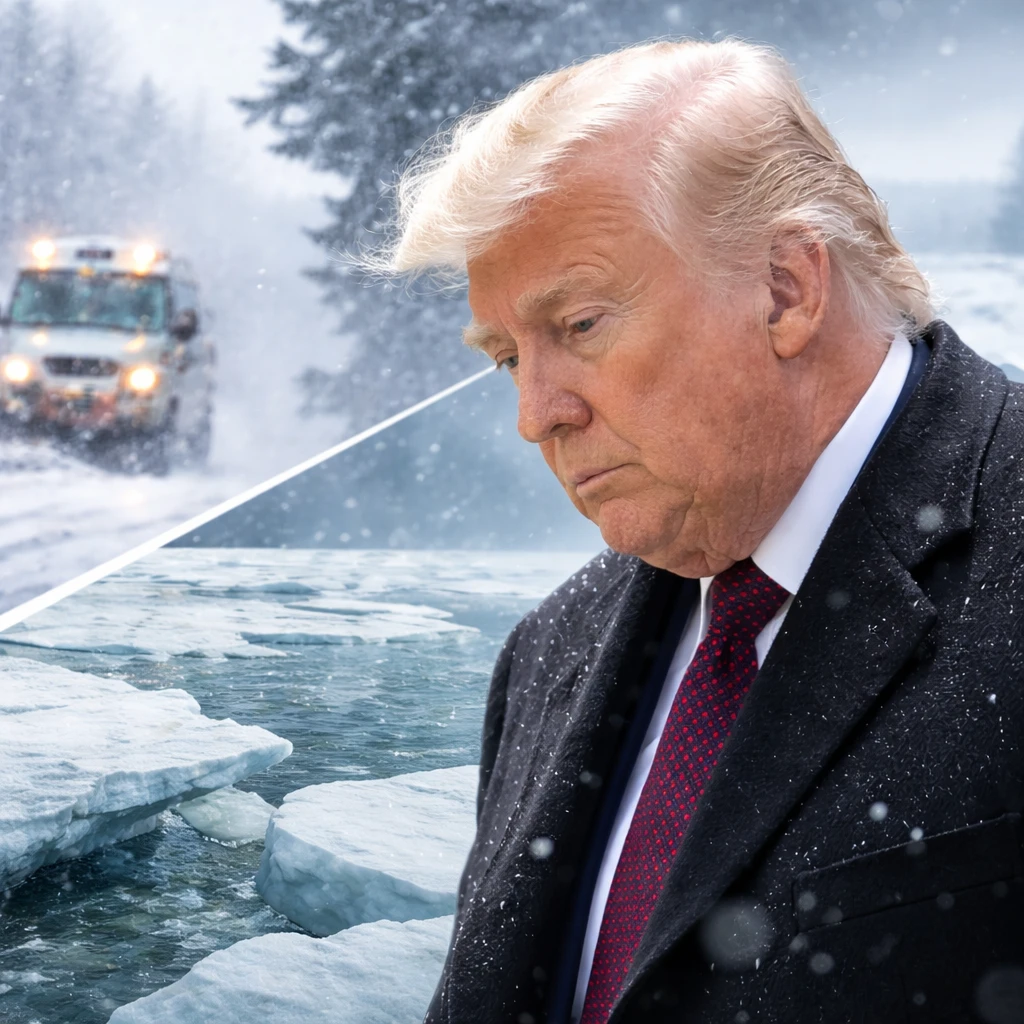

During a severe and expansive winter storm across the United States characterized by freezing temperatures, dangerous ice, and heavy snowfall, former President Donald Trump utilized his Truth Social platform to question the phenomenon of global warming. In a concise 25-word post, Trump expressed skepticism about a warming planet in light of the current frigid conditions, describing the cold spell as nearly unprecedented and labeling environmental advocates and scientists as \"environmental insurrectionists.\"
Countering these statements, over a dozen climate scientists engaged by The Associated Press emphasized that the president's assertions are incorrect. They clarified that global warming does not eliminate the occurrence of cold weather or winter seasons and that they have never claimed otherwise. While cold conditions currently affect much of the eastern U.S., observations indicate that a larger portion of the globe is experiencing temperatures above average. These experts underscored the critical distinction between local and daily weather fluctuations versus extended, planet-wide climate trends.
Meteorologists have also suggested that global warming observed over the recent decades could contribute to this winter's extreme cold and record-breaking weather, although government data reveals even colder conditions have been recorded historically.
Daniel Swain, a climate scientist at the California Institute for Water Resources, stated, \"This social media post crams a remarkable amount of inflammatory language and factually inaccurate assertions into a very short statement. First of all, global warming continues -- and has in fact been progressing at an increased rate in recent years.\"
Climate change persists despite short-term cold
Refuting the social media claim, Gabriel Vecchi, a climate scientist at Princeton University, remarked, \"Global warming hasn’t gone anywhere, it's here.\" Recorded temperature data indicates that the last three years are the warmest in history, with warming accelerating compared to previous periods.
According to records from the National Oceanic and Atmospheric Administration, global winter temperatures (covering December, January, and February) have risen by approximately 1.3 degrees Fahrenheit (0.72 degrees Celsius) since 1995, with the two most recent winters registering as the warmest. The warming trend in the U.S. has been slower relative to the global average, warming by about 0.5 degrees Fahrenheit (0.28 degrees Celsius) since 1995. Additionally, last month ranked as the fifth hottest December on record both globally and within the United States.

Understanding local cold weather in a warming world
Experts stress that \"global warming\" denotes planetary-scale temperature increases rather than uniform warming everywhere simultaneously. The United States constitutes only about 2% of Earth's surface area. Notably, regions west of the Rocky Mountains have not experienced unusually low temperatures for this season. Temperature maps demonstrate that while two-thirds of the U.S. and parts of Russia are currently colder than typical, continents including Australia, Africa, Asia, and significant portions of Europe, Canada, and polar regions are above normal temperatures.
Michael Oppenheimer, a Princeton University climate scientist, observed, \"Even as the Earth warms, cold days and cold winters are not projected to disappear, just become fewer in number.\" He further explained that short-duration weather events in the U.S. do not reflect the overall climatic shifts happening across the country or the globe.
There is an emerging, albeit not yet universally accepted, scientific hypothesis proposing that Arctic warming may drive more extreme winter cold incidents in the eastern U.S. This could relate to changes in the jet stream influenced by reduced temperature contrasts between the polar regions and mid-latitudes, allowing for the penetration of cold Arctic air into lower latitudes.
Victor Gensini, a meteorology professor at Northern Illinois University, noted, \"This is an active research area with uncertainty. One hypothesis is that Arctic warming reduces the temperature contrast between the pole and mid-latitudes, which can sometimes weaken or distort the jet stream and allow cold Arctic air to spill south. Not every cold outbreak can or should be attributed to climate change, as weather maintains substantial natural variability.\"
Historical cold temperatures surpass current extremes
Addressing the president’s remark on \"rarely seen\" record cold waves predicted across 40 states, experts highlighted that colder temperatures have occurred in the past. The National Weather Service's forecast of Minneapolis temperatures at minus-11 degrees Fahrenheit (minus-24 Celsius) on Saturday and minus-13 (minus-25 Celsius) on Sunday are well above the historical records of minus-33 and minus-31 degrees Fahrenheit from 1904.
Likewise, Chicago’s forecast lows of 2 degrees (minus-17 Celsius) and 8 degrees (minus-13 Celsius) for Saturday and Sunday respectively do not breach past record lows of minus-15 and minus-20 degrees Fahrenheit (minus-26 and minus-29 Celsius) set in 1897. In fact, temperatures have more recently dropped to minus-23 Fahrenheit (minus-31 Celsius) as recently as January 2019. Other cities like Fargo, North Dakota, and Washington, D.C. are also expected to remain well above their coldest recorded temperatures.
Gensini remarked that \"truly historic cold waves\" in decades such as 1978-79 and 1983-85 were generally colder and lasted longer over large geographic areas. He added that modern populations are less accustomed to such severe cold currently, partially because overall winters have become warmer over the decades.
Record setting implications and frequency
Kristina Dahl, vice president of science at Climate Central, reviewed data from U.S. weather stations with over 50 years of data and found 45 record lows set this January compared to 1,092 record highs, a stark difference illustrating the warming trend. While some daily records may fall during the ongoing cold blast, especially in the central U.S., breaking long-standing temperature records spanning 100 years or more is unlikely.
Ryan Maue, former NOAA chief scientist during the end of Trump’s first term, noted that on an upcoming Monday, the average low temperature across the Lower 48 states would be around 10 degrees Fahrenheit (minus-12 degrees Celsius), with over 90% of the country below freezing. However, past January averages, such as 4.1 degrees Fahrenheit (minus-15.5 degrees Celsius) in 1985, were substantially colder.
Maue acknowledged Trump's alerts about the severe cold, suggesting that \"while he is trolling about global warming it seems to be on his mind.\"
In summary, the current cold weather does not negate the long-term global warming trend, as regional cold snaps are expected within an overall warming climate. The complexity of weather variability, combined with ongoing climate shifts, calls for distinguishing between short-term phenomena and long-term climate observations.