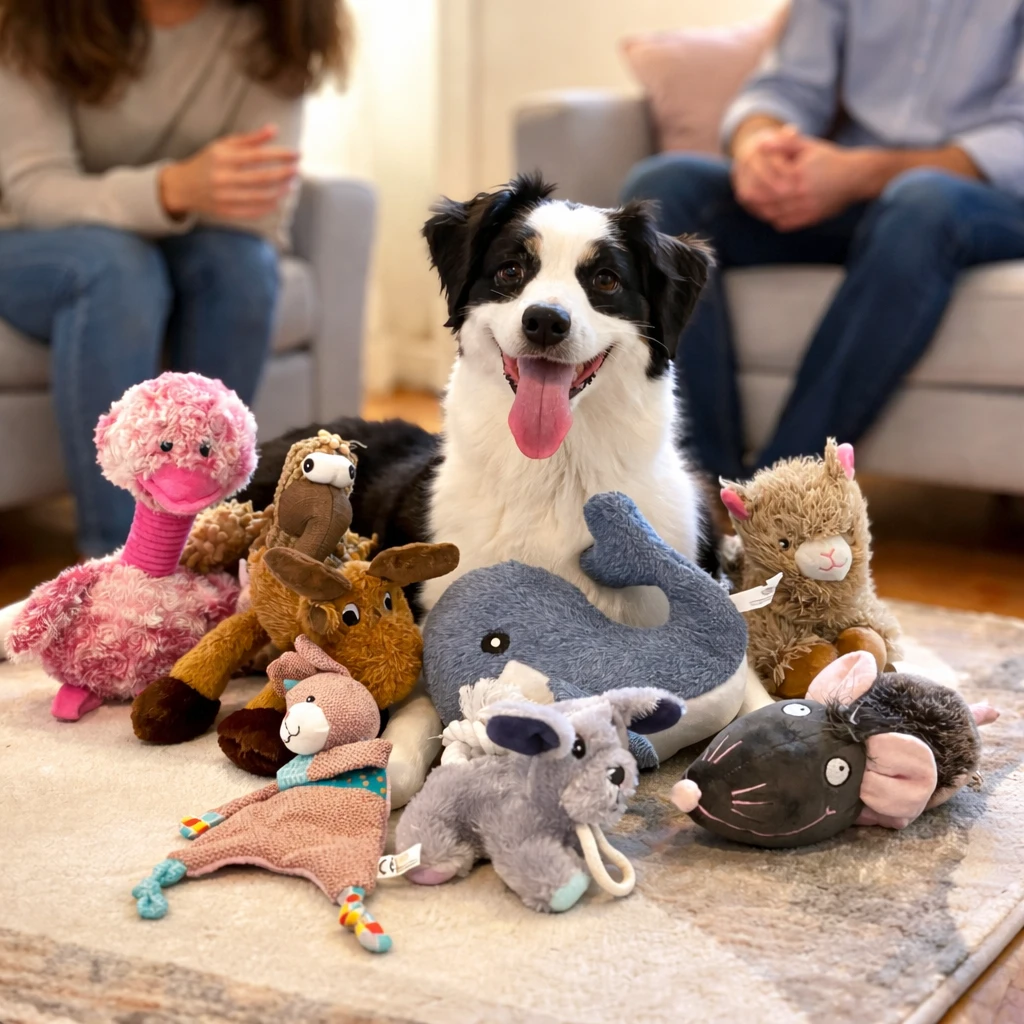

Dogs often master action-oriented commands such as "sit" and "stay," yet they generally struggle with memorizing labels for objects, including their assortment of squeaky or plush toys. There exists, however, an exceptional subset of canines known for their remarkable proficiency in associating numerous toy names with their respective objects. Approximately 50 dogs worldwide are recognized for this talent, though the precise cognitive mechanisms underlying their word-learning abilities remain unclear.
Recent scientific research has advanced our comprehension of these gifted dogs’ linguistic capabilities. It was previously established that such dogs could learn the designations of their familiar playthings—like stuffed pizzas or doughnuts—through interactive sessions with their handlers. Extending this knowledge, the latest study reveals that these dogs are also capable of acquiring new toy names passively, by overhearing conversations.
In the study, ten highly skilled dogs, including a Border Collie named Basket and a Labrador Retriever named Augie, observed their owners holding unfamiliar toys and discussing these with another person. Following this, the dogs were directed to another room where they were tasked with retrieving the specific new toy from a collection of varied items.
Remarkably, seven out of the ten dogs correctly identified and fetched the target toys—which consisted of items named "stingrays" and "armadillos"—after simply listening to the interaction without direct training. The research team, led by Shany Dror from Eötvös Loránd University in Hungary and the University of Veterinary Medicine in Austria, notes that this represents the first documented instance of dogs learning labels solely through passive observation of social exchanges.
The dogs' success persisted even when the toys were placed inside opaque boxes prior to the naming conversation, demonstrating their ability to dissociate the visual presence of the object from the auditory learning of its name.
Such eavesdropping skills have only been documented in a limited range of animal species, such as parrots and primates. In humans, this faculty is critical during early language acquisition, with children under two years old able to pick up new vocabulary incidentally—even words their parents did not intend to teach them. However, as the dogs in this study were fully mature, the neurological foundations facilitating this kind of learning likely differ from those among human infants, according to Dror.
Heidi Lyn, an animal cognition expert at the University of South Alabama who was not involved with the study, comments that the findings underscore the complex cognitive processes inherent in animals beyond common assumptions. The study's publication in the journal Science occurred on Thursday.
It is important to emphasize that this advanced word-learning ability is rare and not characteristic of the general dog population; thus, most pet dogs are unlikely to acquire new object names through overhearing casual conversations at home. Dror expresses intentions to continue investigating what cues these uniquely talented dogs detect and how they process linguistic information. Researchers note that while interactions with these dogs in laboratory settings are rewarding, they also present challenges typical of working with lively animals, such as occasional accidents on furniture.