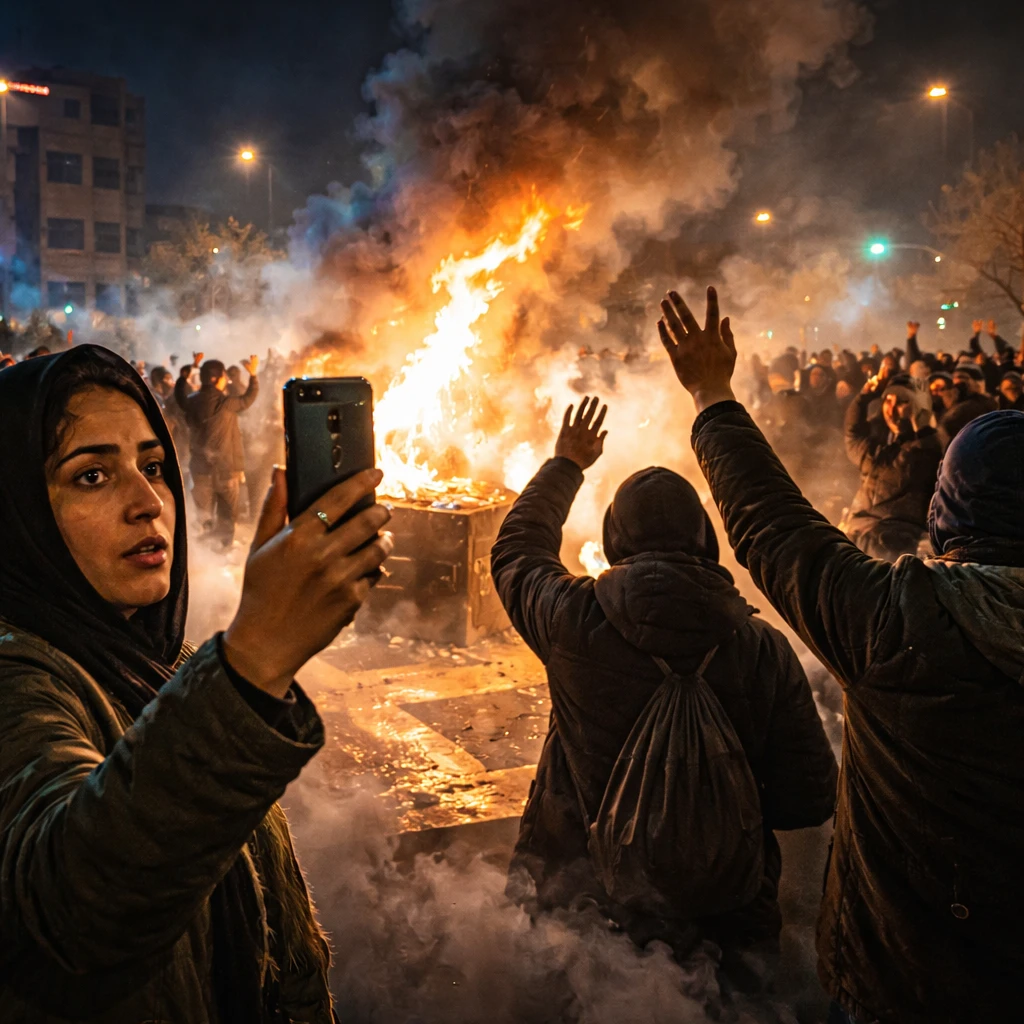

Amid one of the broadest demonstrations in recent Iranian history, a 37-year-old beautician in Karaj found herself amid escalating violence, capturing the realities of protest and repression on her phone.
On the evening of January 8, she and her peers took refuge under trees on a city boulevard as tear gas canisters disrupted the crowd. Hidden in the shadows illuminated by streetlamps and nearby flickering fires, gunshots soon pierced the air, audible within her video recordings. She called out repeatedly to encourage calm, while protesters chanted defiant slogans denouncing the regime.
This demonstration was part of massive nationwide anti-government protests involving hundreds of thousands of Iranians across a vast range of cities, voicing their dissent against a theocracy in place for nearly five decades. However, following the aggressive government response that night, the beautician now lives in fearful seclusion with her mother, plagued by anxiety and insomnia.
She describes an atmosphere heavy with fear, grief, and suppressed anger. In late January, via text messages, she depicted scenes where people in the streets appeared like "walking corpses," drained of hope. Her videos and correspondence reveal the initial high spirits of protestors rapidly extinguished by the most lethal crackdown witnessed in Iran to date. She voiced skepticism about prospects for reform or meaningful change, expressing feelings of abandonment by the global community.
The beautician also dismissed optimism surrounding contemporaneous nuclear discussions between Iran and the United States, warning that Iran's leadership might endure current international pressures, rendering the sacrifices of protesters futile.
Monitoring organizations estimate deaths numbering at least 6,854 across January 8 and 9, though actual figures could be substantially higher. The crackdown, alongside intensified repression, includes a month-long internet blackout masking the full scope of the conflict and detentions surpassing 50,000 individuals. Sporadic internet access allowed the beautician to convey video and text communications to relatives abroad, which have been independently verified as authentic and shot around Karaj's Samandehi Park. To protect identities, names have been omitted.
Economic hardship has been a persistent strain on the beautician, whose decision to operate as a self-employed nail technician arose amid scarce employment driven by ongoing sanctions and governance challenges. Personal choices such as forgoing family plans were influenced by financial difficulties and the oppressive societal environment.
She harbored little faith in political figures professing reformist intentions but found inspiration in widespread popular movements. Previous protests, notably those sparked by the death of Mahsa Amini in 2022, had galvanized her participation, though the resultant violence significantly dampened her resolve. Since then, her focus shifted to prioritizing personal survival amid deteriorating conditions.
When deficient economic circumstances worsened due to currency depreciation and mounting inflation—evidenced by her income plummeting to about $40 in December from prior monthly averages of $300 to $400—she joined renewed protests alongside friends on January 8.
According to data from Iranian human rights organizations, protests spanned at least 192 cities across all 31 provinces, marking some of the largest demonstrations in Iran’s recent history with distinctive social and economic diversity among participants.
Her footage depicts large crowds occupying major boulevards in Karaj, confidently moving and chanting slogans targeting Supreme Leader Ali Khamenei. Some invoked support for exiled figures seeking leadership change. Protesters created bonfires and formed circles, underscoring communal solidarity.
Descriptions from her message exchanges indicate that confrontations escalated quickly, with police launching tear gas and shotgun pellets from a police station, subsequently deploying live rounds. The beautician recounted multiple casualties among acquaintances, including deaths sustained while aiding the injured and distressing financial demands imposed on families seeking to reclaim victims’ bodies.
Videos show attempts to provide emergency care to wounded protesters, hindered by fears of medical facilities being unsafe due to potential detentions.
Government sources have attributed a death toll exceeding 3,000, with the Supreme Leader condemning the unrest as a coup attempt. The following night reportedly featured continued sniper activity and fatalities in Karaj, intensifying community fear and confinement.
The beautician has since rarely left her residence, communicating ongoing psychological distress including reliance on tranquilizers and pervasive insomnia stemming from pervasive anxiety about government raids.
Encounters such as a futile bank visit to withdraw assistance from abroad underscore daily hardships. Despite decades of repression, previous resilience has eroded amid this brutal toll, leaving widespread mourning and an imposed silence from fear of further violence.