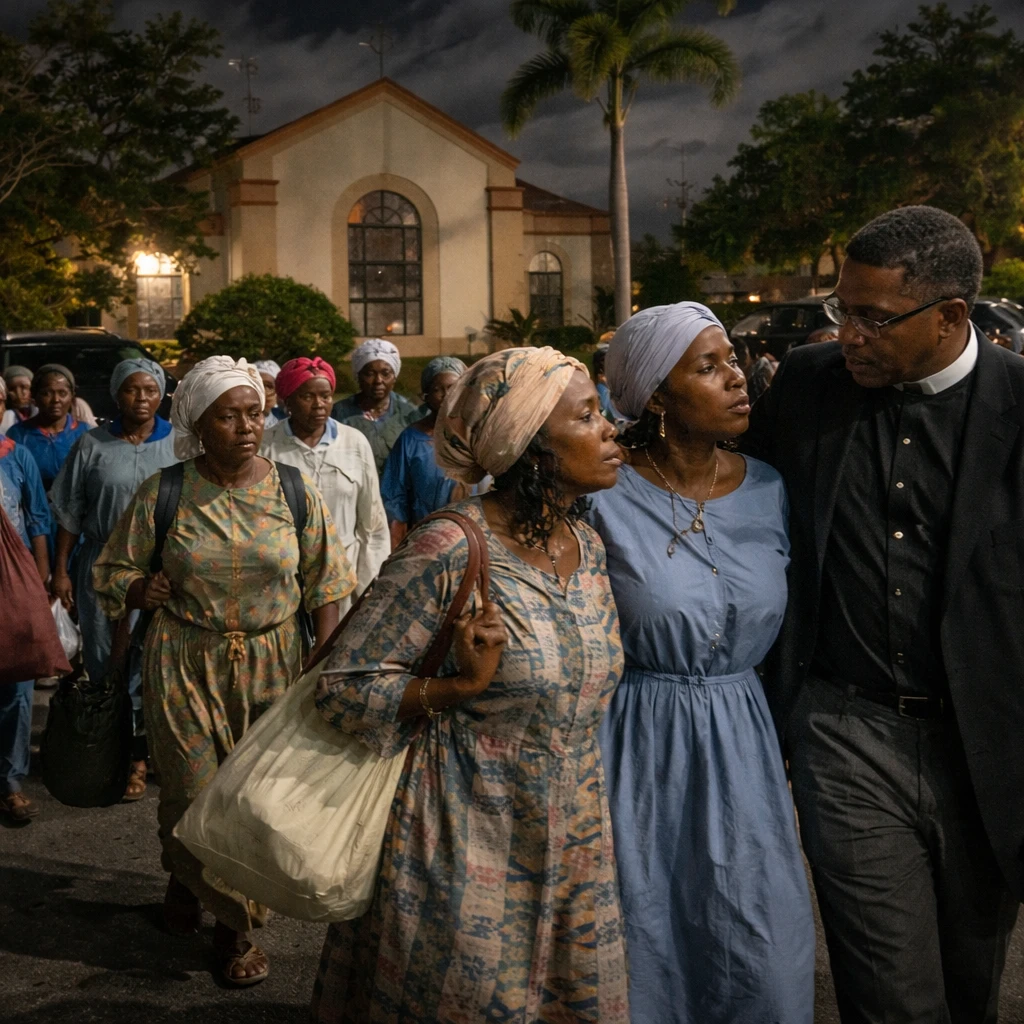
Throughout 2025, faith leaders who serve immigrant communities across the United States encountered significant obstacles and setbacks linked to shifting political rhetoric and policies targeting immigrants. Looking forward, many within these religious circles anticipate an even more challenging year ahead.
Central to their concerns is an escalation in harsh rhetoric and policy proposals from President Donald Trump, who has increasingly attributed societal issues such as crime and housing shortages to immigrant populations. His publicly stated call for "REVERSE MIGRATION" on social media further intensifies fears among immigrant groups.
Communities such as Haitians who escaped gang violence, Afghans admitted following their collaboration with U.S. forces prior to the Taliban's resurgence, and Somali Americans—particularly concentrated in Minnesota's Twin Cities—are apprehensive about their precarious status amid these stringent policy changes. Notably, Somali individuals have faced derogatory remarks from President Trump, who referred to them as "garbage." This ignited widespread condemnation from religious leaders, including the chair of the U.S. Conference of Catholic Bishops’ subcommittee on racial justice, who called on public officials to reject dehumanizing language.
"Each child of God has value and dignity," stated Bishop Daniel Garcia of Austin, Texas. "Language that denigrates a person or community based on ethnicity or country of origin contradicts this fundamental truth."
This article explores the challenges confronting these immigrant populations and the responses from faith leaders striving to protect and serve them.
Precarity for Haitians Awaiting Temporary Protected Status Renewal
In 2024, President Trump propagated false accusations against Haitian residents in Springfield, Ohio, alleging they consumed neighbors’ pets, which exacerbated prevalent anti-immigrant sentiments in this predominantly white, blue-collar community of approximately 59,000 residents, home to over 15,000 Haitians.
Many Haitians in Springfield have settled under the Temporary Protected Status (TPS) program, which permits continued legal residency due to dangerous conditions in their native country. However, this program is scheduled to expire in early February, leaving their futures uncertain. Rev. Carl Ruby, pastor at Central Christian Church—a faith community actively supporting Haitian immigrants—warns of dire consequences.
"The expiration of TPS will result in both economic and humanitarian calamities," Ruby asserted.
Ruby and Viles Dorsainvil, a leader within Springfield’s Haitian community, recently traveled to Washington, D.C. to petition Congressional representatives for legislative relief. Their efforts met widespread pessimism.
"Legislators have uniformly declared no forthcoming legislative action, and with President Trump’s intensifying rhetoric, prospects appear bleak," said Ruby. "It feels as if the tides are turning against us."
Many Haitians experience profound fear about returning to a homeland afflicted by gang violence. In response, faith groups in Springfield have mobilized, expressing increased determination to oppose deportations and safeguard community members.
"More churches are declaring sanctuary provisions and pledging to do all required to protect our community," Ruby reflected.
Impact on Afghan Refugees and Service Organizations
On the first day of his second term, President Trump suspended the U.S. refugee program, ceasing federal funding that numerous faith-based organizations depend on to assist refugees. This abrupt change critically affected groups such as Lutheran Social Services of the National Capital Area (LSSNCA), which operates near Washington, D.C.
Consequently, LSSNCA’s budget contracted by 68%, forcing layoffs that cut two-thirds of its nearly 300-strong staff, approximately 100 employees remain. A significant portion of their employees and nearly two-thirds of their service recipients are Afghan refugees who assisted U.S. efforts in Afghanistan and fled following the Taliban’s takeover in 2021.
Following the November 26 shooting of two National Guard members by an Afghan national in Washington, new immigration restrictions were imposed. This development profoundly disturbed the LSSNCA team.
Kristyn Peck, CEO of LSSNCA, said, "The incident and ensuing restrictions deeply impacted our staff morale. The prevailing public narrative wrongly portrays Afghans as threats."
Despite these adversities, Peck remains committed to their mission, highlighting ongoing volunteer engagement that helps provide services no longer fundable, such as English language and job skills courses particularly targeted at Afghan women.
World Relief, a U.S.-based global Christian humanitarian network linked with the National Association of Evangelicals, has also publicly condemned the intensified restrictions on Afghan refugees. CEO Myal Greene emphasized the broader implications for the religious community globally.
"President Trump’s intent to ‘permanently halt’ migration from ‘Third World countries’ disrespects the majority of the global Church," Greene said. "By halting Afghan processing due to one individual’s actions, tens of thousands who risked their lives alongside U.S. forces risk abandonment."
Somali Community Reacts to Negative Depictions and Enforcement
In December, leaders from Minnesota’s Somali community—including imams—formed a task force addressing challenges including immigration enforcement surges, repetitive fraud incidents, and disparaging remarks from President Trump aimed at the largest U.S. Somali refugee group.
Imam Yusuf Abdulle, directing the Islamic Association of North America, which encompasses over three dozen predominantly East African mosques (approximately half in Minnesota), stressed the community's resilience and accomplishments.
"While crime such as fraud and youth violence are challenges, no immigrant community escapes such struggles," Abdulle noted. "Given the time here, the Somali community has demonstrated remarkable resilience and success."
Nonetheless, many Somali residents, who are mostly citizens or legally present, felt compelled to avoid local businesses and mosques amid increased immigration enforcement.
The task force, comprising more than two dozen faith and business leaders alongside community organizers, prioritizes quelling fear and preparing for enhanced advocacy ahead of the 2026 midterm elections.
Community leader Abdullahi Farah remarked, "As election years approach, rhetoric escalates. We aim not only to counteract hateful narratives but also to unite our community."
Faith Leaders Mobilize Against Hostile Policies
In November, U.S. Catholic bishops issued a rare "special message" condemning the growing fears and anxiety among immigrant populations; this marked the first such collective pronouncement in twelve years.
The bishops expressed grave concern over detention center conditions and limited pastoral access, opposing mass deportations and dehumanizing rhetoric directed both at immigrants and law enforcement. They also acknowledged the dedicated efforts of clergy and lay persons assisting immigrants, urging broader continuation and expansion of support.
Similarly, Yehiel Curry, presiding bishop of the Evangelical Lutheran Church in America, released a pastoral message commending congregations for their support amid aggressive immigration enforcement. Highlighting ongoing racial profiling and harm, Curry called on congregations to actively accompany immigrant neighbors.
HIAS, a Jewish international nonprofit aiding refugees and asylum seekers, criticized recent administration actions targeting Afghan and Somali communities. Reflecting on the historical consequences of collective targeting, HIAS affirmed steadfast solidarity with those seeking safe lives in America.
"We understand painfully well how entire communities can be scapegoated due to one individual’s actions," HIAS stated. "We remain committed to standing with those impacted by these harmful policies and rhetoric."