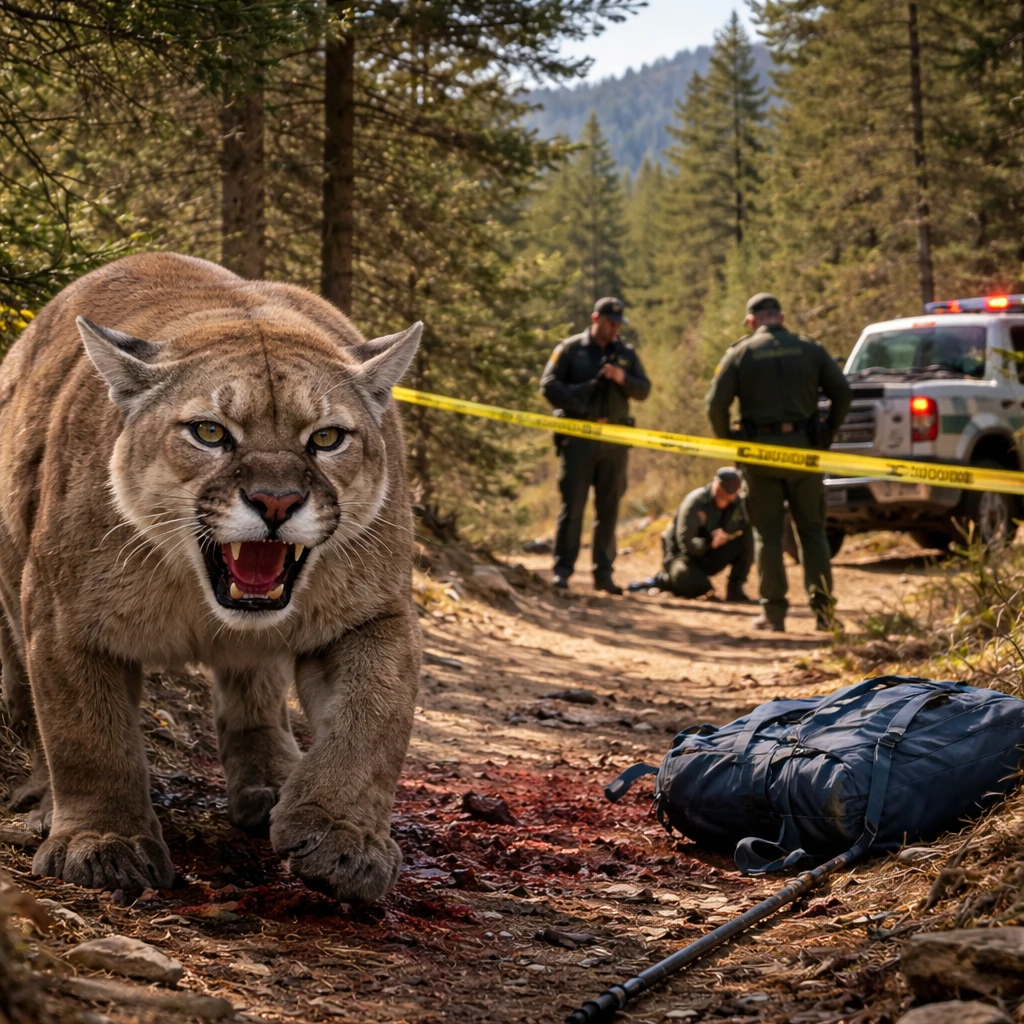

In a remote Colorado wilderness area, authorities are investigating a suspected fatal mountain lion attack that occurred on New Year’s Day, involving a solo hiker whose body was discovered along a trail. This incident follows recent close encounters with aggressive mountain lions reported in the same region.
Gary Messina, a 32-year-old runner from Glen Haven, recalled a dangerous encounter on the same trail during a dark November morning. While running, his headlamp illuminated two eyes in the brush nearby. As he attempted to document the encounter with his phone, a mountain lion charged at him. To defend himself, Messina resorted to throwing his phone at the animal, kicking dirt, and yelling to deter the predator, which persistently tried to maneuver behind him. After several tense moments, he managed to break off a sizable stick and struck the lion on the head, causing it to flee.
Colorado Parks and Wildlife officials confirmed that the female victim found Thursday on the Crosier Mountain trail sustained wounds consistent with a mountain lion attack, according to spokeswoman Kara Van Hoose. The Larimer County Coroner’s Office indicated that an autopsy scheduled for next week will provide more definitive findings.
Wildlife Response and Ongoing Concerns
Following the discovery of the body, wildlife officers tracked down and euthanized two mountain lions in the vicinity, one directly at the scene and another nearby. Necropsies are planned to determine if either animal was responsible for the fatal attack and to assess if they harbored any neurological diseases such as rabies or avian influenza. A search for a third mountain lion reported in the area was continuing as of Friday, with nearby trails remaining closed for public safety. Decisions on controlling the third cat will depend on ongoing assessments.
Reflecting on his own encounter, Messina suspects the same aggressive lion he confronted in November may have been involved in the recent fatal incident, given the animal's behavior. He described the experience as a life-threatening fight, where escape was impossible as the lion attempted multiple lunges, forcing him to defend his life actively. After reporting the November incident, wildlife authorities posted warning signs along the trails, though these have since been removed.
Mountain Lions in Colorado: Habitat and Human Interaction
Mountain lion sightings are relatively common east of Rocky Mountain National Park due to the region’s conducive habitat, which features dense forests, rocky terrain, and varied elevations. Despite their presence, attacks on humans remain rare. The last suspected fatal mountain lion attack in Colorado prior to this was in 1999, involving a young child who disappeared, although evidence was limited. Another fatal attack occurred in 1997, when a 10-year-old boy was killed and dragged off while hiking.
On the day the victim’s body was found, two hikers spotted it from approximately 100 yards away. They noticed a mountain lion nearby and succeeded in scaring it off by throwing rocks. One of the hikers, a physician, attempted to provide aid but detected no pulse.
Mountain lions—also known variously as cougars, pumas, or catamounts—can grow over six feet in length and weigh up to 130 pounds. In Colorado, their population is estimated between 3,800 and 4,400 individuals, and they are classified as a big game species eligible for regulated hunting. These solitary predators primarily prey on deer.
Understanding the Risks and Safety Measures
This recent incident marks the fourth fatal mountain lion attack in North America over the past decade and the 30th recorded since 1868, although not all deaths have been definitively attributed to mountain lion attacks. Attacks frequently occur during daylight hours when human activity overlaps with lion territories, suggesting that these predators do not actively seek humans but rather react to proximity.
According to the Mountain Lion Foundation, about 15% of such attacks are fatal. Byron Weckworth, the foundation’s chief conservation officer, stresses that increased interaction between humans and mountain lions largely stems from expanding human presence in wildlife habitats rather than increased aggression from the animals.
To reduce the risk of attack, experts advise moving in groups, keeping children close, and avoiding outdoor activity during dawn and dusk when mountain lions are most active. In the event of an encounter, maintaining eye contact, making oneself appear larger, and backing away slowly without running are recommended safety protocols.
A recently reported attack in Northern California, where two brothers were stalked and attacked by a mountain lion resulting in one fatality, underscores the potential dangers of human-cougar interactions.