
Saturday began with a cold and quiet atmosphere on Minneapolis' well-known Eat Street, a vibrant corridor south of the city center noted for its array of small eateries and coffee shops spanning multiple cuisines from New American to Vietnamese. However, within a few hours, the tranquility was shattered.
At approximately 9 a.m., a federal immigration officer fatally shot a man near this area, roughly 1.5 miles from the site of a previous fatal shooting of a local woman by an Immigration and Customs Enforcement (ICE) officer on January 7. That earlier incident had already stirred public outrage and sparked daily demonstrations.
Shortly after the shooting, videos began circulating online showing multiple federal agents restraining the man as gunfire erupted. This event quickly escalated tensions in the city, leading to a sharp division of blame between federal and local officials. Eat Street subsequently transformed into a focal point for intense confrontations as federal officers, alongside local and state police forces, withdrew amid the growing crowds of protesters occupying the area.
Within just over an hour, protests surged dramatically, expressing profound anger in a city already tense under the ongoing visitation of immigration enforcement actions. Prior to the latest developments, vast networks of local citizens had mobilized to monitor and challenge ICE activities, intensifying debates and accusations among national, state, and municipal leaders over the causes and management of the unrest.
On location minutes after the incident, independent reporters observed a swelling throng of demonstrators rapidly converging and challenging federal officers. Protesters sounded whistles, a common signal used to identify federal agents' presence during such operations.
The reporters had covered multiple events, including a large protest the previous day downtown, yet the emotional charge during Saturday's assembly appeared even more urgent and profound. The crowd, ballooning to several hundred participants, voiced their frustration through screams and profanities directed at the officers, some of whom responded with taunts.
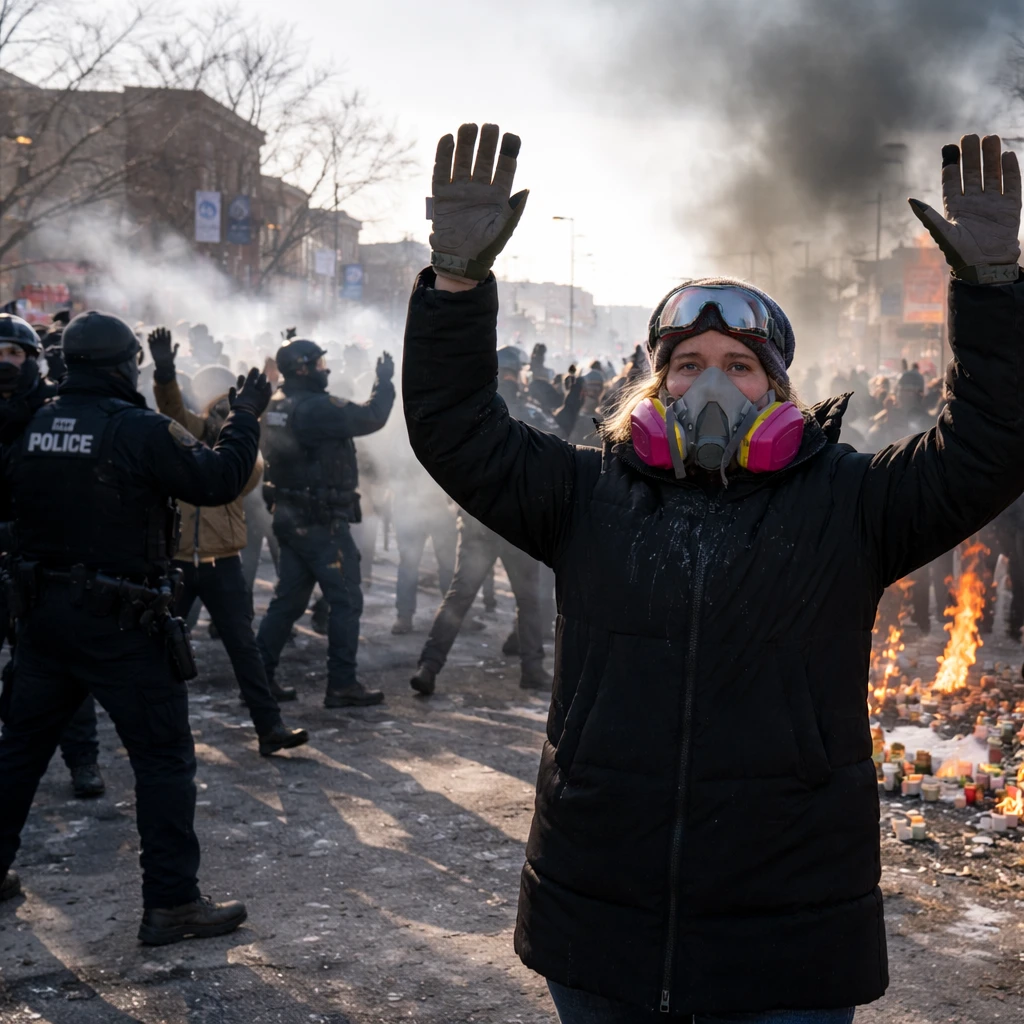
Over subsequent hours, the groups engaged in repeated clashes marked by the deployment of tear gas amid subfreezing temperatures. Law enforcement repeatedly pushed demonstrators back from makeshift barricades, aided by flash bangs and pepper balls. Despite these efforts, protesters reassembled and reclaimed positions. After roughly five hours and a final forceful advance down the street, federal agents departed in a convoy.
By mid-afternoon, the protest crowd commandeered the intersection adjacent to the shooting site, barricading it with discarded yellow police tape. Individuals perched atop large metal dumpsters blocking traffic, banging on them, while others addressed the assembly from within an impromptu memorial space dedicated to 37-year-old Alex Pretti, whose death sparked the unrest.
The memorial area was demarcated with tree branches formed into a circle, while flowers and candles were laid near snowbanks. Handmade signs demanding ICE's immediate departure from Minnesota featured prominently, many displaying explicit language that had become prevalent in recent weeks across the Twin Cities.
The mood conveyed a potent mix of widespread sorrow and indignation, echoing the emotional response witnessed following the George Floyd killing in 2020 — although notably without the associated widespread rioting from that period.
Despite multiple agencies deploying personnel and the National Guard pledging increased security contributions, immediate law enforcement presence was minimal around the shooting vicinity. Minneapolis Police Chief Brian O’Hara indicated at a press briefing that officers and National Guard members wearing high-visibility safety vests were maintaining safety and managing traffic to allow for lawful, peaceful demonstrations. The area within a 6-by-7 block perimeter surrounding the scene restricted traffic access exclusively to residents.
Many businesses, including retail, sports venues, and cultural institutions, closed Saturday afternoon due to safety concerns, though some remained open to aid protesters by offering refreshments like water, coffee, snacks, and hand warmers during the harsh cold.
As evening set in, hundreds gathered somberly at the memorial site, holding a vigil. Caleb Spike, one of the attendees, reflected on the relentless nature of the unrest, stating, “It feels like every day something crazier happens. What comes next? I don’t know what the solution is.”