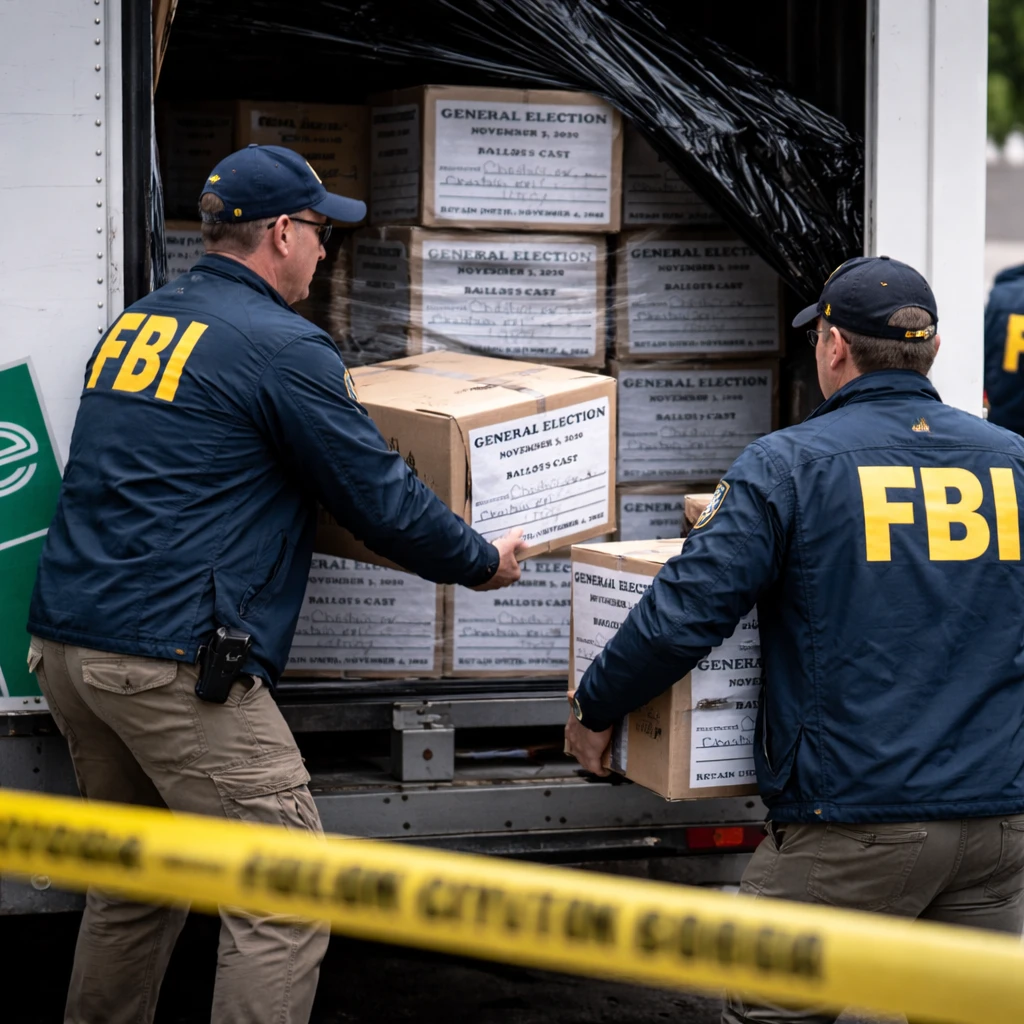

In a notable development this week, FBI agents arrived at a warehouse south of Atlanta to seize hundreds of boxes containing ballots and election documents tied to Georgia's 2020 general election, specifically from Fulton County, the state's most populous and predominantly Democratic voting jurisdiction. The seizure operation involved box trucks transporting the materials away from the site, which serves as the central hub for Fulton County election activities.
Fulton County has been under intense scrutiny since President Donald Trump's narrow loss to Democrat Joe Biden in the state during the 2020 presidential election. Trump and his supporters have repeatedly alleged, without presenting verified evidence, that extensive voter fraud occurred in the county, influencing the election outcome. However, the precise reason for Wednesday's search and seizure mission by federal agents has not been disclosed to the public, and the search warrant authorizing the operation remains sealed.
The county officials first learned of the federal investigation when Fulton County Chairman Robb Pitts was notified just after noon that FBI personnel were present at the county elections facility. Initially, agents visited the county elections office but had to return with a revised warrant as custody of the election materials lies with the county court clerk, who stores them securely within the hub. County legal counsel advised compliance with the search after reviewing the federal paperwork.
Despite his position, Pitts was not permitted entry into the specific areas where the seizure took place. "I was not even allowed where they were," Pitts explained, mentioning he could only intermittently observe the activity. Similarly, Sherri Allen, chair of the Fulton County election board, attempted to coordinate an arrangement that would allow the county to retain copies of the documents being removed, but her request was denied. Allen reported uncertainty about the exact items that were taken.
Documentation shared with the county includes a warrant cover sheet that lists sought items covering comprehensive election-related materials from the 2020 general election: all ballots, the tabulator tapes reflecting vote counts, electronic ballot images generated during counts and recounts, and the complete voter rolls.
This incident signals a significant federal intervention in a highly contentious political arena. Traditionally, the FBI and the Department of Justice are institutions that conduct investigative and prosecutorial actions independent of executive branch politics. The seizure bears on ongoing disputes stemming from President Trump's personal grievances surrounding the election results, raising concerns about the use of federal law enforcement to target political opponents. Past assertions of widespread election fraud by Trump have been dismissed by multiple audits, state officials, courts, and even by Trump's own former attorney general.
Notably, high-ranking officials were present during the raid. FBI Co-Deputy Director Andrew Bailey and U.S. Director of National Intelligence Tulsi Gabbard were observed at the site, although neither has publicly commented. Gabbard's involvement is particularly unusual given that she is not part of the FBI or any federal law enforcement agency; her role has revolved around defending Trump administration positions that question intelligence conclusions on foreign interference in previous elections. Officials indicated that Gabbard has a key function relating to safeguarding election security from interference, including threats to voting systems and related infrastructure.
Senator Mark Warner, ranking Democrat on the Senate Intelligence Committee, called for Gabbard to report to the committee if foreign interference is suspected in relation to the 2020 election. He warned against injecting partisan narratives into intelligence processes, cautioning that it risks legitimizing conspiracy theories harmful to democratic institutions.
The attorney identified on the warrant documents is Thomas Albus, interim U.S. attorney from Missouri's eastern district, rather than the U.S. attorney based in Atlanta. The Justice Department has remained silent on the matter and has not explained why a Missouri official is leading this investigation.
Reactions to the FBI action have fallen sharply along partisan lines. Democratic leaders criticized the search as an assault on democratic principles and a distraction tactic, whereas Republican officials defended the investigation as a legitimate effort to unearth electoral truths. Some Democrats voiced apprehension regarding potential attempts by Trump allies to cultivate distrust and turmoil ahead of the 2026 midterm elections. Representative Saira Draper stressed the risk of fabricated pretexts leading to further consequences. Conversely, Republican State Representative Victor Anderson urged caution, underscoring faith in the justice system and describing the event as a routine legal execution of a federal search warrant.
Fulton County's recent election history has attracted considerable attention. Prior to 2020, elections were characterized by issues such as long wait times and delayed result reporting. The 2020 primary election heightened these challenges due to disruptions from the COVID-19 pandemic. Following those problems, the county agreed to have an independent monitor oversee the general election that year. The monitor reported on disorganized and inadequate processes but found no signs of fraud or illegal activity.
Subsequent reviews reflect marked improvements in the county’s election administration. In 2023, the State Election Board opted not to intervene in local election management after improved evaluations, and the latest monitoring found elections to be orderly and well organized. Leadership in the county elections office has turned over almost entirely since 2020, adopting new procedures and consolidating operations at a central facility in Union City rather than multiple dispersed locations.
While the investigation continues with limited public information, the developments underscore ongoing political tensions regarding election security and federal oversight in state and local electoral matters.
Contributors to this report include several journalists based in Washington and Atlanta.