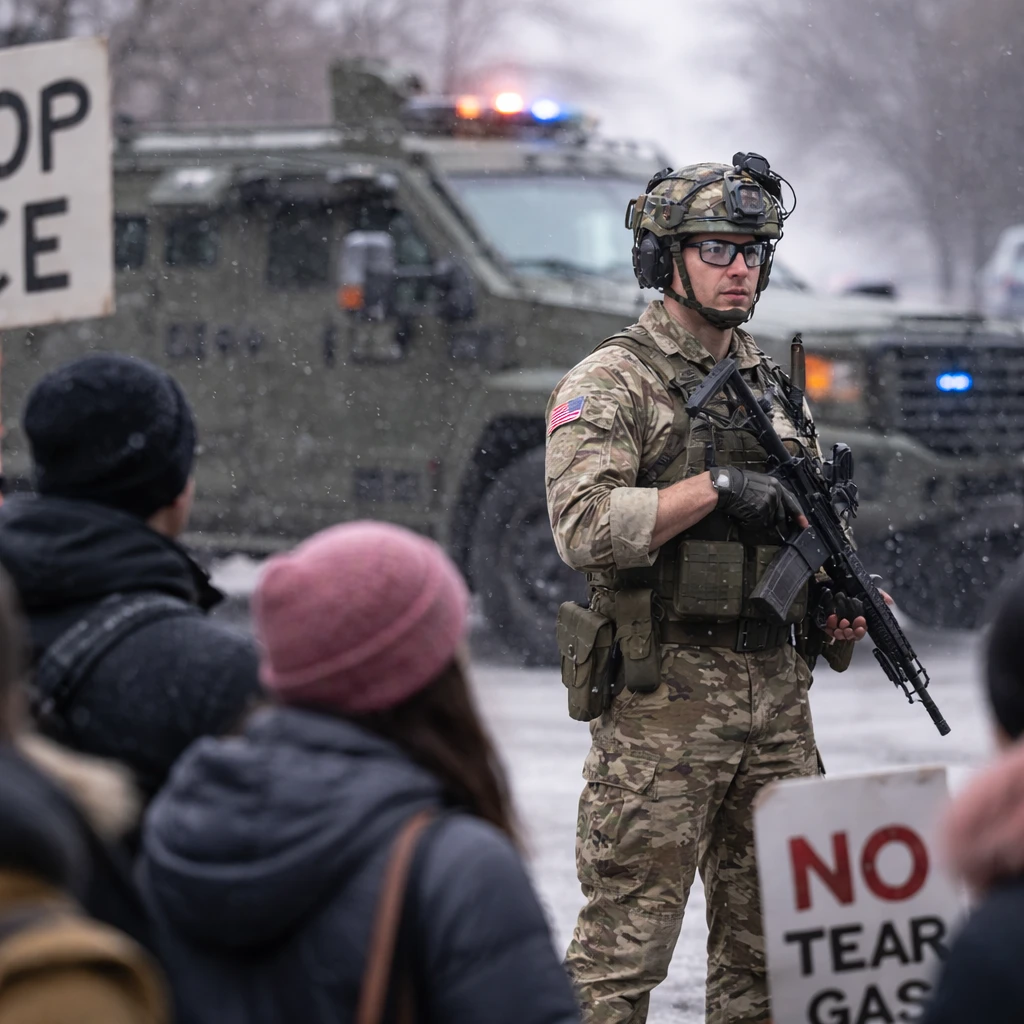

In the Minneapolis metropolitan area, federal law enforcement personnel involved in the largest recent immigration enforcement actions in the United States are prohibited from detaining or deploying tear gas against peaceful protesters who are not hindering officials, according to a ruling by a Minnesota federal judge on Friday.
U.S. District Judge Kate Menendez issued this ruling in response to a legal complaint brought forth in December by six Minnesota activists. These individuals are part of the many local residents who have been monitoring Immigration and Customs Enforcement (ICE) and Border Patrol officers as they implement intensified immigration measures enacted during the Trump administration in the Minneapolis-St. Paul region since the previous month.
Since the commencement of these enforcement operations, repeated confrontations between federal agents and demonstrators have occurred. Tensions significantly increased following an event on January 7, when an immigration officer fatally shot Renee Good in the head while she was driving away from a situation in Minneapolis. This incident was widely recorded from various vantage points. Numerous arrests and brief detentions of individuals in the Twin Cities have also been conducted by agents during this period.
The activists involved in the lawsuit have obtained legal representation from the American Civil Liberties Union (ACLU) of Minnesota. The ACLU contends that the actions of federal government officers infringe upon the constitutional rights of people residing in the Twin Cities.
Following the judicial decision, Tricia McLaughlin, Assistant Secretary of the U.S. Department of Homeland Security, issued a statement affirming that the agency is undertaking "appropriate and constitutional measures to uphold the rule of law and protect our officers and the public from dangerous rioters." According to her, some individuals have assaulted officers, damaged federal property and vehicles, and attempted to obstruct officers from performing their duties.
McLaughlin emphasized, "We remind the public that rioting is dangerous - obstructing law enforcement is a federal crime and assaulting law enforcement is a felony." The ACLU had not issued any immediate comments following the ruling on Friday night.
The judge's injunction further specifies that officers are forbidden from stopping and detaining drivers and passengers of vehicles where there is no reasonable suspicion of interference or obstruction of law enforcement activities. The court recognized that "safely following agents at an appropriate distance does not, by itself, create reasonable suspicion to justify a vehicle stop."
Menendez clearly articulated that without probable cause or reasonable suspicion of a crime or interference with officers’ work, arrests of individuals are not permitted.
Judge Menendez is also overseeing a related case filed earlier in the week by the State of Minnesota alongside the cities of Minneapolis and St. Paul. This suit requests a suspension of the immigration enforcement crackdown and raises legal questions that overlap with the original case. During a hearing on Wednesday, she declined the state's appeal for an immediate temporary restraining order.
Brian Carter, Assistant Attorney General for the state, urged for a de-escalation, stating, "What we need most of all right now is a pause. The temperature needs to be lowered." Menendez acknowledged the significance of the issues raised by the state and cities, describing them as "enormously important," while noting the complexity and novelty of the constitutional and legal questions involved. She ordered submissions of additional legal briefs from both parties by the following week for further consideration.
This ongoing legal scrutiny highlights the delicate balance between ensuring lawful immigration enforcement and respecting the rights of citizens and peaceful protesters during a period of increasing regional conflict and attention.
Reporting for this story include contributions from Honolulu and Seattle.