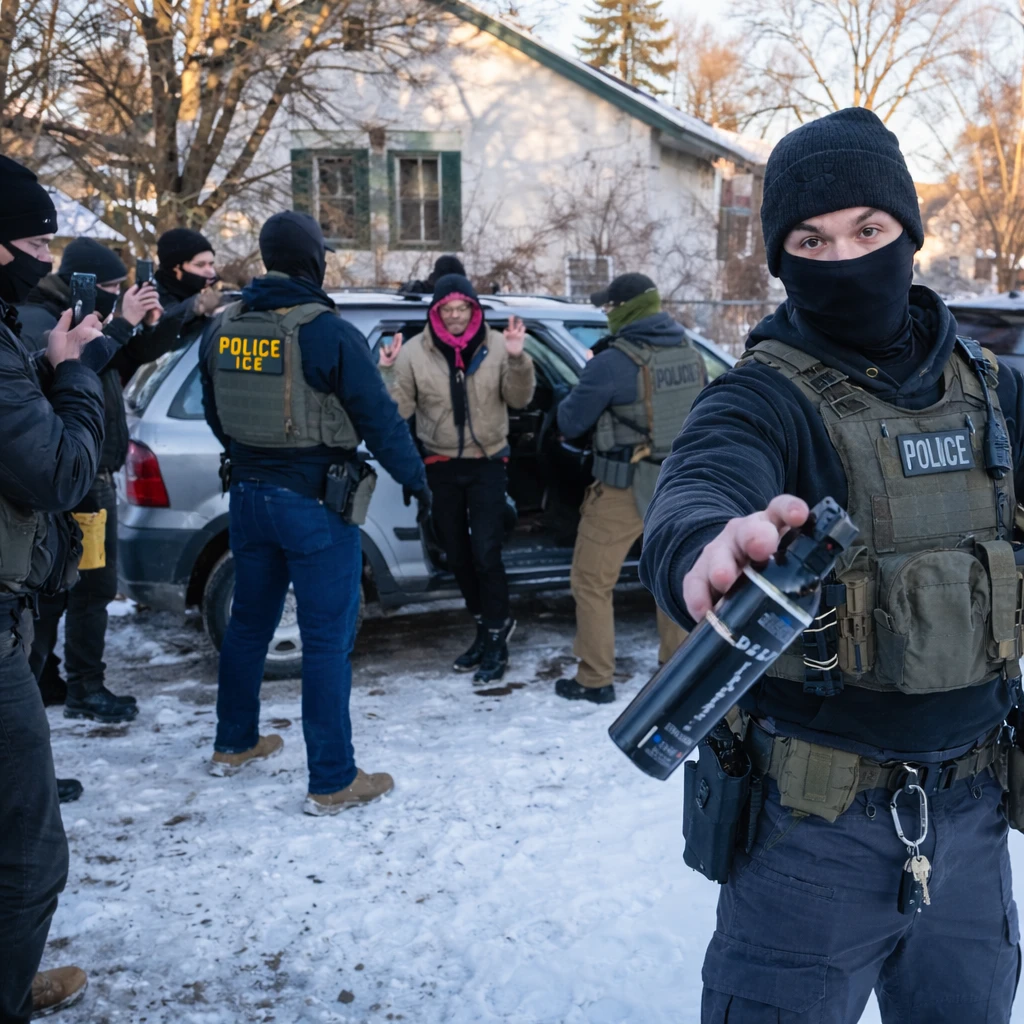

Federal immigration officers in Minneapolis detained several activists on Tuesday after those individuals followed immigration enforcement vehicles through the city. The arrests, which included the handcuffing of at least one individual wearing anti-ICE attire who was placed face-down on the ground, signal persisting tensions in the area since the recent departure of a prominent Border Patrol commander involved in the city's immigration crackdown.
Witnesses and photographers at the scene reported that federal agents, who had their firearms drawn, ordered activists trailing their vehicles to exit a car at gunpoint. The convoy of federal agents was conducting immigration-related arrests, typically focusing on residential neighborhoods and individual homes rather than public staging areas, which marks a shift from previous enforcement tactics. Observers noted that operations had become more discreet and less confrontational compared to earlier, more visible convoys.
During the arrests, agents instructed media personnel to maintain distance and issued warnings about the possible use of pepper spray if their instructions were not followed. The heightened enforcement activity follows reports of immigration agents knocking on doors in south Minneapolis and prompted local activists to track their movements through the city. The Department of Homeland Security (DHS) and Immigration and Customs Enforcement (ICE) have yet to issue statements regarding these recent events.
Adding to the legal complexities, a federal judge recently imposed restrictions on federal officers' treatment of motorists who follow their vehicles without obstructing law enforcement activities. The judge ruled that following agents at a safe distance does not automatically justify stops or detentions. However, an appeals court has since lifted this order, leaving enforcement strategies and rights of observers in a state of legal ambiguity.
The enforcement situation in Minneapolis has evolved following the departure of Border Patrol commander Greg Bovino, who led immigration crackdowns in Minneapolis and other major U.S. cities. Bovino left the city in the wake of a fatal shooting involving federal officers, which was the second such incident in the area during January. Subsequently, former Trump administration border chief Tom Homan was assigned to Minnesota, where he cautioned that individuals interfering with immigration operations could face legal consequences.
Concurrently, the Minneapolis city government faced a federal grand jury subpoena seeking records related to efforts to impede federal immigration enforcement. The subpoena demands information on any city activities aimed at obstructing the Trump administration's immigration crackdown. The city, under Democratic Mayor Jacob Frey, has denounced the subpoena as an intimidation tactic but stated compliance without providing additional details. Additional subpoenas have been issued to other state and local offices, though specific deadlines and responses vary. Sources suggest these inquiries focus on whether local officials hindered enforcement through public statements.
Separately, legal proceedings in Minnesota continue with a federal magistrate denying bond to a man accused of assaulting Democratic U.S. Representative Ilhan Omar by squirting apple cider vinegar during a public event. Prosecutors emphasized the intolerance for attacks on elected officials conducting official duties, while the defense raised health concerns regarding the accused’s jail conditions.
These incidents highlight ongoing friction between federal immigration enforcement efforts and local demonstrations and political responses in Minneapolis. The dynamic reflects broader national debates surrounding immigration policy, law enforcement conduct, and political activism. At this time, DHS and ICE have not publicly addressed the recent arrests or the evolving enforcement patterns in the city.