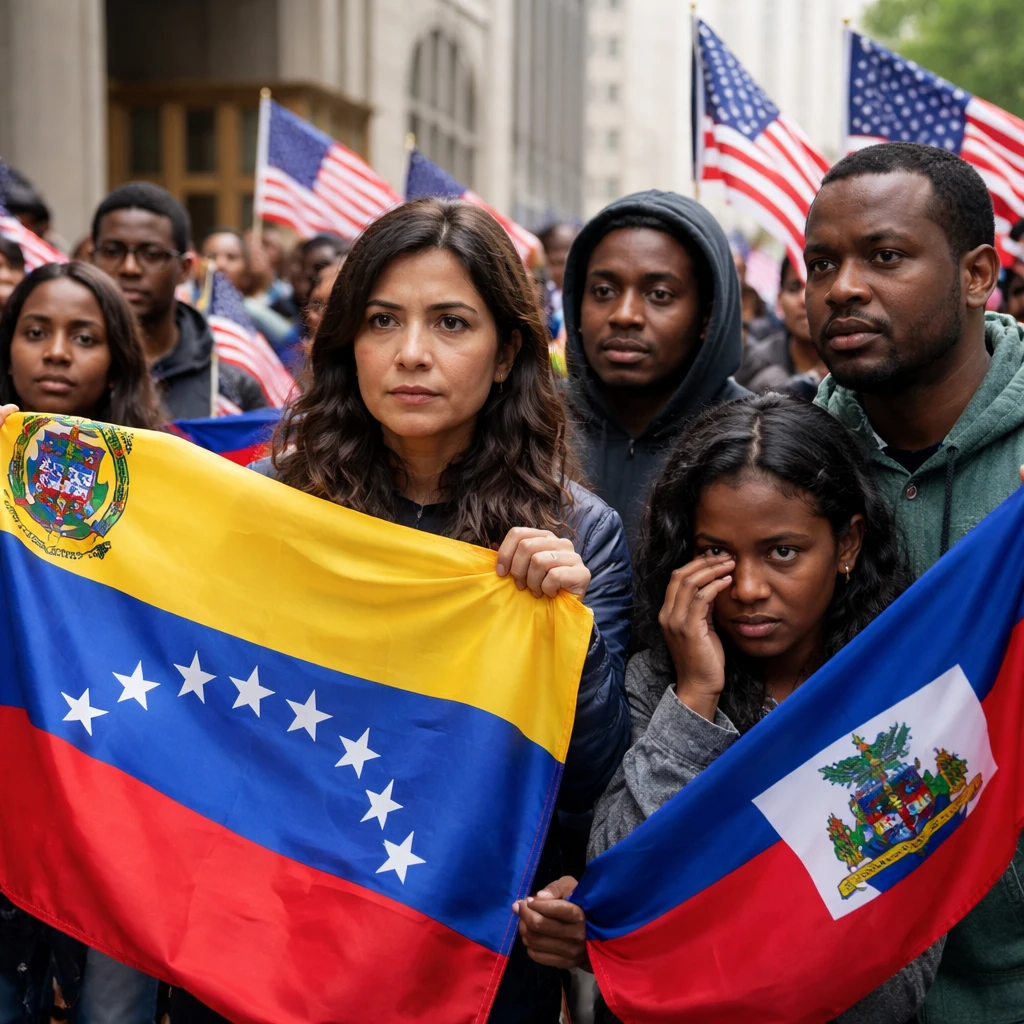

On Wednesday, a federal appeals court determined that the Trump administration unlawfully terminated legal protections that had permitted hundreds of thousands of Venezuelan immigrants to reside and work in the United States. The decision came from a three-judge panel of the 9th U.S. Circuit Court of Appeals, which affirmed a preceding district court ruling concluding that the Homeland Security Secretary Kristi Noem exceeded her jurisdiction by ending Temporary Protected Status (TPS) for Venezuelans prematurely.
Despite this ruling, the immediate implications are limited because the U.S. Supreme Court authorized Noem's termination to remain effective pending a final review by the justices last October. Following the appellate decision, a Department of Homeland Security spokeswoman issued a statement condemning the ruling as an unlawful and activist overreach by the judiciary, asserting that federal courts continue to undermine established immigration statutes.
Assistant Secretary Tricia McLaughlin underscored that TPS was intended as a provisional measure. The same 9th Circuit panel also affirmed the lower court's finding that Noem overstepped her bounds by prematurely ending TPS for hundreds of thousands of Haitian immigrants.
Furthermore, a federal judge in Washington is anticipated to issue a ruling imminently regarding a motion to maintain TPS protections for Haitians while an additional lawsuit contesting the termination proceeds. The country’s TPS designation currently is scheduled to expire on February 3.
The appeals court judges—Kim Wardlaw, Salvador Mendoza Jr., and Anthony Johnstone—determined that the TPS statute passed by Congress does not authorize the secretary to entirely revoke an existing TPS designation. All three judges were appointed by Democratic presidents.
"The statute contains numerous procedural safeguards that ensure individuals with TPS enjoy predictability and stability during periods of extraordinary and temporary conditions in their home country," Judge Wardlaw, nominated by President Bill Clinton, explained on behalf of the panel.
Judge Wardlaw emphasized the real and consequential impact of Noem's illegal actions on Venezuelans and Haitians in the United States relying on these protections. She highlighted that the record contains numerous examples of productive, law-abiding members of society—including parents and spouses of U.S. citizens—who pay taxes but have nonetheless faced detention or deportation following the loss of TPS.
TPS, established by Congress as part of the Immigration Act of 1990, provides the Homeland Security secretary with discretionary power to grant lawful status to individuals fleeing nations suffering from civil unrest, natural disasters, or other temporary yet grave conditions precluding safe return. TPS designations are issued for durations of six, twelve, or eighteen months, with the possibility of extensions if adverse conditions persist. While the status prevents deportation and authorizes work, it does not offer a route to citizenship.
Noem justified ending these protections by asserting that conditions in Haiti and Venezuela had sufficiently improved and that it was not in the national interest to extend what is inherently a temporary program.
Venezuela has been entrenched in prolonged political turmoil, soaring unemployment, and widespread hunger due to chronic hyperinflation, rampant corruption, economic mismanagement, and ineffective governance. In her response, McLaughlin attributed emerging stability in Venezuela to the Trump administration's efforts to remove President Nicolas Maduro from power.
Haiti's TPS designation dates to 2010 following a devastating magnitude 7.0 earthquake that left hundreds of thousands dead or injured and over one million displaced. The country continues to grapple with severe hunger and widespread violence. McLaughlin criticized past administrations for treating Haitian TPS as a "de facto amnesty program," given that the earthquake occurred over 15 years ago.
In a separate opinion, Judge Mendoza stated there was substantial evidence indicating racial and national origin bias, reinforcing the lower court's finding that Noem's decisions were predetermined and that the stated reasons were pretextual.
"It is evident that the Secretary's decisions to vacate TPS designations were not grounded in genuine policy changes or substantive disagreements with prior agencies’ TPS procedures but instead stemmed from stereotypical assumptions portraying Venezuelan and Haitian immigrants as criminals or mentally unstable," Mendoza wrote.
The government attorneys defended the broad discretion of the secretary in managing the TPS program and contended that such decisions are generally insulated from judicial review. They also rejected allegations that racial animus influenced the terminations.