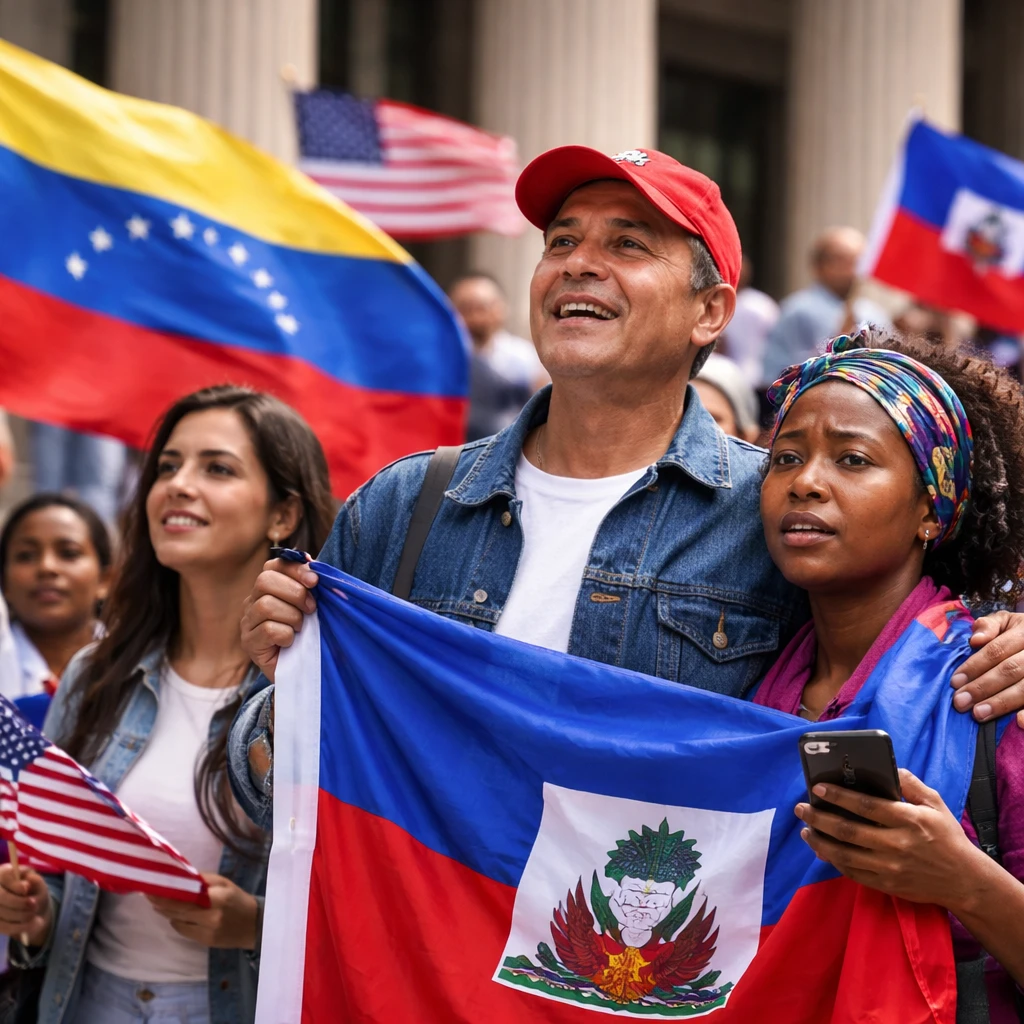

On Wednesday evening, a federal appeals court panel concluded that the White House acted beyond its legal powers by rescinding Temporary Protected Status (TPS) for hundreds of thousands of Venezuelan nationals who have been living and working in the United States. The three-judge panel from the U.S. Ninth Circuit Court of Appeals affirmed a ruling from a lower court, stating that Secretary of Homeland Security Kristi Noem had overstepped her authority when she ended TPS designations for Venezuelans prematurely.
Despite this ruling, the decision does not have an immediate operational impact. In October, the U.S. Supreme Court allowed Secretary Noem’s termination of TPS to take effect while it deliberates on the final outcome of the case.
Requests for comment sent Wednesday evening to the Department of Homeland Security went unanswered.
The Ninth Circuit judges also concurred with the lower court's conclusion that Noem exceeded her legal authority in deciding to cut short protections afforded to hundreds of thousands of Haitian migrants under TPS. A separate federal judge based in Washington, D.C., is expected to weigh in soon on a motion seeking to halt the termination of TPS for Haitians, an action challenged by a different lawsuit. The protections for Haitian nationals were scheduled to end on February 3.
Judges Kim Wardlaw, Salvador Mendoza Jr., and Anthony Johnstone jointly authored the appellate decision, emphasizing that the TPS statute, enacted by Congress, does not empower the Secretary of Homeland Security to revoke an existing TPS designation arbitrarily. All three judges were appointed by Democratic presidents. Wardlaw, a Clinton appointee, detailed how the legislation contains several procedural safeguards to guarantee predictability and stability for people with TPS during periods of severe and temporary adverse conditions in their home countries.
Judge Wardlaw also noted the significant and tangible consequences of Noem's unlawful actions on Venezuelan and Haitian TPS holders in the United States. Documentation from the legal proceedings demonstrates cases involving hardworking community members who pay taxes, have close family ties to U.S. citizens, and lack criminal records, yet have faced detention or deportation after losing their TPS status.
Established under the Immigration Act of 1990, TPS allows the Secretary of Homeland Security to grant temporary lawful status to individuals fleeing nations experiencing armed conflict, environmental disasters, or extraordinary and temporary conditions that make safe return impossible. TPS status is typically granted for six, 12, or 18 months and can be extended while hazardous conditions persist. This status protects holders from deportation and grants work authorization, but does not provide a pathway to U.S. citizenship.
Secretary Noem justified ending the protections by stating that conditions in Haiti and Venezuela had improved sufficiently and that continuing to allow migrants from these countries to remain under a temporary program was not in the national interest. Millions of Venezuelans have fled socio-political instability, widespread unemployment, and severe food shortages amid a long-lasting crisis wrought by hyperinflation, political corruption, economic mismanagement, and ineffective governance.
Haiti was initially designated for TPS in 2010 after a devastating 7.0 magnitude earthquake caused thousands of deaths, injuries, and left over a million homeless. Currently, Haitians face rampant hunger and pervasive gang violence.
Judge Mendoza emphasized that extensive evidence of racial and national-origin animosity underpinned the lower court's finding that Secretary Noem’s decisions were predetermined and used justification as a pretext. He stated it was evident that the Secretary's measures were not genuinely based on substantive policy considerations or meaningful deviations from prior administration practices regarding TPS but were instead rooted in stereotypical and negative perceptions of Venezuelan and Haitian migrants as dangerous criminals or mentally unstable individuals.
Government attorneys have argued that Secretary Noem holds broad and explicit authority to make decisions related to the TPS program and that these decisions are insulated from judicial review. They have also denied that racial bias influenced the policy changes.