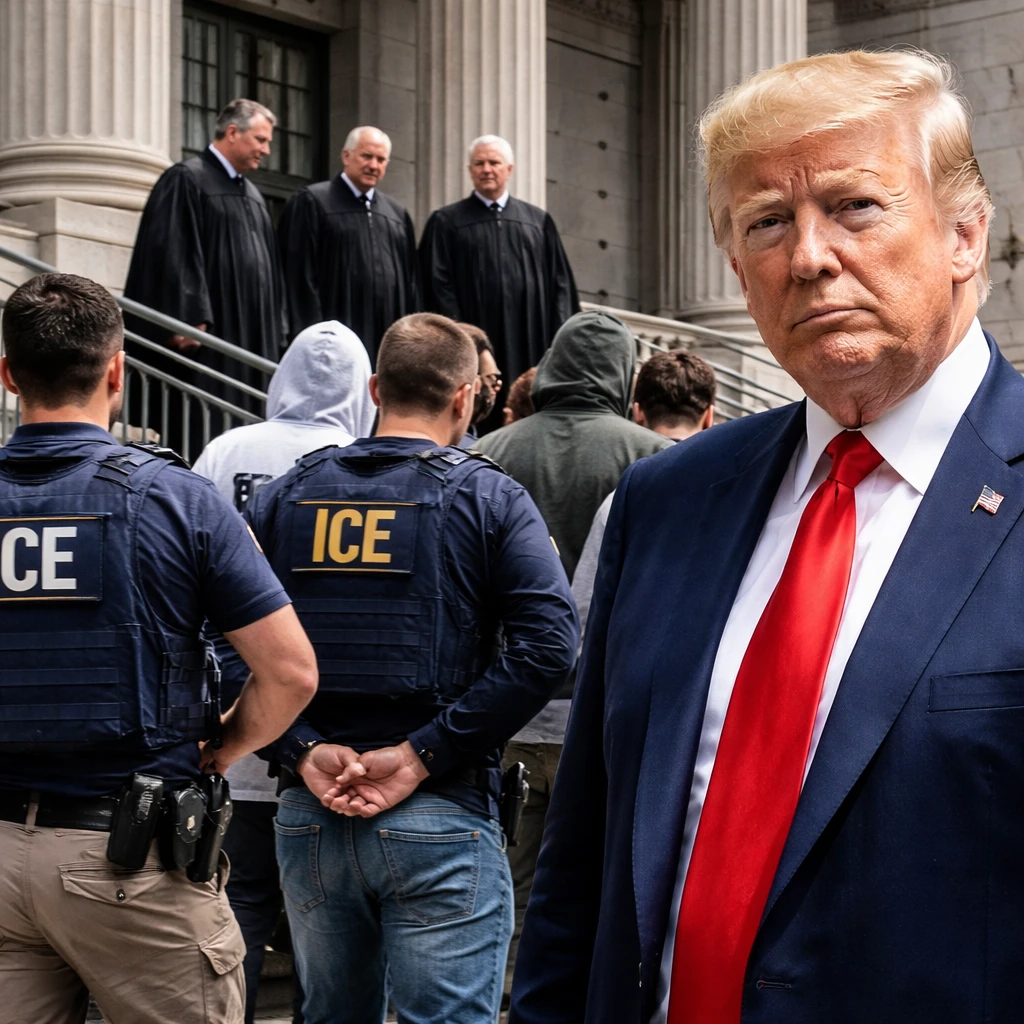

On Thursday, the full 5th U.S. Circuit Court of Appeals heard arguments regarding President Donald Trump's controversial use of a centuries-old wartime statute to deport individuals associated with a Venezuelan gang. Chief Judge Jennifer Walker Elrod of New Orleans posed a striking hypothetical to government counsel, inquiring whether such a law could be invoked against a "British invasion" that was perceived to be corrupting young American generations—a nod to the cultural concerns surrounding the Beatles and other British bands during the 1960s.
Judge Elrod acknowledged the fanciful nature of her question, yet government attorney Drew Ensign responded affirmatively, asserting the president’s authority under the Alien Enemies Act was broad and not subject to judicial constraints in these circumstances. "These sort of questions of foreign affairs and the security of the nation are specifically political issues," Ensign remarked, emphasizing that any check on these powers fell within the legislative domain.
The case arises from a 5th Circuit three-judge panel decision last year, one of the most conservative bodies in the federal judiciary, which ruled that the administration’s invocation of the Alien Enemies Act—enacted in 1798 during the Quasi-War with France—was improper when applied to the Venezuelan criminal group Tren de Aragua. Historically, the act, rarely used, has been invoked only during formal wars such as the War of 1812 and the two World Wars.
The original three-judge panel and several lower courts held the law was meant to address enemy nations in wartime, not criminal gangs operating within or abroad. The government has since appealed that decision, prompting all 17 judges of the 5th Circuit to convene for an en banc hearing in New Orleans.
ACLU attorney Lee Gelernt challenged the administration's stance, emphasizing that the gang's activities constituted ordinary criminal offenses dealt with within the regular law enforcement framework, whereas the Alien Enemies Act was designed explicitly for wartime and military contexts.
Judges during the proceedings expressed concern about the judiciary’s role in second-guessing presidential judgments on threats to national security. Ensign argued the statute’s language covered "invasion" and "predatory incursion," which a president could interpret liberally, citing legal precedents where foreign fishing boats entering U.S. waters were seen as predatory incursions.
Furthermore, Ensign noted the administration's allegation that the gang acted under orders from Venezuela’s ousted President Nicolas Maduro's government, although some analysts have disputed this claim.
The timeline for issuing the court's ruling remains uncertain. Ultimately, the constitutionality of the Trump administration’s actions under the Alien Enemies Act will likely require resolution by the U.S. Supreme Court.
This is not the first instance that the Supreme Court has engaged with the administration’s use of the act. Previously, the government forcibly transferred over 250 Venezuelans to a notorious prison in El Salvador, asserting federal courts lacked jurisdiction. The Supreme Court rejected this position, ruling that individuals subjected to removal must have a "reasonable" opportunity to contest their designations as gang members in court.
Subsequently, the Supreme Court intervened with an unusual midnight order to halt further flights under the act and mandated that removals be paused pending the 5th Circuit’s development of appropriate legal procedures. The nation’s highest court has not yet addressed the fundamental constitutionality of the administration’s deployment of the Alien Enemies Act, reserving that question for the lower court’s adjudication first.