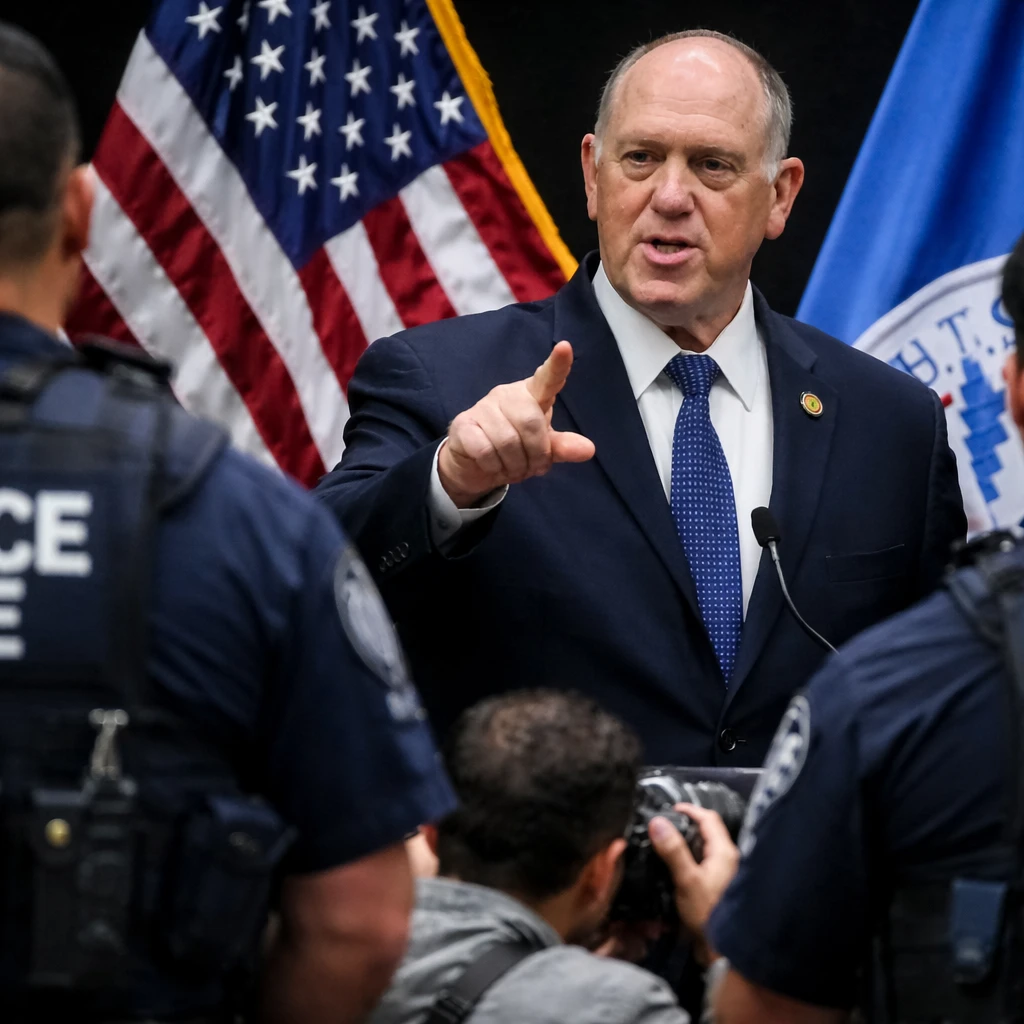

The U.S. administration has declared plans to scale back the presence of immigration enforcement agents in Minnesota, withdrawing roughly 700 of the nearly 3,000 federal officers currently assigned to the state. The decision, announced by Tom Homan, the designated "border czar," comes after last week's agreement with Minnesota's state and local authorities to facilitate the transfer of detained immigrants, allowing for a reduction in personnel without halting ongoing enforcement efforts.
Homan did not specify an end date for the operation—a campaign that has become highly controversial since violent confrontations arose, including the fatal shootings by immigration officers of Renee Good and Alex Pretti, both U.S. citizens, in Minneapolis. Despite agents being removed, the operation remains active, with a contingent of about 2,000 federal agents continuing to enforce immigration laws across the state.
This figure represents a return to the initial deployment level in early January when the Department of Homeland Security launched what it termed its "largest immigration operation ever." Since then, the presence of heavily armed, masked agents has sparked resistance among community members frustrated with the aggressive tactics employed.
Homan indicated that further reductions in federal personnel would depend on enhanced cooperation from local and state law enforcement and a cessation of protests that interfere with arrests. He suggested that such conditions would create a safer environment for agents to operate with fewer numbers.
President Donald Trump stated in an interview with NBC News that he ordered the reduction and acknowledged the need for "a somewhat softer approach," while emphasizing that firmness in enforcing immigration laws remains essential. Minnesota's Democratic Governor Tim Walz and Minneapolis Mayor Jacob Frey, both critics of the federal operation, agreed that removing 700 agents is a positive but insufficient step and called for the entire operation to end promptly.
Governor Walz used social media to demand a faster and more substantial reduction in forces, the initiation of state investigations into the deaths of Pretti and Good, and an end to what he described as a campaign of retaliation. In addition, Vice President JD Vance clarified that agents departing Minnesota were mainly present in Minneapolis to safeguard arresting officers and insisted in a radio interview that the overall immigration operation was not being diminished.
Homan took over command of the Minnesota operation in late January, following the second officer-involved shooting fatality and amid intensifying political scrutiny and questions about the operation's conduct. Upon assuming leadership, Homan emphasized that a reduction in agents would hinge on increased collaboration with local authorities, urging jails to notify Immigration and Customs Enforcement (ICE) about detainees potentially subject to deportation. This strategy aims to reduce the number of agents needed to track and arrest undocumented individuals by facilitating custody transfers.
In a Wednesday press briefing, Homan pointed to an unprecedented rise in cooperation from local police departments as the main reason for reducing the federal presence, resulting in a safer overall environment and justifying the withdrawal of 700 agents. However, he did not name the specific jurisdictions involved. White House press secretary Karoline Leavitt stated the federal government would continue monitoring local officials to ensure compliance with their commitments.
The Trump administration has long criticized so-called sanctuary cities—municipalities that limit their cooperation with federal immigration enforcement. Minnesota officials report that state prisons and nearly all county police departments cooperate with immigration authorities, although two major county jails serving Minneapolis and St. Paul had not fully complied with ICE's request for total cooperation prior to the operation, despite transferring inmates on judicial orders.
The Hennepin County Police, which serves Minneapolis and nearby suburbs, asserted that its policies remained unchanged. The Ramsey County Police in St. Paul did not respond to requests for a comment.
Homan maintained that the Minnesota ICE operation has been successful, citing removals of individuals wanted for violent crimes as evidence of its effectiveness in enhancing public safety, though acknowledging it had not been a perfect endeavor. He stressed that scaling back the number of agents does not indicate a retreat from the president’s deportation goals, affirming the agency’s commitment to continuing enforcement activities despite ongoing protests.
Meanwhile, two Minnesota school districts and a teachers' union filed a lawsuit seeking to block federal immigration actions in or near schools, citing disruptions to classes, threats to student safety, and declining attendance. They argued that the "Operation Metro Surge" marked a policy shift dismantling previous boundaries on law enforcement activities in sensitive locations such as schools. A Department of Homeland Security spokesperson asserted that ICE is not targeting children but is focused on protecting them.
This evolving situation underscores tensions between federal immigration enforcement efforts and local community responses, with implications for public safety, civil rights, and intergovernmental relations within Minnesota and beyond.