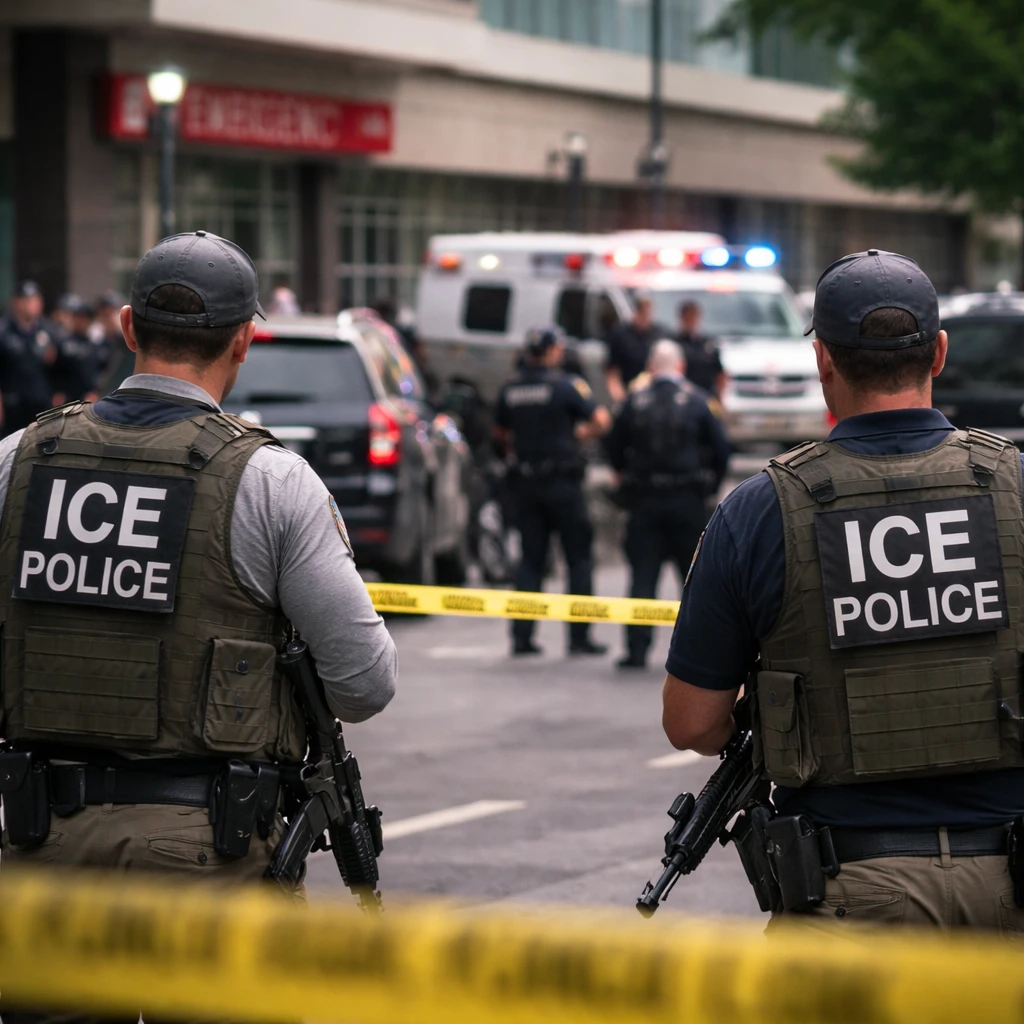

In Portland, Oregon, federal immigration officers shot and wounded two people outside Adventist Health hospital on Thursday afternoon, according to police and federal authorities. The incident occurred just one day after a fatal shooting by an immigration agent in Minneapolis, leaving the Portland community on edge and prompting protests.
The Department of Homeland Security (DHS) provided details stating that the occupants of the vehicle were targeted during a "targeted vehicle stop." DHS asserted that the passenger in the vehicle was a Venezuelan individual allegedly connected with the transnational Tren de Aragua prostitution ring and involved in a recent shooting within Portland.
During the stop, officers claimed the driver attempted to strike agents with the vehicle. Citing self-defense, the DHS reported that an officer fired a shot, resulting in injuries to two occupants before the vehicle fled the scene.
Portland Police Bureau received the initial shooting report near the hospital at 2:18 p.m., and shortly thereafter, officers were directed to a residential area a few miles away where one wounded man was reportedly seeking assistance. Police found both a man and a woman sustaining gunshot wounds consistent with the earlier incident involving federal agents.
Authorities did not immediately disclose the current conditions of the injured individuals but noted that field responders had administered a tourniquet to at least one victim. City Council President Elana Pirtle-Guiney, speaking during a council meeting, stated that as of that afternoon, both individuals were confirmed alive with hopes for positive updates.
Later in the evening, Police Chief Bob Day announced that the FBI would lead the ongoing investigation and expressed his lack of detail regarding motives or precise circumstances leading to the shooting.
The incident has intensified longstanding frictions in Portland, a city known for its contentious relationship with federal immigration enforcement, particularly in light of recent efforts by the Trump administration that included proposed National Guard deployments, which were unsuccessful.
Oregon Attorney General Dan Rayfield declared an intent to investigate "whether any federal officer acted outside the scope of their lawful authority" and indicated that any criminal violations would be referred to prosecutorial authorities. Concurrently, Mayor Keith Wilson and the City Council demanded an immediate cessation of Immigration and Customs Enforcement (ICE) activities within the city until the investigation reaches a conclusion.
Public officials jointly criticized federal immigration operations, describing the deployment of heavily armed agents as detrimental to community trust and public safety. In a joint statement, they condemned the use of Portland as a "training ground" for military-style tactics and emphasized the deadly consequences of such measures.
The mayor expressed skepticism about the federal narrative surrounding the shooting, suggesting that official accounts are no longer fully credible. This sentiment was echoed by Democratic State Senator Kayse Jama, a local resident near the event site, who emphatically called for federal immigration agents to leave Oregon.
The officials asserted their commitment to protecting civil rights through legal and legislative means and urged the public to remain calm yet purposeful during this challenging period. Despite this appeal, the evening saw dozens gathering near the site of the shooting, seeking clarification and justice.
Community members voiced distress over the lack of clear information, describing the atmosphere as chaotic and emphasizing the need for transparent communication.
U.S. Senator Jeff Merkley, also from Oregon, appealed for peaceful conduct among demonstrators, warning against provocations that may incite unrest.
The DHS and Trump administration have highlighted the role of the Tren de Aragua gang in local violence and illicit activities, though independent verification of these affiliations in relation to the shooting remains unconfirmed. Previous encounters involving federal immigration agents in other cities have shown discrepancies between federal accounts and evidence captured on video, adding complexity to public discourse surrounding these incidents.