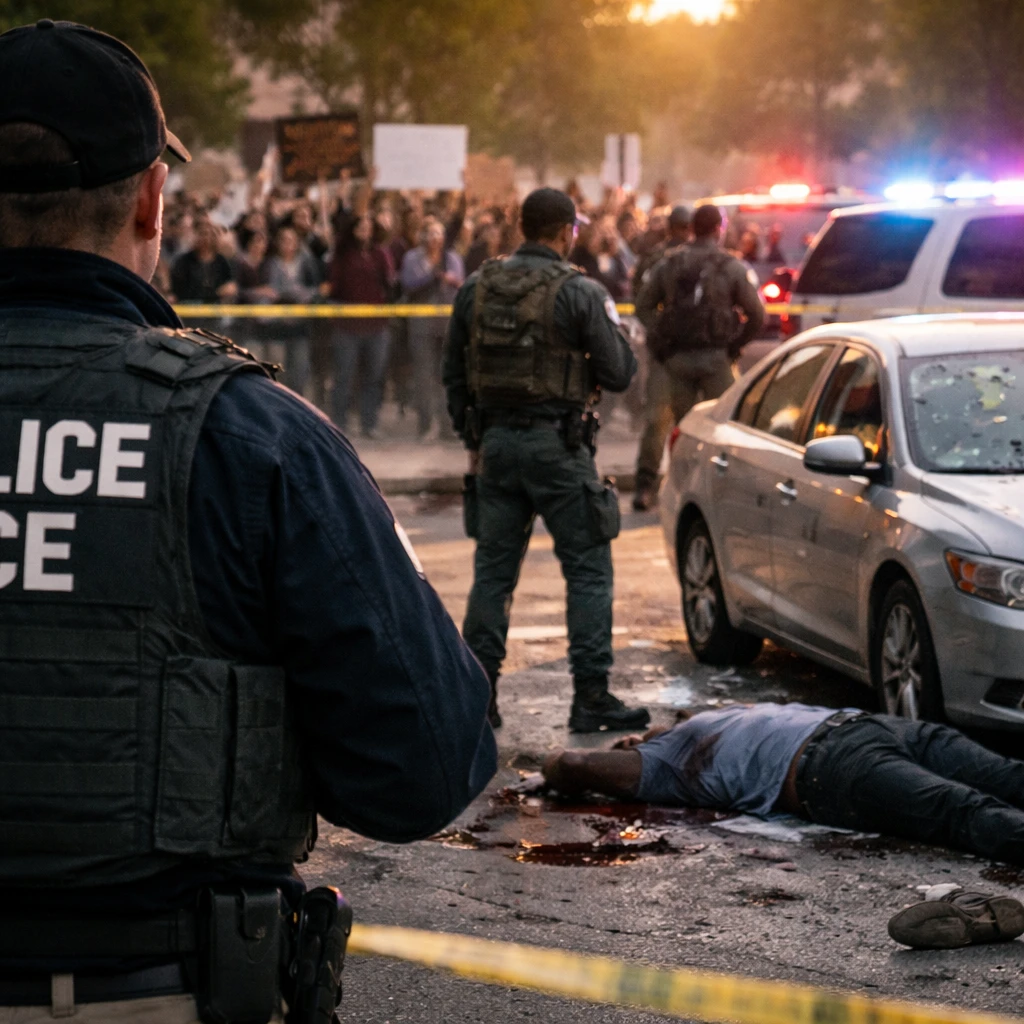

In Minneapolis, an Immigration and Customs Enforcement (ICE) agent shot and killed a motorist on Wednesday amidst a large-scale immigration enforcement campaign initiated under the Trump administration. Federal officials described the shooting as an act of self-defense, while Minneapolis Mayor Jacob Frey condemned it as reckless and unnecessary.
The incident occurred within a residential district south of Minneapolis's city center. This neighborhood is situated near some of Minneapolis's oldest immigrant markets and lies roughly a mile from the site where George Floyd was killed by police in 2020, underscoring the area's historical and social significance.
Department of Homeland Security Secretary Kristi Noem, speaking from Texas, labeled the shooting incident an "act of domestic terrorism" against ICE agents, attributing it to a female suspect who allegedly attempted to strike agents with her vehicle. Noem stated that the ICE officer responded promptly and defensively by discharging his weapon to protect himself and surrounding individuals.
In sharp contrast, Mayor Frey denounced the federal characterization and the presence of over 2,000 immigration enforcement personnel deployed in the Twin Cities area, including Minneapolis and St. Paul, as part of this ongoing operation.
"The federal officers are not contributing to safety in our city or the nation," Frey asserted. "Instead, they are driving chaos, generating mistrust, and inflicting harm—dividing families and, in this tragic case, causing death."
Frey directly disputed claims of self-defense, stating, "Having reviewed the video myself, I can unequivocally say that portrayal is inaccurate."
This shooting represents a marked intensification in immigration enforcement activities sweeping multiple U.S. cities. Since early 2024, at least five individuals have died in related enforcement actions across several states.
The Twin Cities region has been tense since the Department of Homeland Security announced the operation on Tuesday. The crackdown, which appears partially motivated by allegations of fraudulent activity among the Somali community, involves a considerable contingent exceeding 2,000 federal agents and officers.
Following the shooting, a large group of protesters congregated near the scene, vocalizing their dissatisfaction with both local and federal law enforcement figures present. Among the officials was Gregory Bovino, a senior U.S. Customs and Border Protection leader known for directing similar enforcement operations in metropolitan areas like Los Angeles and Chicago.
The protest atmosphere recalled earlier federal immigration actions, with demonstrators jeering, employing whistles, and chanting slogans such as "Shame! Shame! Shame!" and "ICE out of Minnesota!" These whistles have become emblematic of public resistance to these operations.
During her address from Texas, Noem confirmed that the ongoing operation had resulted in "hundreds and hundreds" of arrests thus far.
For nearly a year leading up to the current enforcement surge, immigrant advocacy groups and community organizers across Minneapolis and St. Paul have actively prepared for such an event. These preparations include coordinated communications among houses of worship, mobile home parks, and neighborhood networks, surveillance of license plates potentially associated with federal agents, and acquisition of whistles and other awareness tools to alert residents of law enforcement presence.
On the evening before the operation's commencement, the Immigration Defense Network—a coalition dedicated to immigrant rights in Minnesota—conducted a training session for approximately 100 volunteers ready to monitor the federal operation's impact on their communities.
Mary Moran, one of the participants, conveyed her personal motivation to take action: "I feel like I'm just an ordinary person, but I have the capacity to act, so I must do it."
The unfolding developments in the Twin Cities reflect a broader, nationwide expansion of immigration enforcement under current federal policies. As these operations intensify, their implications for community relations and local governance remain complex and contested.