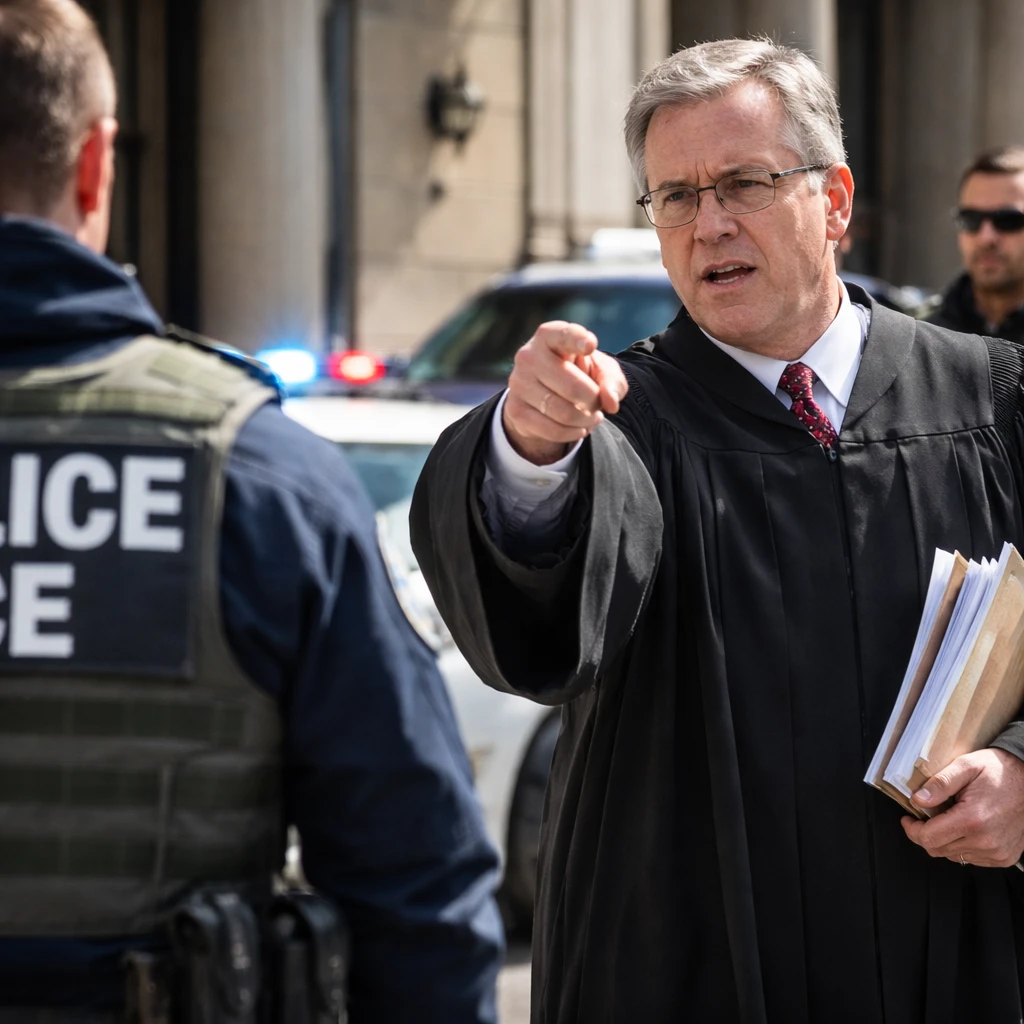

In an escalating judicial response to immigration enforcement practices in Minnesota, Chief U.S. District Judge Patrick Schiltz, known for his conservative legal background, has publicly condemned U.S. Immigration and Customs Enforcement (ICE) for what he describes as a persistent pattern of disregarding court orders. This criticism arises amidst a period when ICE has been aggressively increasing immigration crackdowns under directives aligned with the former administration’s policies.
Judge Schiltz’s remarks come as a notable contrast to the frequent partisan disputes between state and city Democratic officials and federal leaders, positioning the issue within a broader spectrum of legal accountability rather than political ideology. He emphasized that ICE cannot operate above the law, stating explicitly that the agency is not "a law unto itself." This statement underscores the judiciary’s demand for adherence to court mandates regardless of political pressures or enforcement goals.
The judge’s concerns center less on individual enforcement incidents—such as tragic events involving the deaths of U.S. citizens during immigration operations or aggressive tactics involving forced home entries, property damage, and deployment of tear gas—but more on ICE’s repeated failure to comply with judicial orders issued in response to legal challenges. Since the start of the year, Schiltz enumerated nearly 100 instances in at least 74 cases where ICE did not follow court instructions related to individuals detained during Operation Metro Surge, a concentrated enforcement campaign in the Minneapolis area. He admitted this figure likely underrepresents the total number of violations.
“This list should give pause to anyone—no matter his or her political beliefs—who cares about the rule of law,” Schiltz wrote. He insisted that while ICE retains the right to legally challenge court orders, it must continue to obey these directives until they are formally overturned or vacated, consistent with principles of judicial process and accountability.
These judicial admonitions have been met with resistance from Homeland Security officials. A spokesperson described Schiltz’s comments as an "activist judge’s diatribe," signaling a refusal to be dissuaded by what they characterized as judicial overreach or protest movements. Likewise, a senior White House official denounced the judge’s statements as symptomatic of "judicial sabotage of democracy," reflecting heightened tensions between the executive branch and federal judiciary over immigration enforcement standards.
Judge Schiltz’s critiques align with other judicial interventions across the country addressing heavy-handed immigration enforcement. For instance, U.S. District Judge Kate Menendez has issued orders restricting ICE and other law enforcement agencies from using chemical agents against peaceful demonstrators in Minnesota, although her rulings have faced appellate challenges. Similarly, a federal judge in Chicago recently imposed limitations on Border Patrol use of force, criticizing misleading official descriptions of threats to officers during confrontations, though subsequent legal appeals have complicated enforcement of these rulings.
Schiltz’s judicial tenure spans approximately two decades, beginning with his nomination by President George W. Bush. His legal career includes work as a clerk for the late U.S. Supreme Court Justice Antonin Scalia and roles as an attorney and law professor, highlighting his strong conservative legal foundations.
Legal scholars note Schiltz’s approach is characterized not by desire for controversy but by a commitment to uphold the rule of law and government accountability, particularly in instances where government entities are ordered by courts to alter behaviors or adhere to legal standards. Mark Osler, a law professor and former federal prosecutor, asserts that the social contract requires government officials to make good faith efforts to comply with judicial orders to maintain accountability within an ordered society.
More recently, Schiltz took the extraordinary legal step of summoning ICE’s acting director, Todd Lyons, to justify why he should not be held in contempt for the agency’s widespread noncompliance. This hearing was later canceled following the release of an immigrant involved in one of the cases prompting the contempt consideration.
Responding to reports about his personal affiliations, Schiltz acknowledged his past financial support for organizations providing free legal counsel to immigrants and low-income individuals, underscoring his belief in accessible legal representation for vulnerable populations. His transparent disclosures align with his judicial philosophy emphasizing fairness and adherence to due process.
The unfolding legal dispute highlights ongoing clashes over immigration policy enforcement in Minnesota and potentially signals broader implications for how federal agencies must navigate judicial oversight during periods of intensified immigration operations.