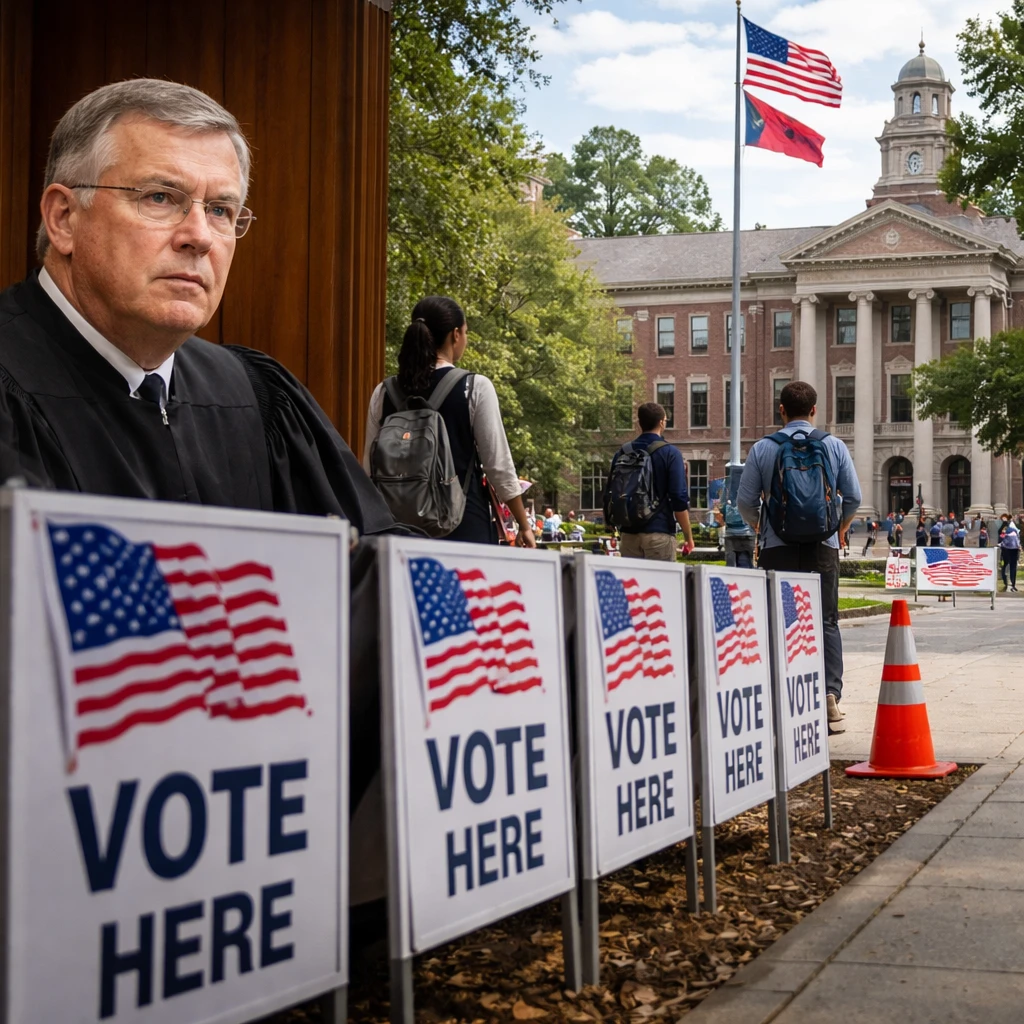

GREENSBORO, N.C. - In a significant legal decision impacting North Carolina's upcoming March 3 primary election, U.S. District Judge William Osteen denied requests Sunday to compel the establishment of early voting centers at three public university campuses, all amid contentions that Republican-led election boards had imposed undue hardships on voters.
The contentious lawsuit, brought by the College Democrats of North Carolina and several students, argued that the GOP-majority boards' refusal to maintain or open early voting sites at Western Carolina University, the University of North Carolina at Greensboro, and North Carolina A&T State University infringed on voters' constitutional rights. North Carolina A&T is notably the nation's largest historically Black university.
Despite these assertions, Judge Osteen - appointed by former President George W. Bush - found insufficient grounds to grant preliminary injunctions or temporary restraining orders that would force the immediate reopening of these polling locations. He cited concerns that instituting polling sites so close to the election date could generate voter confusion and disrupt orderly election administration.
The ruling addresses broader shifts in election oversight following recent legislation that altered the partisan composition of the State Board of Elections as well as local boards across all 100 counties, moving from Democratic to Republican majorities.
The legal challenge contended that the absence of early voting facilities on these prominent campuses would disproportionately affect student voters, imposing logistical burdens such as travel time and costs, particularly on individuals who may be less familiar with voting procedures. The suit underscores that while early voting is offered at other college campuses across North Carolina, and same-day registration is available at existing early voting locations, the withdrawal of site options on these campuses denies a convenient access point historically available for voters.
Defending the decisions, attorneys representing the state and county election boards emphasized that there is no statutory obligation to retain polling sites from previous elections. They maintain that site selection decisions are made based on reasonable factors including parking availability and patterns of past voter turnout.
As early in-person voting begins this Thursday, encompassing races for U.S. Senate, the U.S. House, the state legislature, and numerous local positions, the impact of this ruling will be closely observed by voters and political figures alike in North Carolina.