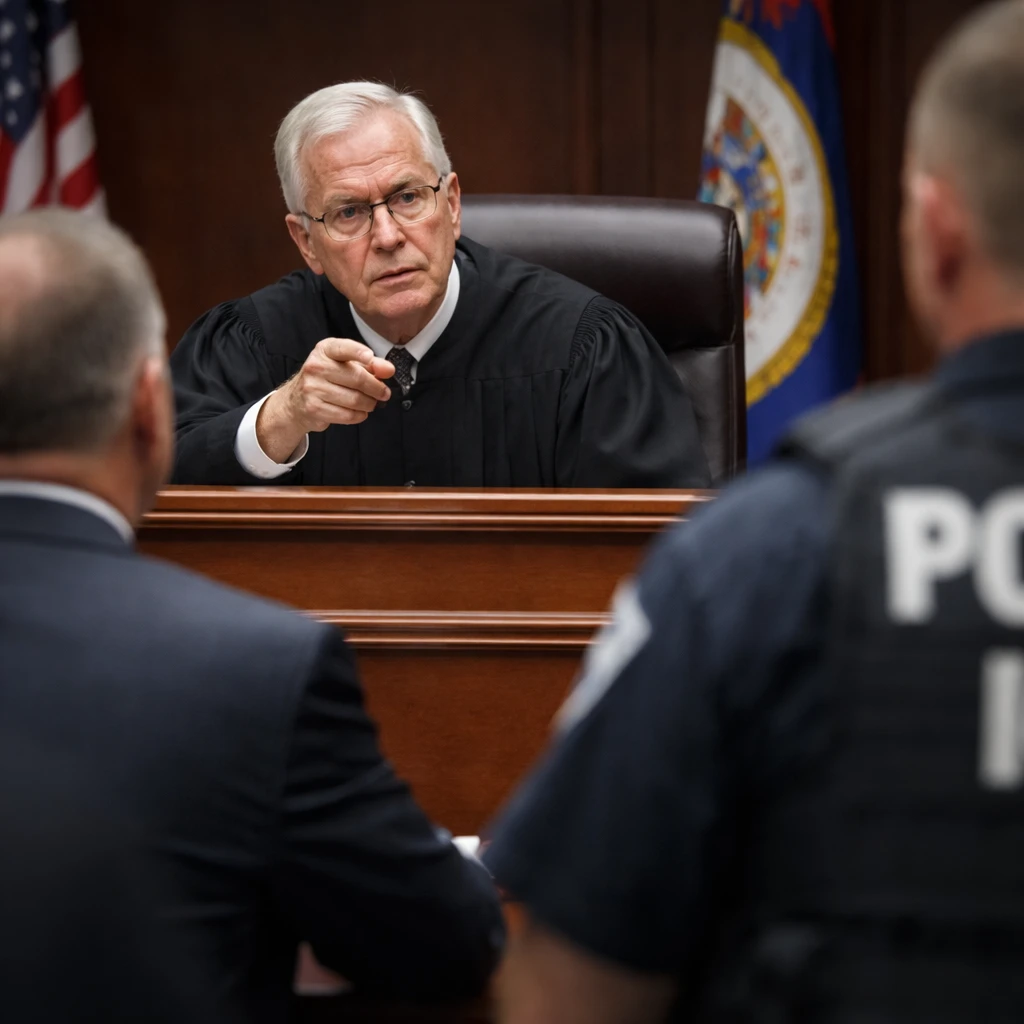

MINNEAPOLIS – The chief federal judge in Minnesota, Patrick J. Schiltz, has issued a critical order addressing the federal government's inadequate response to compliance issues concerning detained immigrants' bond hearings. Dated Monday, the order requires Todd Lyons, the acting director of Immigration and Customs Enforcement, to personally appear in court by Friday to justify why he should not be held in contempt for failing to adhere to earlier judicial mandates.
Judge Schiltz highlighted his extensive patience with the federal respondents, emphasizing that despite the deployment of thousands of immigration agents to Minnesota, there was no corresponding system in place to manage the resulting hundreds of habeas corpus petitions and related lawsuits that inevitably followed. The judge underscored, "This Court has been extremely patient with respondents, even though respondents decided to send thousands of agents to Minnesota to detain aliens without making any provision for dealing with the hundreds of habeas petitions and other lawsuits that were sure to result."
This judicial action emerges in the context of President Donald Trump's recent directive, assigning border czar Tom Homan to oversee the immigration enforcement surge in Minnesota. This transition in leadership came shortly after the second death within the month linked to immigration law enforcement officers in the state.
President Trump, in an interview aired Tuesday, remarked on "great calls" with Minnesota Governor Tim Walz and Minneapolis Mayor Jacob Frey conducted the previous day, echoing his initial statements following those discussions.
The Office of Governor Walz confirmed on Tuesday that the Democratic governor met with Homan and advocated for impartial investigations into the shootings involving federal officers. They collectively agreed on the necessity for ongoing communication and cooperation.
Earlier, the White House had attempted to attribute public protests against federal immigration enforcement activities to Democratic leadership. However, after the killing of Alex Pretti on Saturday and circulating videos suggesting he posed no active threat, the administration reassigned authority over Minnesota immigration operations from Border Patrol commander Gregory Bovino to Homan.
Immigration agents maintained a significant presence across the Twin Cities region on Tuesday. Observers noted the continued presence of agents in northeast Minneapolis and the suburb of Little Canada, though many neighborhoods in south Minneapolis, frequent locations for recent unmarked immigration convoys and incidents, appeared largely quiet.
Judge Schiltz's order also follows a federal hearing held Monday concerning a petition by the state and the mayors of Minneapolis and St. Paul seeking judicial intervention to suspend the ongoing immigration enforcement intensification. The presiding judge indicated the ruling would be prioritized but did not provide a definitive timeframe for the decision.
In his order, Judge Schiltz acknowledged the unusual measure of compelling a federal agency head to appear in court personally but justified it by noting the extraordinary extent of ICE's failure to comply with court orders. He cited previous unsuccessful attempts employing lesser measures, stating, "Respondents have continually assured the Court that they recognize their obligation to comply with Court orders, and that they have taken steps to ensure that those orders will be honored going forward. Unfortunately, though, the violations continue."
The Associated Press sought commentary from ICE and Department of Homeland Security representatives but received no immediate response.
The court order cited the case of petitioner Juan T.R., an Ecuadorian immigrant who arrived in the United States around 1999. Although the court granted his petition for a bond hearing on January 14, seven days thereafter, his attorneys reported on January 23 that he remained detained. The judge's directive states that should Juan T.R. be released, Lyons' mandated court appearance would be rescinded.
This situation highlights ongoing tensions in immigration enforcement operations in Minnesota, involving judicial oversight, administrative leadership changes, political dialogue, and community reactions to enforcement tactics.