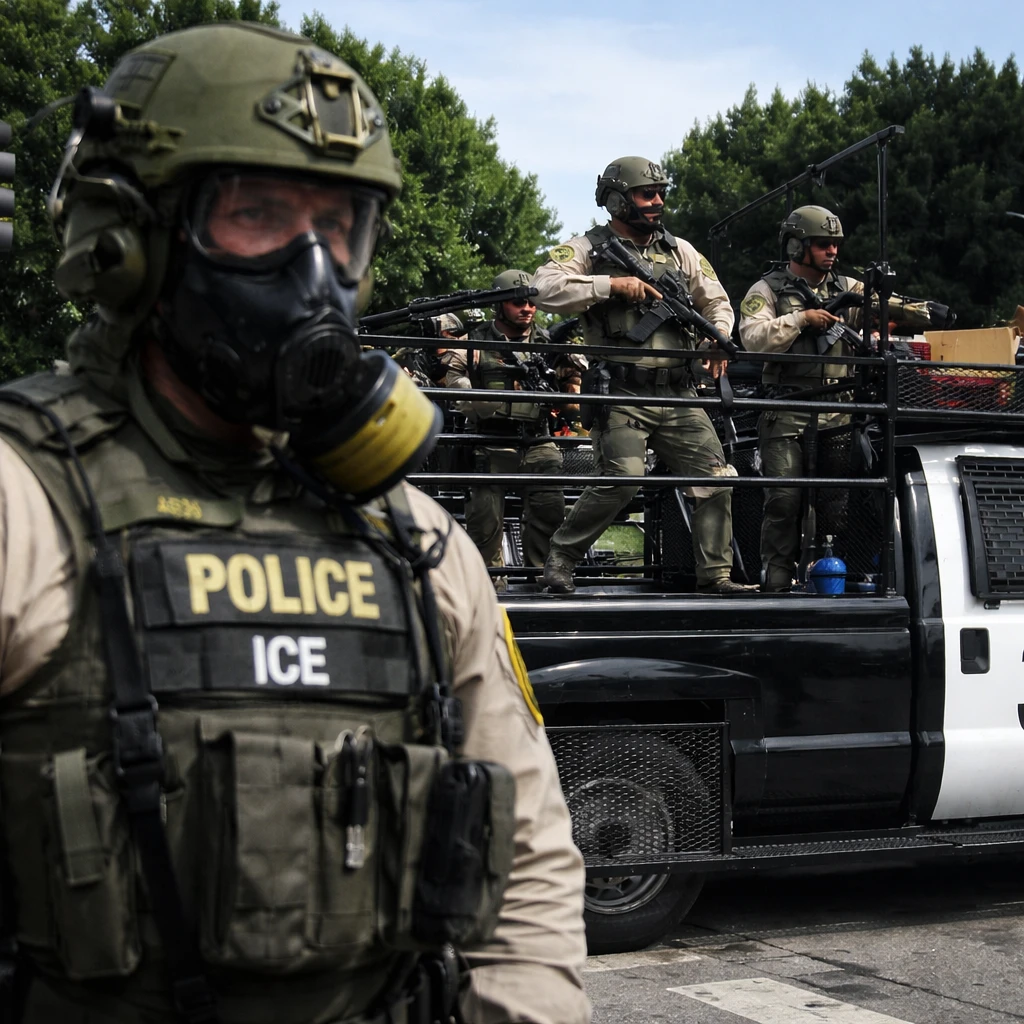

On Monday, a federal judge issued a preliminary injunction blocking a California statute designed to prohibit federal immigration enforcement officers from concealing their faces while conducting official duties. However, the judge maintained the portion of the law mandating law enforcement personnel to display visible identification, including their agency affiliation and badge number, while on assignment.
California’s legislation, enacted in September to take effect January 1, represents the first regulatory effort by a state to broadly prohibit facial coverings among law enforcement officers, motivated by public concern following high-profile Immigration and Customs Enforcement (ICE) raids in Los Angeles over the preceding summer. The Trump administration mounted a legal challenge in November, contending the statute unfairly endangered federal officers by limiting protective measures against harassment and violence and overstepped constitutional bounds by regulating federal operations.
Judge Christina Snyder’s ruling determined the mask ban was flawed because the law exempted state law enforcement personnel, thereby applying unevenly to federal agents and creating discriminatory treatment. This aspect of the decision holds potential significance nationally as other states consider policies towards federal immigration enforcement actions.
While halting the mask prohibition for federal agents, the ruling leaves open the possibility for a future, uniformly applied law that restricts all law enforcement officials from wearing masks. Judge Snyder observed, "the Court finds that federal officers can perform their federal functions without wearing masks." The injunction, set to be effective February 19, therefore preserves the status quo pending further legislative or judicial developments.
Governor Gavin Newsom championed the bill, which also specifies exemptions for undercover officers, tactical gear use, or health-related protective equipment such as N95 respirators. The inclusion of these exceptions highlights the legislature’s intent to preserve operational viability and officer safety in certain conditions. Nonetheless, the federal government successfully argued these exemptions discriminated against federal agents who lacked similar allowances in the law.
Separately, a companion provision mandating law enforcement to display clear identification on duty was also challenged but upheld by the court. Governor Newsom described the judge’s decision as a "clear win for the rule of law." California State Senator Scott Wiener, the bill’s sponsor, indicated plans to introduce new legislation expanding the mask ban to incorporate state police, emphasizing that ICE and Border Patrol officers conceal masks to enhance intimidation tactics and reduce accountability.
During court proceedings on January 14, Judge Snyder questioned federal counsel Tiberius Davis on the necessity of masks for federal agents, especially given their reportedly infrequent use before 2025. Davis cited information from the Department of Homeland Security pointing to a marked increase in assaults and threats against federal personnel, alongside a specific Los Angeles incident wherein individuals allegedly livestreamed an ICE agent’s residence and posted it on social media, raising officer safety concerns.
California Department of Justice attorney Cameron Bell challenged the federal safety claims, arguing the absence of definitive proof that federal officers require face coverings to execute their responsibilities effectively. Bell also referenced testimonies of U.S. citizens detained by federal agents who initially feared they were victims of abduction, underlining the need for transparent identification to allay public fears.
Furthermore, the federal government warned that California’s mask ban could incentivize other states to pursue similar laws, which they consider unconstitutional restraints on federal authority. Davis highlighted Governor Newsom’s own remarks from July 2025, acknowledging the limited state power over federal law enforcement while maintaining authority over state agencies, underscoring the legal complexities at play.
In local developments, Los Angeles County enacted its own ordinance in December banning facial coverings among law enforcement, effective January 8. Despite this, the sheriff’s department refrained from enforcing the ordinance pending judicial direction on the statewide law, and the Los Angeles Police Department also announced it would wait on the court ruling before enforcement.