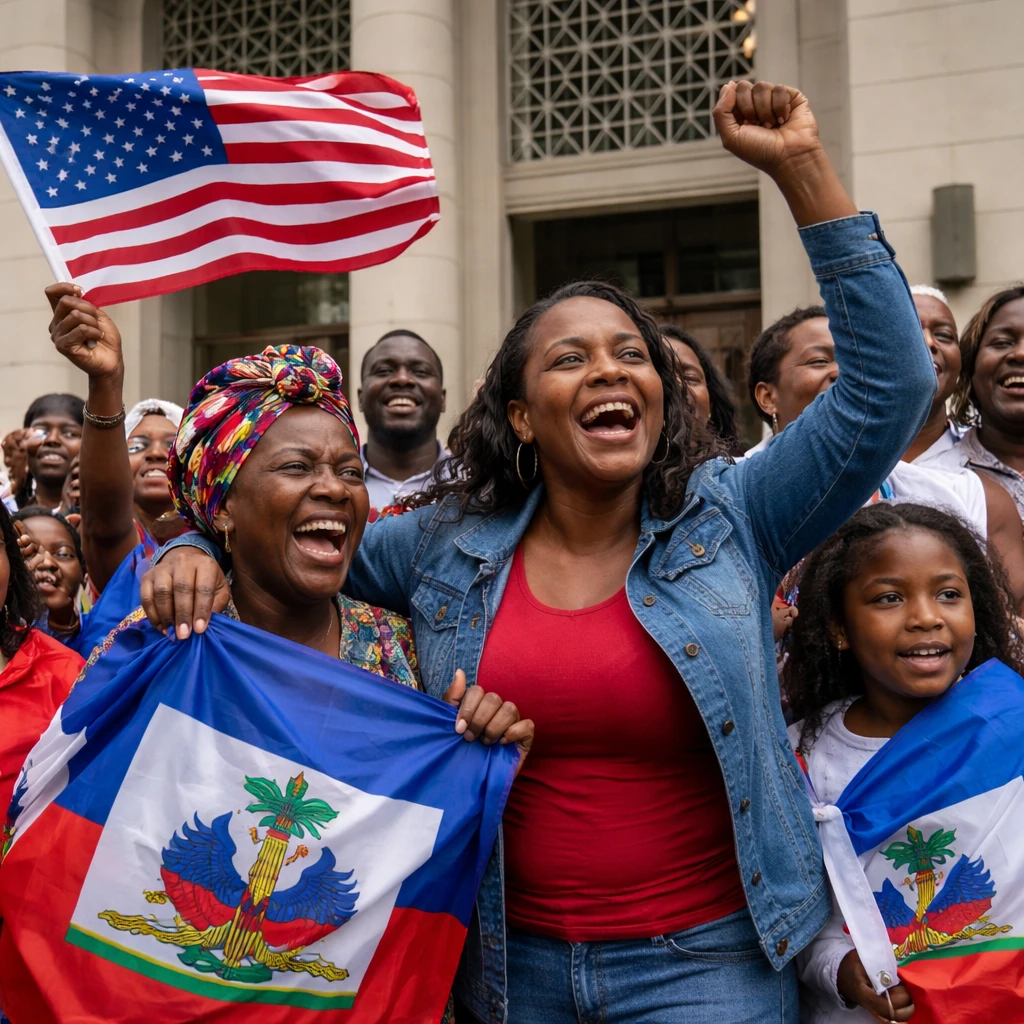
In Springfield, Ohio, Roudechel Charpentier sought refuge from the violence that gripped Haiti by relocating in 2023. Since then, he has enrolled at Clark State College as an agriculture technology major and secured part-time employment at a fast-food establishment. Charpentier has faced considerable anxiety over the Trump administration's initiative to terminate the Temporary Protected Status (TPS) that safeguards him and an estimated 350,000 Haitians residing in the United States.
Monday brought a significant development when U.S. District Judge Ana Reyes issued a ruling to maintain TPS protections for Haitians pending the outcome of ongoing litigation contesting the administration's directive. Despite this judicial reprieve, Charpentier’s driver's license was set to expire shortly afterward, underscoring persistent concerns about his ability to remain in the country until his anticipated graduation in May. He noted, "Everybody is happy right now," while acknowledging that a definitive resolution regarding TPS has not yet been finalized.
TPS is a humanitarian designation granted by the Department of Homeland Security when conditions in a country—such as natural disasters or political instability—render returning unsafe. Those under TPS may reside and work legally in the U.S.; however, this status does not confer any pathway to citizenship. Haiti’s TPS initially followed the devastating 2010 earthquake and has been extended multiple times since.
Over the past 16 years, many Haitian TPS recipients have grown up in the U.S., deeply rooted in their communities and facing an uncertain future due to the pending termination. For example, Hansmie Pierre, 22, relocated to Florida at the age of four and has not returned to Haiti since. The prospect of TPS ending abruptly compelled her to confront the possibility of family separation, particularly the pain of potentially missing her nephew’s milestones in Jacksonville. "I didn’t want to go to a country where I wouldn’t be able to come back and see my family," Pierre shared.
Beyond Haitians, the Trump administration has also sought to end TPS protections for several other nationalities, including approximately 600,000 Venezuelans, 60,000 individuals from Honduras, Nicaragua, and Nepal, over 160,000 Ukrainians, as well as thousands from Afghanistan and Cameroon. Many of these actions are currently subject to federal court challenges.
According to Pierre, the TPS program has wide-reaching implications: "A lot more people are dealing with this than people realize. These are your co-workers. These are your friends. Sometimes people stay quiet because it could put them at risk. But it’s very real, and it’s often much closer than people think."
Judge Reyes’s written opinion expressed that the plaintiffs in the lawsuit were likely to succeed on their claims. She found it "substantially likely" that the Homeland Security Secretary Kristi Noem had predetermined the decision to end Haitian TPS status, citing “hostility to nonwhite immigrants” as a motivating factor. In response, a spokesperson for the Department of Homeland Security, Tricia McLaughlin, condemned the ruling as “lawless activism.”
McLaughlin noted, "Haiti’s TPS was granted following an earthquake that took place over 15 years ago. It was never intended to be a de facto amnesty program, yet that’s how previous administrations have used it for decades."
The administration may choose to appeal the decision or attempt to address the court’s concerns to surmount the legal challenges. This is reminiscent of previous executive efforts, such as President Trump's early attempts at travel bans, which underwent extensive judicial scrutiny before a final version was upheld by the Supreme Court in 2018.
This recent ruling presents a significant obstacle to Trump administration efforts aimed at revoking legal protections for roughly 2.5 million individuals living under TPS, humanitarian parole, and other temporary programs allowing work authorization but offering limited stability. The Migration Policy Institute refers to this population as those in “twilight status,” a number which expanded during the Biden administration.
Legal experts, including lead attorney Andrew Tauber representing Haitian TPS holders, point to numerous public statements from President Trump expressing a “deep-seated animus toward Haitian immigrants, in particular, and nonwhite immigrants in general.” All courts examining the motives behind the TPS decisions have thus far ruled against Secretary Noem.
The city of Springfield, with a Haitian population of approximately 15,000, has witnessed profound distress due to these policies. Notably, during his 2024 reelection campaign, President Trump made unfounded and derogatory remarks about Haitians. Community concerns include potential increased enforcement actions to remove TPS holders. However, DHS stated in the hours before the court's injunction that no new deportation operations were planned.
Jean Philistin, a Springfield real estate agent and former educator, remarked that rescinding TPS protections would have been "a disaster" for the local population. This concern is underscored by economic data showing a loss of 1,100 jobs in the Springfield area between December 2024 and December 2025, according to a preliminary Bureau of Labor Statistics survey.
In South Florida, which hosts one of the largest Haitian communities in the nation, advocacy groups and NGOs are assisting TPS recipients in managing their affairs. Efforts include preparing legal documents such as powers of attorney and living trusts should family separations occur. Paul Namphy, political director at Family Action Network Movement, advised TPS holders to carry copies of Judge Reyes’s decision to verify ongoing work authorization. He noted, "The impact of TPS and Judge Reyes’ decision from last night on the Haitian community is enormous, but risks being very short-lived."
Similarly, in North Miami Beach, home to around 18,000 Haitians, Mayor Michael Joseph described the judge's ruling as a form of divine relief while acknowledging persistent anxiety within the community regarding potential appeals and future developments. "The fever still persists," he said. "It gives some type of stability, but at the same time you don’t know when the next hammer or the next shoe is going to fall."