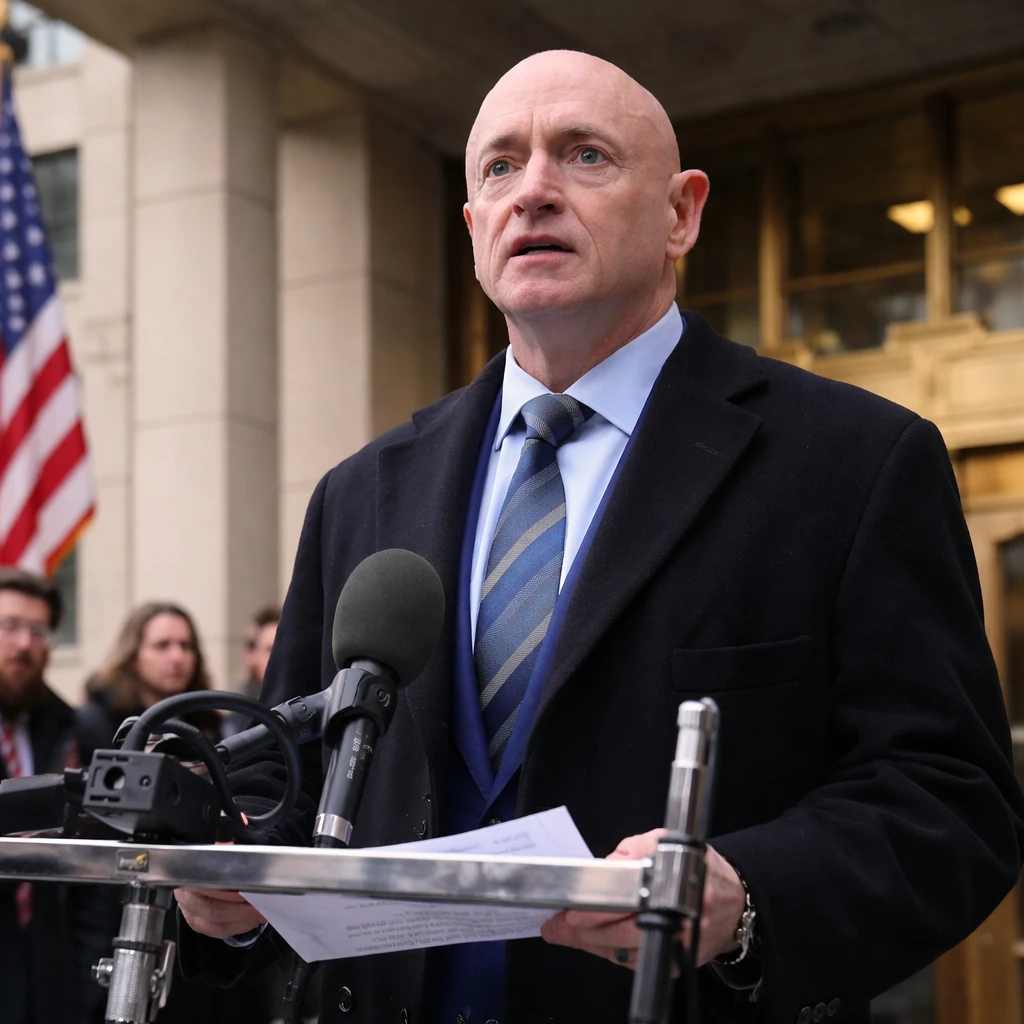

During a federal court session on Tuesday, skepticism was expressed by U.S. District Judge Richard Leon regarding the Pentagon’s legal justification for censuring Senator Mark Kelly. Kelly, an Arizona Democrat and former Naval aviator, faces Pentagon sanctions after his involvement in a video pleading for troops to disobey illegal orders from the previous Trump administration. The senator's legal counsel sought judicial intervention to halt this punitive process, citing infringement on Kelly’s First Amendment rights.
Judge Leon, who was appointed by President George W. Bush, indicated during the hearing that he was unaware of any Supreme Court precedents endorsing the Pentagon's approach to disciplining an active senator through military justice mechanisms. This point was articulated while addressing arguments presented by Justice Department lawyer John Bailey, who contended that retired military personnel remain subject to the Uniform Code of Military Justice (UCMJ), similarly to active duty members.
“You’re asking me to do something the Supreme Court has never done,” Leon remarked to Bailey, suggesting that applying UCMJ sanctions to a retired senator might stretch judicial boundaries.
Bailey’s defense rests on the legislative stance that military retirees are integrated within the armed forces’ legal framework, thus subject to military discipline. Conversely, Benjamin Mizer, representing Kelly, highlighted the absence of any judicial rulings affirming diminished speech rights for retired service members and emphasized Kelly’s expression falls under the protection of the First Amendment.
“Any other approach would be to make new law,” Mizer emphasized, reinforcing the argument that existing legal precedent does not back the Pentagon’s actions.
In addition to the constitutional issues, Judge Leon voiced concern about the broader implications of the Pentagon’s measures, pointing out the potential suppressive effect on other retired military personnel who might wish to exercise their free speech rights. The court expects to deliver a ruling by the middle of next week. Following the hearing, Kelly greeted the government’s attorneys with handshakes, indicating a professional exchange despite the contentious issues.
The controversy began after a November video release featuring Kelly alongside five other Democratic congress members. In the recording, the lawmakers encouraged military personnel to uphold the Constitution and to refrain from obeying illegal commands purportedly issued during the Trump administration. Notably, all participants are veterans, with Kelly being the only one retired from military service, which is pivotal to the Pentagon’s jurisdictional claim.
Days after the video’s circulation, then-President Donald Trump accused the lawmakers of sedition, a claim accompanied by a severe prescription of the death penalty.
Defense Secretary Pete Hegseth defended the censure as a procedural necessity, part of proceedings that might lead to a reduction in Kelly's retired rank from captain, along with a decrease in his retirement benefits.
The Pentagon initiated an investigation into Kelly towards the end of November under federal law permitting the recall of retired service members to active duty by the defense secretary, enabling the possibility of military prosecution. Hegseth clarified that Kelly was uniquely scrutinized because he formally retired, distinguishing him from the other lawmakers in the video.
The video had originally been posted on the social media account of Senator Elissa Slotkin and included representatives Jason Crow, Chris Deluzio, Maggie Goodlander, and Chrissy Houlahan. Each participant has a background in military or intelligence service, heightening the profile and potential impact of their statements.