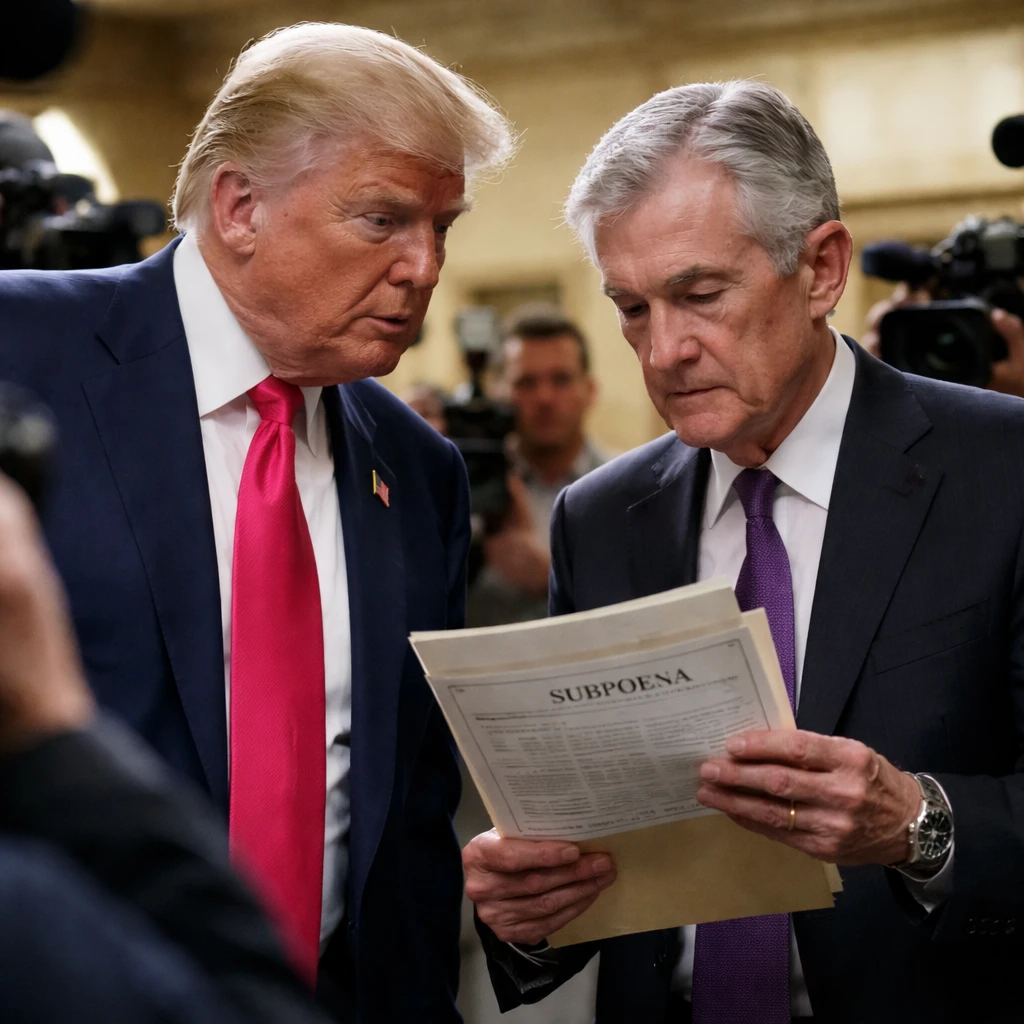

The White House’s legal maneuvering against Federal Reserve Chair Jerome Powell has escalated with the Department of Justice issuing subpoenas concerning the expenses associated with renovating Federal Reserve properties, including its prominently marble-adorned headquarters in Washington, DC. These subpoenas, which surfaced on Friday, have been characterized by Powell as an attempt to coerce him into complying with directives from President Donald Trump, reflecting a broader confrontation between the executive branch and the U.S. central bank.
While the subpoenas ostensibly focus on renovation costs—specifically a $2.5 billion building upgrade—the underlying contest is fundamentally about safeguarding the Federal Reserve’s autonomy. This struggle embodies a larger debate about how power is balanced within the federal government and the potential repercussions on the broader U.S. economy.
In response, bipartisan voices have raised alarms. A contingent of Republican senators has voiced reservations about the subpoenas and the prospect of diminishing the Fed’s politically independent status. Furthermore, leading economists and former chairs of the Federal Reserve issued a formal letter on Monday emphasizing the threats that such governmental actions pose to economic stability. Their concern highlights how these conflicts could ultimately influence everyday financial conditions, including employment opportunities and accessibility to mortgages and auto loans.
Throughout the past year, President Trump has persistently pushed Chair Powell to enact significant rate reductions in the benchmark interest rate. This demand illustrates a fundamental divergence between Trump and Powell regarding inflation’s relevance to the current U.S. economic landscape. Powell has maintained that inflation remains elevated, partially due to the lingering effects of tariffs implemented during Trump’s administration, and he has advocated for a cautious approach to adjusting interest rates. Conversely, Trump dismisses inflation as a present concern and advocates for steep rate cuts.
In a public statement released Sunday evening, Powell asserted: “I have carried out my duties without political fear or favor, focused solely on our mandate of price stability and maximum employment.” He underscored the necessity of public officials standing firm against external pressures, particularly when such pressures threaten institutional integrity.
Powell’s current term as Fed chair concludes in May, but the recent legal confrontations likely reflect concerns within the Trump administration about Powell’s potential intention to remain on the Fed board until his gubernatorial term expires in January 2028. Such a scenario would deny the administration an opportunity to appoint a new member, thereby preserving Powell’s influence over monetary policy.
Kevin Hassett, the director of the White House National Economic Council and a prospective candidate for Fed chair, stated on Monday that he is unaware of Powell’s intentions regarding continued service as a Fed governor, indicating uncertainty about the leadership outlook.
Market reactions to Powell’s Sunday announcement were negative, with stock values declining amid apprehensions about the implications of the DOJ subpoenas. Powell described the government's legal action as a “pretext” aimed at pressuring the Federal Reserve into cutting short-term interest rates more aggressively.
Senator Kevin Cramer, a North Dakota Republican known for criticism of Powell, expressed skepticism about the criminality implied by the subpoenas. He conveyed hope that the inquiry would be resolved swiftly, suggesting a desire to avoid protracted political strife.
A coalition of former Fed chairs—including Ben Bernanke, Janet Yellen, and Alan Greenspan—alongside former Treasury Secretaries Henry Paulson and Robert Rubin, publicly condemned the White House’s aggressive legal actions. Their statement described them as an “unprecedented attempt to use prosecutorial attacks to undermine” the institution’s independence.
They further warned that such politicization of monetary policy mirrors the dysfunction seen in emerging markets with fragile institutions, where political interference often results in harmful inflationary effects and broader economic instability. They emphasized that such challenges have no place in the United States, whose robust adherence to the rule of law forms the bedrock of its economic success.
The tensions reported have been escalating for some time, with President Trump routinely criticizing Powell for the Federal Reserve’s policy decisions, particularly as they relate to rate adjustments. Trump has attempted to attribute dissatisfaction with the economy, including the fallout from his tariff strategies, to Powell’s leadership. At a press conference on December 29, the president foreshadowed forthcoming legal proceedings by labeling Powell “a very incompetent man” and announcing plans to pursue a lawsuit based on renovation costs exceeding historical construction price benchmarks, calling the expenditures the “highest price per square foot in the history of the world.”